

What matters most when you sign a funeral home contract is knowing what your family is agreeing to. Unfamiliar terms and lists of services can make an important decision feel complicated. Understanding funeral home contracts starts with separating three parts: the plan, the itemized services and selections, and the payment terms. Read each part to see what is included, what remains optional or undecided, and what the agreement commits your family to.
Before signing, it’s reasonable to want clear answers about changes, cancellation, and whether prices are guaranteed. This guide explains common contract sections in plain language and offers practical questions to resolve. You’ll learn how to compare written selections and payment terms, and how to check that the paperwork reflects your family’s wishes. If you’re considering advance arrangements, recording personal and cultural preferences can also make future conversations more focused. Sunnyside Cremation and Funeral is a family-owned California mortuary offering pre-planning contracts intended to help preserve cultural customs. Taking time to review the details can help your family discuss wishes together and move forward with greater confidence.
Key Takeaways
- Understanding funeral home contracts is easier when you review the plan, selected arrangements, and payment terms separately.
- Compare written line items rather than package names to see which services are selected and which are optional.
- Review how the agreement describes payment, changes, cancellation, and any stated exclusions before signing.
- Check names, dates, selections, and terms, then keep a copy of the completed document.
- Advance planning gives families time to record personal and cultural preferences and discuss them together.
Understanding funeral home contracts: what they are and what they do
Reviewing funeral arrangements can feel unfamiliar, whether you’re planning ahead or making decisions after a death. A written document may use terms your family hasn’t encountered before, so take time to understand what each page records. In practical terms, a funeral home contract sets out selected arrangements and the terms agreed to for them. The wording and effect depend on the document, so read what it actually says rather than assuming every contract follows the same format.
What information may appear in a funeral contract?
Depending on the document and arrangements, you may see service selections, merchandise, third-party items, responsibilities, and payment terms. A contract might distinguish a selected ceremony from optional merchandise or list an outside charge separately from the funeral home’s services. Don’t rely on headings alone. Look for what is included, what remains undecided, and what the document expressly excludes.
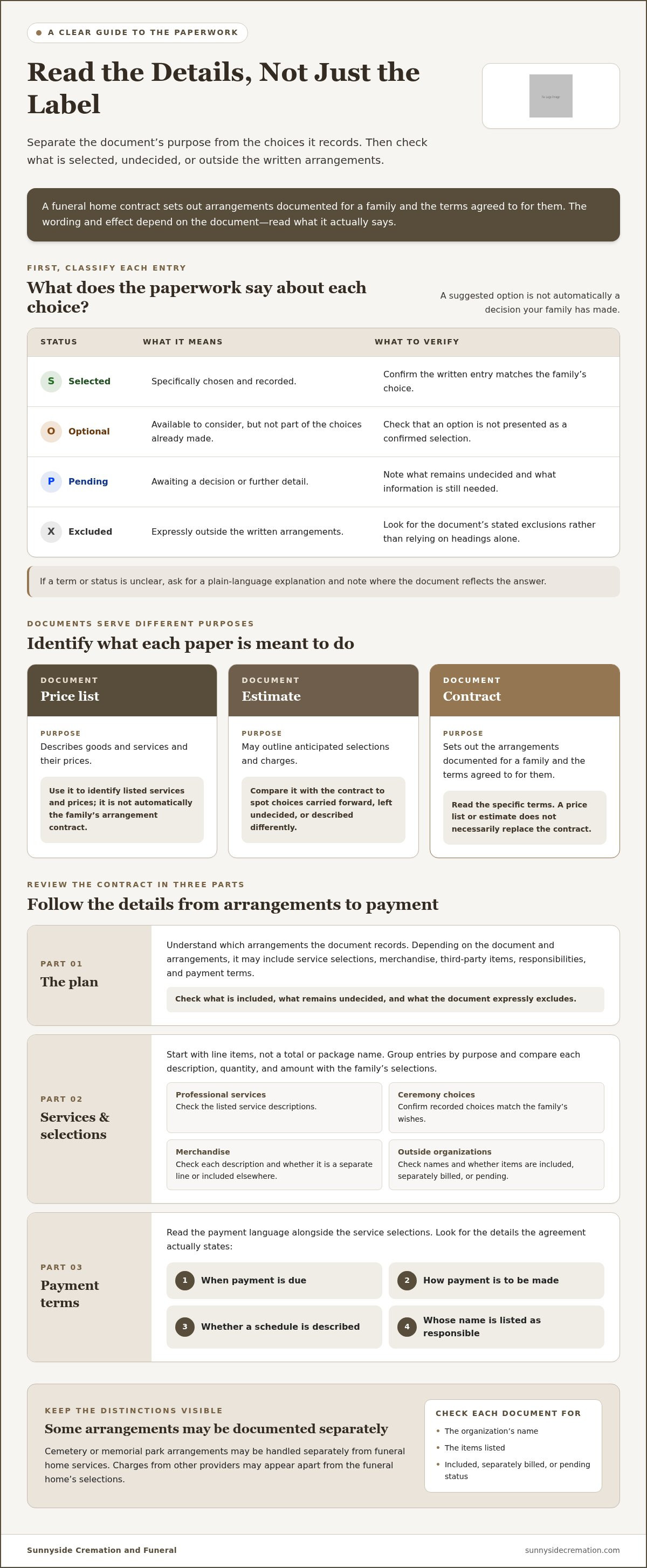
Terminology and layout can vary. One document may use a checklist; another may group choices by service or show them in a separate statement. As you review each entry, mark it as:
- Selected: specifically chosen and recorded.
- Optional: available to consider, but not part of the choices you’ve made.
- Pending: awaiting a decision or further detail.
- Excluded: expressly outside the written arrangements.
This distinction helps prevent a suggested option from being mistaken for a decision your family has already made. If a term is unclear, ask for a plain-language explanation and note where the document reflects the answer.
How advance planning relates to written arrangements
Advance planning gives a person and family time to discuss preferences before arrangements are needed. Writing down choices about the kind of service, cultural customs, or family priorities can help loved ones understand what matters. Sunnyside’s pre-planning contracts are intended to help preserve cultural customs. Families can also explore funeral pre-planning for Asian families as they consider how traditions and personal wishes may be recorded.
Keep preferences distinct from assumptions about a document’s financial or future effect. A written wish doesn’t by itself explain whether money has been paid, how payment is handled, whether arrangements can be transferred, or whether every selection will be available later. Those points depend on the terms stated in the agreement. After a death, the family may make selections at that time rather than refer to preferences recorded in advance. In either situation, understanding funeral home contracts means identifying what the specific document commits each party to, rather than relying on a general description.
Funeral contract sections explained: services, selections, and payment terms
Start with the line items, not the total or a package label. Read each entry and identify whether it’s a service selected by the family, an optional choice, or a charge connected to another organization. This makes it easier to see what the written arrangement covers and where a separate cemetery, memorial park, or third-party document may apply.
Keep any estimate or price information alongside the contract. Comparing the documents can show whether a selection was carried forward, left undecided, or described differently. If an item’s status isn’t clear, note it and ask for an explanation that accurately reflects the current paperwork.
How to read an itemized list of services
Group entries by purpose: professional services, ceremony choices, merchandise, and items provided by an outside organization. Then check each description, quantity, and amount against the family’s selections. For example, if the document lists several merchandise selections, confirm that each description matches what your family chose and whether it appears as a separate line or is included in another item.
Some terms may be unfamiliar or used differently across documents. Instead of relying on a general definition, ask what a specific phrase means in the contract you’re reviewing. Tie the explanation to that document, especially if the phrase affects what is included or who is responsible for an item.
Cemetery or memorial park arrangements may be handled separately from funeral home services, and charges from other providers may appear apart from the funeral home’s selections. Review the organizations’ names, the items listed, and whether the paperwork describes each as included, separately billed, or pending. The documents should make these distinctions clear enough for your family to understand the arrangement.
What payment and funding language can mean
Review payment terms as carefully as service selections. Look for when payment is due, how it’s to be made, whether a schedule is described, and whose name appears as the responsible party. If the agreement mentions funding or money paid in advance, read the surrounding language closely. A prepaid arrangement and an obligation for future payment are not necessarily the same thing, so focus on the contract’s wording.
Don’t assume terms such as “prepaid,” “guaranteed,” or “trust” have a particular effect without reviewing the complete, current document. California requirements can apply to advance arrangements, while specific payment provisions depend on the contract. If you’re unsure about a legal or financial term, seek a clear explanation and appropriate professional guidance before relying on an assumption.
- Payment timing: Identify the due dates or events tied to payment.
- Funding language: Note how the document describes any advance payment or funding arrangement.
- Responsible party: Check whose name is attached to the payment obligation.
- Outside charges: Separate amounts connected to other organizations from funeral home selections.
Understanding funeral home contracts means connecting every selection with its description and payment language, not simply scanning for a final figure. Families considering advance arrangements can discuss pre-planning arrangements with Sunnyside and take time to understand the terms that matter to them.
Comparing funeral home contracts without overlooking family priorities
Comparing arrangements is most useful when you look beyond a package title and consider what your family actually wants. Two plans with similar names may describe different services, selections, or payment terms. Compare the written details item by item, then weigh practical arrangements alongside personal, spiritual, and cultural priorities.
Compare what is written, not just package labels
Place the documents side by side and match each service or item by description. If one document lists a ceremony, check whether the other describes the same type of service or leaves it optional. Keep missing details visible instead of treating them as included. A title can summarize an arrangement, but it may not show every selection or condition.
| What to compare | Questions to consider |
|---|---|
| Scope | What overall arrangements does the document describe? |
| Selected services | Which services and items are specifically recorded as chosen? |
| Payment language | What timing, method, or responsibilities does the written agreement state? |
| Flexibility | Does the document explain how changes or undecided selections are handled? |
| Stated exclusions | What does the document identify as separate, optional, pending, or excluded? |
For a useful comparison, align similar written items first, then note the differences. An item that appears in one document but not another could be excluded, optional, or addressed elsewhere. Don’t assume. Write the question next to the relevant line and use the explanation to clarify the paperwork before deciding.
Keep cultural and personal wishes visible
Practical details matter, but they aren’t the only measure of a suitable arrangement. Families may want to discuss ceremony format, language preferences, spiritual guidance, or customs that are meaningful to them. These wishes vary from person to person, even within the same community. Write down the specific preferences your family wants reflected rather than relying on broad labels.
For example, one family may want a particular spiritual element included, while another may prioritize gathering time or language support. Neither preference should be assumed from a person’s background. A discussion of Chinese funeral traditions and services can help families consider how cultural practices may shape arrangements while keeping each person’s wishes at the center.
Service scope also matters when comparing direct cremation with a plan that includes a ceremony. Consider which parts of the experience are important to your family, then check that the written selections reflect those priorities. This keeps the comparison grounded in what is planned, not just in a label.
Understanding funeral home contracts means recognizing that the most suitable comparison isn’t simply the shortest list or the broadest package name. It’s the written arrangement that clearly reflects the selected services, the terms attached to them, and your family’s priorities. Take time to discuss open questions and let the details guide the conversation.
Before signing a funeral home contract: a careful review checklist
A careful review can make a difficult decision feel more manageable. Before signing, read the complete document, including attachments and any pages that describe payment or changes. Check that the written arrangements match what your family discussed. If something is unclear, ask for an explanation before proceeding.
- Read the full document. Review every page, attachment, and referenced document, not only the summary or signature page.
- Check identifying details. Confirm names, dates, and other information are accurate.
- Match selections to the agreement. Make sure chosen services and items are described correctly, and identify anything optional, pending, or excluded.
- Clarify payment and changes. Understand when payment is due, who is responsible, and how a requested change would be recorded.
- Keep a complete copy. Save the signed agreement and related written communications together for family reference.
Questions to resolve before signing
Ask what each line covers and whether it reflects a choice your family has made or an option still under consideration. If you’ve requested a change, ask how it will appear in the final paperwork. Read any language about payment timing, cancellation, or transfer in the context of this specific agreement. These questions can clarify the document, but they aren’t a substitute for legal advice.
Where appropriate, request that an important explanation or agreed change be put in writing, such as in an amended document. Read the revised version to make sure it reflects the discussion. If a term could affect your legal or financial responsibilities, consider consulting a qualified professional before signing. Understanding funeral home contracts includes knowing when a plain-language explanation is useful and when independent advice may be needed.
California oversight and keeping clear records
The California Cemetery and Funeral Bureau is a relevant state oversight agency for the funeral industry. Rules and agency guidance can change, so verify current information directly with the Bureau or an appropriate qualified professional rather than relying on a summary alone.
The federal FTC Funeral Rule applies to covered funeral providers and transactions. Among other protections, it requires providers to give consumers a General Price List upon request and allows consumers to select only the goods and services they want. It also addresses the use of a casket or urn purchased from another seller. Because the Rule’s application depends on the transaction and provider, consult current FTC guidance for details relevant to your circumstances.
Store the signed contract with any price lists, amendments, receipts, and written answers to questions. Keeping these records together gives relatives a clear reference if arrangements need to be discussed later. If you’re preparing or reviewing advance arrangements, speak with Sunnyside about pre-planning contracts and the choices you’d like your family to understand.
How Sunnyside Cremation and Funeral can guide contract conversations
Reviewing an agreement can raise practical questions alongside deeply personal ones. Sunnyside Cremation and Funeral is a family-owned California mortuary offering funeral arrangements and pre-planning contracts. Staff can help families talk through choices and understand written arrangements while honoring personal and cultural preferences. The aim is a thoughtful conversation, not a rushed decision.
Families from Korean, Chinese, Taiwanese, Vietnamese, and Hindu communities can discuss arrangements shaped by their needs and traditions. Mandarin-speaking support is also available. Sunnyside serves families in Garden Grove, Buena Park, La Mirada, Cerritos, Anaheim, La Habra, Fullerton, Norwalk, Cypress, Artesia, Stanton, Tustin, Orange, Los Alamitos, Westminster, and Irvine. Each family’s wishes are individual, so the conversation can begin with what matters to the person being honored and connect those preferences to the arrangements under consideration. Understanding funeral home contracts becomes more approachable when families can discuss choices in clear, familiar language.
A thoughtful conversation about preferences and arrangements
Families may wish to talk about ceremony, disposition, spiritual guidance, language, and other customs that hold meaning for them. Sunnyside offers Buddhist funeral guidance and coordinates with Forest Lawn and Rose Hills where relevant. For families considering cemetery coordination as part of Chinese funeral planning, Chinese funeral planning with Forest Lawn can help frame the details to discuss.
A helpful conversation can cover what the family already understands about the paperwork and what still feels uncertain. Bring a contract or planning document and point to a phrase you’d like explained, or describe a preference you want recorded. Staff can guide families through the available choices and written terms without assuming one cultural practice or family preference applies to everyone.
Including relatives who will take part in planning can help surface different questions and perspectives. Note which preferences are essential, which are open for discussion, and which details need clarification. This gives the conversation structure and keeps personal wishes in view as practical arrangements are considered.
A calm next step for families considering pre-planning
You don’t need to understand every term before beginning a conversation. Bring your questions, take time to review any written terms, and ask for explanations in everyday language. Understanding the available choices comes before deciding which arrangements feel right for your family. Advance planning can also create space to record personal and cultural preferences for loved ones to refer to later.
If you’re considering pre-planning, a conversation with Sunnyside is a calm place to begin. Discuss the arrangements that matter to your family and review the relevant paperwork at a manageable pace. Talk with Sunnyside about thoughtful funeral pre-planning.
Make room for a more thoughtful next step
A contract can do more than record arrangements. It can turn a family conversation about care, customs, and personal wishes into a clearer plan. You don’t need to resolve every detail at once. Start by noting what matters most, what you’d like explained, and who you want involved in the discussion.
Understanding funeral home contracts is part of making informed choices, not a test you need to pass before asking for help. Bring your questions to the conversation and take time to consider the written terms. Sunnyside, a family-owned mortuary, guides discussions about future funeral and cremation needs, including culturally specific arrangements and Mandarin-speaking support, as your family considers what feels right.
If you’re ready to explore advance planning, take the next step at a pace that feels comfortable. Talk with Sunnyside about thoughtful funeral pre-planning and begin a conversation grounded in your family’s wishes.
Frequently Asked Questions
What is included in a funeral home contract?
A funeral home contract may list selected services, merchandise, third-party items, responsibilities, and payment terms. Its contents depend on the arrangement and document, so look for wording that shows whether each item is chosen, pending, or separate. A package name alone doesn’t establish what the agreement covers. This overview supports understanding funeral home contracts, but it isn’t a legal interpretation of an individual agreement.
Is a funeral home contract the same as a general price list?
No. A general price list describes goods and services with their prices; a contract records selections and terms for a particular arrangement. Under the FTC Funeral Rule, covered providers must give consumers a General Price List upon request, and consumers may choose only the goods and services they want. Compare the agreement with applicable disclosures, and verify current California and federal requirements for your circumstances.
Can funeral home contracts be changed or canceled after signing?
A change or cancellation may be possible, but the answer depends on the agreement, timing, and applicable law. Before relying on a phone explanation, read the written provisions and ask how a requested change would be recorded. Keep revised paperwork with the original. If a disagreement involves legal rights or a specific refund claim, consult a qualified professional rather than assuming a particular outcome.
What should I look for before signing a funeral contract?
Check that names and dates are accurate, then review selected services, itemized charges, optional items, payment terms, exclusions, and any written changes. For example, if a ceremony detail was discussed but isn’t reflected in the paperwork, ask for a plain-language explanation before signing. Keep the completed agreement and related documents together. This review can help catch mismatches, but it isn’t legal advice.
Are prepaid funeral plans protected in California?
Protections and requirements for prepaid funeral plans depend on the funding arrangement and current California law, so don’t assume every plan has identical terms. Review the document for how funds are handled and what it says about changes or cancellation. For current guidance, consult the California Cemetery and Funeral Bureau and appropriate qualified sources. A professional familiar with your specific agreement can help explain its legal and financial implications.
How do funeral contracts reflect cultural or religious wishes?
Families can discuss ceremony, language, and spiritual preferences, then review how those choices appear in the written arrangements. Wishes differ between individuals and families, even within a shared tradition. Sunnyside serves families with culturally specific arrangements, Mandarin-speaking support, and Buddhist funeral guidance. For families in Garden Grove and nearby Orange County communities, a planning conversation can bring personal priorities into view without assuming one set of customs fits everyone.
What happens if a family’s plans change after pre-planning?
The written contract and applicable rules determine what changes may be made; the outcome can’t be assumed in advance. Before signing, review the provisions for changes, cancellation, and payment so you understand what the document says. If plans shift later, request that agreed amendments be recorded in writing and kept with the original paperwork. For a particular dispute or legal question, seek qualified advice about your circumstances.


