

What if honoring your parent doesn’t mean following every tradition, but choosing the ones that feel true to your family? When arranging a farewell, it’s natural to wonder which Chinese burial customs for parents are expected and how to avoid causing offense. The answer can differ from one family to another.
Chinese traditions vary with regional heritage, religious or spiritual beliefs, and family preferences. Some relatives may value particular rites, while others may want to shape the service around your parent’s wishes and life. It’s understandable to feel uncertain when these perspectives meet during an already difficult time.
This guide explains customs families may consider, why there’s no single checklist, and how to make thoughtful choices while honoring your parent. We’ll cover common elements of a Chinese funeral and burial, ways to discuss different wishes with relatives, and practical questions to bring into planning. The goal isn’t to get every tradition “right” by someone else’s standard. It’s to create a respectful farewell grounded in care, understanding, and your family’s values.
Key Takeaways
- Chinese burial customs for parents can reflect regional roots, religious beliefs, personal wishes, and family preferences rather than one universal set of rules.
- Discuss ceremony style, burial, religious observances, and how relatives may take part.
- Gather your parent’s known wishes, talk with relatives, and write down meaningful customs and questions before coordinating arrangements.
- Culturally attentive guidance can help families communicate preferences and organize a farewell with care.
- Sunnyside provides Chinese funeral services, Mandarin-speaking staff, and Buddhist funeral guidance for families in Orange County.
What Do Chinese Burial Customs for Parents Mean to Families?
Customs can give a family a meaningful way to honor a parent, but they don’t prescribe one identical ceremony for every household. For adult children, arranging a farewell can carry particular emotional weight. It may be a chance to express gratitude, share family memories, and show care for a parent who shaped their lives.
Burial customs can include family, religious, regional, and personal practices surrounding death and remembrance. Some families draw comfort from inherited observances; others focus on the parent’s wishes or adapt traditions to fit their lives today. Cultural ideas such as filial respect and remembrance of ancestors may be meaningful, but families express them in different ways.
Shared cultural themes can create a sense of connection, while the customs that give those themes meaning vary from one household to another. An overview of Chinese funeral rituals can provide broader context, but it shouldn’t be treated as a rulebook for any particular family.
Why a parent's wishes and family history matter
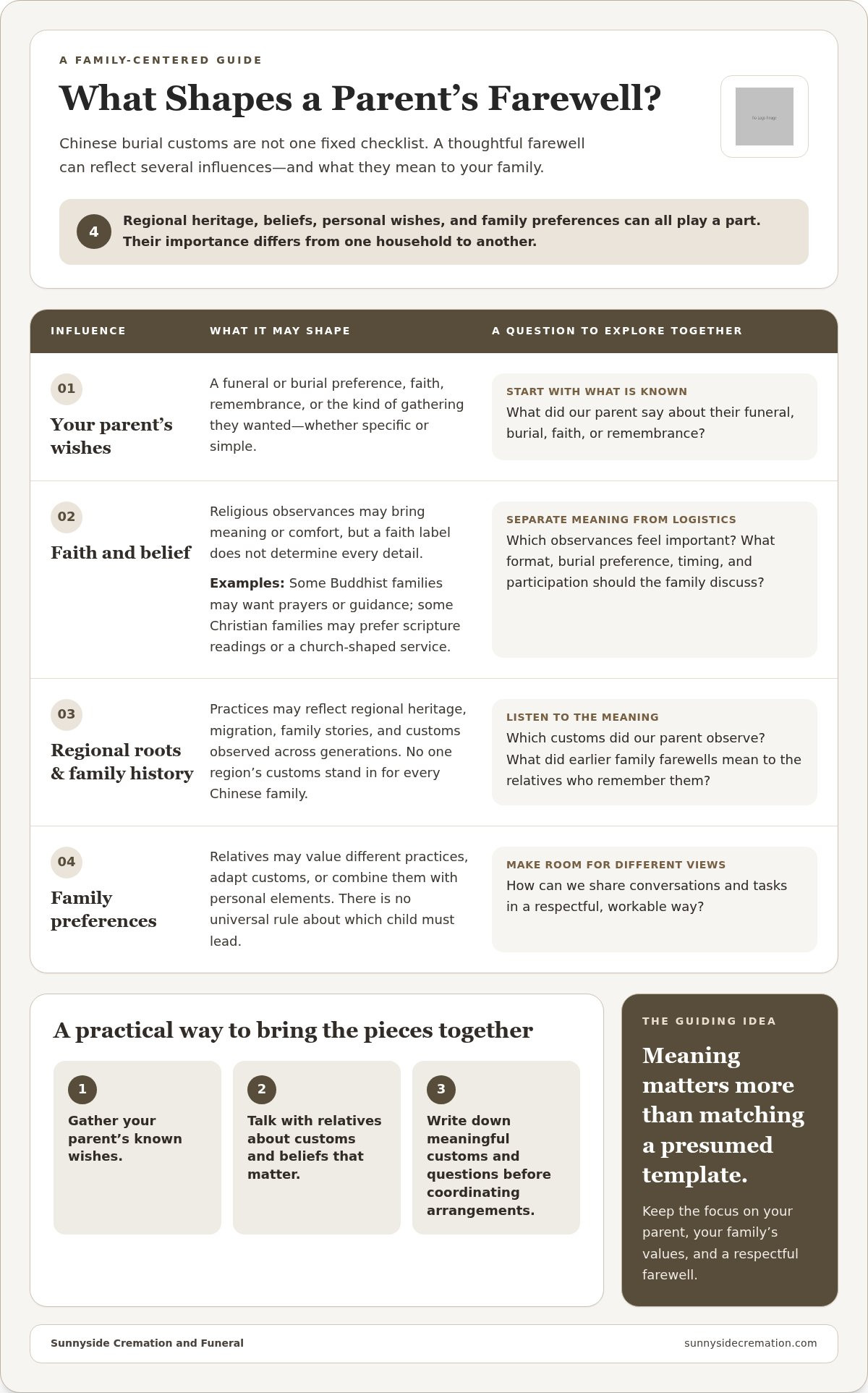
If your parent spoke about their funeral, burial, faith, or remembrance, those wishes can help guide decisions. Preferences might be specific, or as simple as wanting a quiet gathering, a religious service, or a chance for relatives to come together. Keeping those wishes in view makes the farewell about the person, not only about others’ expectations.
When your parent’s wishes aren’t clear, family stories can offer direction. Ask relatives which customs your parent observed, what beliefs or occasions mattered to them, and what earlier family farewells meant. These conversations can bring out shared memories and help relatives explain why a particular practice matters. There’s no universal rule that the oldest child, a son, or a daughter must lead. Families can decide together how to share conversations and tasks in a respectful, workable way.
Why Chinese burial traditions are not one fixed checklist
Family practices can reflect regional heritage, religious life, migration, and personal preference. A Chinese Buddhist family, for example, may want Buddhist guidance as part of planning, while a Chinese Christian family may shape the farewell around Christian belief. These examples aren’t exhaustive, and identity alone can’t tell you which observances a parent or household values.
Families may also hold different views across generations, especially when relatives have lived in different places or developed distinct relationships with tradition. Some choose familiar practices; others adapt or combine customs with personal elements. Instead of treating a custom as mandatory because it’s called “traditional,” consider what it means to your parent and family. That leaves room for sincere differences while keeping the focus on a thoughtful farewell.
How Family Beliefs Shape Chinese Burial Customs for a Parent
Religious identity and personal belief can shape how a family wishes to honor a parent, from the tone of a ceremony to choices about burial and remembrance. Yet a label such as Buddhist, Christian, or nonreligious doesn’t determine every detail. A parent may have held beliefs that differed from relatives’ expectations, or their practice may have changed over time. Start by considering what brought meaning and comfort to this individual.
It can help to separate spiritual meaning from practical arrangements. A family might agree that a prayer or reading matters while still discussing the ceremony’s format, burial preference, timing, and who will take part. These decisions are connected, but they aren’t the same. Discussing them one at a time can make room for religious needs while helping relatives work through each arrangement.
Buddhist, Christian, and other family traditions
Some Buddhist families may wish to include Buddhist prayers or guidance; some Christian families may prefer scripture readings or a service shaped by their church community. These are possibilities, not requirements for every family within either tradition. If religious observance is important, relatives may seek guidance from the parent’s faith community and share their wishes with those coordinating the farewell. A person’s faith alone doesn’t settle every funeral detail.
For Chinese burial customs for parents, the aim isn’t to match a presumed template. It’s to understand the beliefs this parent held and what the family hopes to carry forward. A conversation with a faith leader may clarify which observances feel central, while a family discussion can address how to make them personal and comfortable for those taking part. When relatives hold different beliefs, listening first can reveal shared intentions, such as expressing love, gratitude, or remembrance.
Regional heritage and family customs
Chinese communities have varied histories, and family practices may reflect a place of origin, migration, generations of change, and individual experience. No one region’s customs should stand in for every Chinese family. The National Library Board Singapore’s overview of Chinese death rituals and filial piety discusses how traditions can adapt over time, offering context rather than a checklist for a particular household.
When relatives remember a custom differently, invite them to explain what it means to them. One person may value continuity with a family practice; another may want to adapt it to the parent’s wishes or the family’s circumstances. Both perspectives can be heard with care. Consider asking:
- Which observances were meaningful to our parent?
- What does this practice express for the relatives who value it?
- How might we honor that meaning in a way that feels right for our family?
These questions can help relatives preserve what matters without assuming every detail must remain unchanged. Families in Orange County who want help incorporating Buddhist funeral preferences into arrangements can learn about Sunnyside’s Chinese funeral services and Buddhist guidance.
Which Chinese Burial Customs Should Adult Children Consider?
There isn’t one correct set of choices. Use the questions below to guide a family conversation, not as a checklist of customs every Chinese family is expected to follow. A practice may be meaningful to one household and unfamiliar to another. Let your parent’s known wishes, family beliefs, and practical circumstances shape the decisions.
For Chinese burial customs for parents, consider the farewell and burial together, but discuss each choice separately. The examples in the table are possibilities, not cultural requirements.
| Decision | Possible family preference | Question to discuss |
|---|---|---|
| Ceremony style | A religious service, a family gathering, or a farewell shaped around the parent’s life | What kind of gathering would feel most like them? |
| Burial preference | A burial arrangement guided by the parent’s wishes, family considerations, and available arrangements | Did our parent share a preference, and what can the family manage? |
| Religious observances | Prayers, readings, or other observances that matter to the family’s faith | Which practices feel important to include, and who can guide us? |
| Relatives’ participation | Sharing readings, stories, planning tasks, or other acts of care | How would each person like to contribute? |
Burial preferences, ceremony, and remembrance
Burial arrangements are one part of a larger farewell. A family might choose a formal ceremony or a quieter gathering, and include religious elements if they reflect the parent’s beliefs. Relatives can also consider how they want to remember their parent afterward, such as sharing stories or keeping a family remembrance practice. These are personal options, not measures of how much anyone cared or how faithfully a family followed tradition.
Write down what’s known about your parent’s preferences, then note what remains undecided. This separates a clear wish from an assumption and gives relatives a manageable starting point. If family members have different ideas, return to what each choice is meant to honor.
Family participation and respectful communication
Families can share responsibilities according to availability, willingness, and agreement rather than assuming a particular child must lead. Listening to elders may bring forward family history, while the parent’s stated wishes can help keep decisions personal. Neither needs to become a strict rule that silences another relative.
Try gentle prompts: “What matters most to you about this choice?” or “How can we honor that while respecting what our parent wanted?” Give each person room to explain before looking for common ground. A shared decision doesn’t require everyone to value every custom equally. It asks relatives to approach one another with care and keep the parent’s dignity at the center.
How to Plan a Respectful Burial for a Chinese Parent in California
Planning can feel more manageable when the family moves through a few clear conversations rather than trying to settle every detail at once. Begin with what’s known about your parent, gather relatives’ perspectives, identify the customs that carry meaning, and coordinate the arrangements. This approach gives family members room to honor tradition while keeping the plan grounded in the parent’s wishes.
A family-centered planning sequence
Use these steps as a flexible guide. They aren’t legal requirements or a prescribed order for every family.
- Gather what your parent shared. Note any known wishes about burial, ceremony, faith, or remembrance. Include family practices they valued and people or communities they wanted involved.
- Choose a family contact. Ask one relative to collect preferences and share updates. This role is about clear communication, not authority over everyone else. The contact can keep a simple record of decisions and questions.
- Identify what feels most meaningful. Separate traditions the family considers central from details that are optional or still undecided. For example, relatives may agree that a religious observance matters while continuing to discuss the ceremony’s format.
- Coordinate the arrangements. Once the family has a clearer sense of its priorities, bring those preferences into planning discussions and work through practical details together.
Writing things down can reduce the strain of repeating conversations. Keep a short list of preferences, decisions still needed, and questions for the funeral professional. If relatives disagree, record the concern behind each preference, not only the choice itself. That can help the family find an option that respects the parent and feels considerate of those taking part.
Coordinating burial arrangements in Orange County
For families in Orange County, arranging a burial may involve coordinating funeral plans with the chosen cemetery or memorial park. Sunnyside Cremation and Funeral coordinates with Forest Lawn and Rose Hills. Bring the family’s wishes and cemetery choice into the same planning conversation so each part of the farewell can be considered together.
As you discuss Chinese burial customs for parents, keep the plan specific to your family. A written note might say, “We’d like to include the observance our parent valued,” rather than assuming every detail follows a standard custom. Prepare practical questions about how the planned service and burial arrangements will be coordinated. For cemetery-specific context, consider any information about Forest Lawn alongside your family’s wishes and current arrangements.
Sunnyside provides Chinese funeral planning in Orange County, including Mandarin-speaking support and Buddhist funeral guidance. Learn about culturally attentive funeral planning with Sunnyside.
Finding Culturally Attentive Support for a Parent's Farewell
Families don’t need to arrive with every decision settled. Culturally attentive funeral guidance can help relatives explain what matters, organize preferences, and connect ceremony wishes with practical arrangements. The aim is to make space for the family’s beliefs and the parent’s known wishes, not to fit them into a standard set of customs.
What supportive funeral coordination can help with
A clear conversation can bring several family perspectives into a plan everyone understands. Relatives can share a parent’s stated wishes, explain which customs feel important, and identify questions still to resolve. A funeral professional can help organize those preferences and coordinate arrangements around what the family has described, keeping religious and cultural choices specific to that household.
At Sunnyside Cremation and Funeral, support for Chinese families includes Chinese funeral services, Mandarin-speaking staff, and Buddhist funeral guidance. These services help families communicate their preferences and discuss how those wishes relate to the service. If the family is considering Forest Lawn or Rose Hills, Sunnyside also coordinates with those memorial parks. Families can share their priorities and work through arrangements in a way that reflects their parent, rather than assuming every family needs the same plan.
When beginning to plan, it can help to understand the kinds of support involved in Chinese funeral services in Southern California and how they relate to your family’s arrangements.
Honoring a parent in a way that feels true to your family
A meaningful farewell doesn’t have to reproduce every practice passed down through generations. Families may preserve certain observances, adapt others, or focus on personal ways of remembering their parent. What matters is that decisions are made with care, reflect the parent’s wishes as far as they’re known, and allow relatives to express their respect.
If family members have different views, name the shared intention beneath them. One relative may be seeking continuity with an older family practice; another may want the farewell to reflect the parent’s personal beliefs. Listening to both can make it easier to find a thoughtful path forward. Family history and individual choice can sit together.
Chinese burial customs for parents are best understood through the people they honor. Sunnyside’s family-owned mortuary serves Chinese and multicultural families in Orange County with culturally attentive funeral coordination. Families in Garden Grove, Buena Park, La Mirada, Cerritos, Anaheim, La Habra, Fullerton, Norwalk, Cypress, Artesia, Stanton, Tustin, Orange, Los Alamitos, Westminster, and Irvine can learn about Chinese funeral and burial support that reflects their family’s needs.
Let Your Next Step Begin With What Matters Most
As your family moves from reflection to planning, you don’t need to settle every question in one conversation. Start by writing down what you know your parent wanted, what remains uncertain, and who can help with each part of the discussion. A clear note can make it easier to return to decisions with care, especially when emotions and differing perspectives are present.
There is no single measure of whether a farewell is respectful. The meaning of Chinese burial customs for parents comes from the love and intention behind your family’s choices. Make room for tradition, personal wishes, and the relationships that continue to hold your family together. A thoughtful plan can take shape one decision at a time.
When you’re ready for practical guidance, Sunnyside Cremation and Funeral can help your family consider arrangements with attention to its preferences and beliefs. Contact Sunnyside about Chinese funeral and burial support to take the next step toward a farewell that honors your parent.
Frequently Asked Questions
Is there one set of Chinese burial customs every family follows?
No. Chinese families have diverse regional, religious, and personal traditions, so there’s no single checklist for every farewell. Some families may draw on Buddhist or Christian practices, while others are guided by family history or a parent’s individual wishes. Relatives might, for example, differ on which parts of a ceremony feel important. Begin with what your parent valued, then make room for close family members to share their perspectives.
Can adult children choose burial arrangements that differ from older family customs?
Yes. Families may adapt inherited customs to reflect a parent’s wishes, beliefs, or circumstances. If relatives disagree, discuss the meaning behind each preference rather than treating one option as automatically correct. You might ask, “What part of this tradition feels most important to you?” Then consider how to honor that meaning while keeping the parent’s expressed wishes in view. A calm conversation can clarify which details are essential to relatives and which allow flexibility.
What should I wear to a Chinese parent's funeral?
Attire expectations vary with the family, religious observance, and type of service. Some families may request subdued clothing or give guests specific guidance; others may not set particular expectations. If you’re attending, follow any instructions shared with guests, and ask the family or funeral coordinator if you’re unsure. Without other guidance, understated clothing is a considerate choice. You can also plan for comfort if the service includes time outdoors or at a memorial park.
How long does a Chinese funeral or burial ceremony last?
There’s no single duration for a Chinese funeral or burial. The schedule depends on the family’s traditions, religious observances, service format, and cemetery arrangements. Some farewells include several elements, while others are simple and intimate. For practical planning, ask the family or funeral coordinator for the day’s schedule, including when guests should arrive and whether the burial follows the service. This helps relatives plan travel and lets guests know what to expect.
Are offerings or incense always part of Chinese burial customs?
No. Offerings, incense, prayers, and other observances are not universal requirements. Some families may include them as part of their beliefs or way of remembering a parent; others may choose different practices. If you’re attending a service, follow the family’s guidance rather than bringing or using ritual items on your own. Read the invitation or service information and ask the family what would be appropriate for guests.
Can a Chinese family hold a Buddhist funeral and burial in Orange County?
Yes. Families in Orange County can plan a farewell that reflects Buddhist beliefs alongside their burial preferences and chosen memorial park. Sunnyside Cremation and Funeral provides Chinese funeral services, Mandarin-speaking staff, and Buddhist funeral guidance, and coordinates with Forest Lawn and Rose Hills. For families in Garden Grove and nearby communities, sharing the observances that matter can help shape arrangements around their parent and family. Practices vary, so the plan can reflect the family’s own wishes.


