

Imagine standing in a quiet room in the heart of Little Saigon, the scent of incense filling the air as you prepare for Lễ Nhập Quan, only to feel a wave of anxiety that the staff doesn't truly understand why these moments are sacred. It's a heavy burden to carry when you're grieving and also worried that your loved one's specific traditions might be overlooked or that the corporate funeral home costs will be out of reach. You want to honor your ancestors with the same reverence they showed you, yet the logistics of coordinating with local parks or shipping remains back to Vietnam can feel like a complex puzzle.
You deserve a partner who speaks your language and respects the deep roots of your faith. This guide shows you how to arrange Vietnamese cremation services Orange County families can trust to be both culturally authentic and financially accessible. We'll explore how bilingual support bridges the gap between generations, the specific rituals for Buddhist and Catholic services, and the practical steps for a dignified farewell that stays true to your heritage without sacrificing reverence or peace of mind.
Key Takeaways
- Learn how families in Little Saigon are evolving funeral traditions to include cremation while maintaining deep ancestral connections.
- Discover the essential steps of Vietnamese cremation services Orange County families rely on to correctly perform sacred rites like Lễ Nhập Quan with spiritual guidance.
- Gain insight into the practice of witnessed cremation and why being present for the beginning of the journey offers profound peace and closure.
- Evaluate the meaningful options for a final resting place, including the logistics of local memorialization or the repatriation of ashes to the homeland.
- Find out how bilingual, family-focused care bridges the gap between generations to ensure every detail of your loved one's legacy is honored with dignity.
The Significance of Vietnamese Cremation Services in Orange County
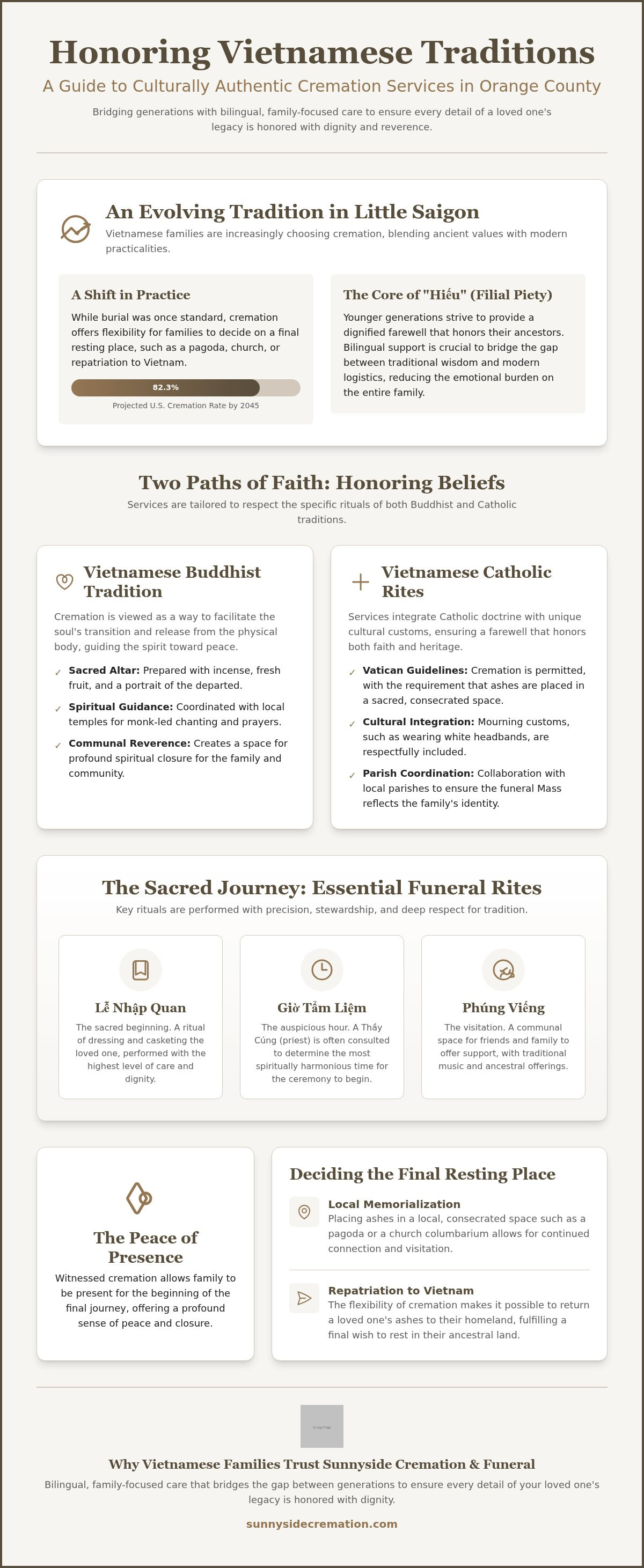
Orange County, specifically the vibrant community of Little Saigon, serves as a vital sanctuary for preserving heritage. For many families, the decision to choose Vietnamese cremation services Orange County providers offer is rooted in a desire to blend ancient values with the realities of life in California. While traditional earth burial was once the standard, a significant shift is occurring. This change isn't a departure from respect; it's an evolution of it. As the national cremation rate is projected to reach 82.3% by 2045, the Vietnamese community is also finding that cremation offers a practical yet dignified way to honor the departed.
Little Saigon remains the epicenter for these services in Southern California. Families travel from across the region to find specialists who understand the nuances of their grief. The rising preference for cremation often stems from the flexibility it provides. It allows families to hold onto their loved ones' remains until they can be properly placed in a pagoda, a church columbarium, or even taken back to Vietnam. This flexibility is essential for families who may not be ready to commit to a permanent local burial plot but want to ensure their loved one is treated with the highest level of care.
Central to this process is the concept of "Hieu," or filial piety. Younger generations feel a deep responsibility to provide a dignified farewell that would make their parents and grandparents proud. However, they often face the challenge of understanding complex rituals while managing modern logistics. Bilingual support acts as the necessary bridge here. It ensures that the elder's wisdom regarding Vietnamese funeral traditions is honored while the younger family members feel confident in the decisions being made. This partnership reduces the emotional burden on everyone involved.
Cremation in the Vietnamese Buddhist Tradition
Buddhist families often view cremation as a way to facilitate the soul's transition and release from the physical body. The service is a sensory experience. An altar is carefully prepared with incense, fresh fruit, and a portrait of the departed. We work closely with local temples to coordinate monk-led chanting and prayers. These rituals are essential for guiding the spirit toward peace. The presence of the community and the rhythmic sound of the bell create a space of profound reverence and spiritual closure.
Vietnamese Catholic Cremation Rites
For the Vietnamese Catholic community in Orange County, cremation is approached with a specific set of guidelines. The Vatican allows for cremation provided the ashes are not scattered but are instead placed in a sacred, consecrated space. Integrating these requirements with traditional mourning customs, such as the wearing of white headbands, requires a delicate touch. We coordinate with local parishes to ensure the funeral Mass reflects both the depth of the Catholic faith and the unique cultural identity of the family.
Essential Vietnamese Funeral Rites and the Cremation Process
Lễ Nhập Quan marks the sacred beginning of the spiritual journey. It is far more than a simple procedure; it is the ritual of dressing and casketing the loved one with the highest level of care. By choosing specialized Vietnamese cremation services Orange County families can ensure these ancient traditions are preserved within a modern setting. Every gesture during this time is performed with a spirit of stewardship, ensuring the transition is handled with the quiet dignity your family expects.
Timing is a critical element of a traditional farewell. Families often consult a Thầy Cúng, or priest, to determine the "Giờ Tẩm Liệm," which is the most auspicious hour for the ceremony to begin. This precision provides the family with a sense of spiritual security, knowing the departure aligns with cosmic harmony. We respect these schedules deeply. Modern facilities in the region have adapted their operations to accommodate these specific prayer times, allowing the ritual to unfold without a sense of rush or urgency.
The visitation period serves as a communal space for grief and "Phúng Viếng," where friends and extended family offer their support. Traditional music often fills the room, creating an atmosphere of reflection. Ancestral offerings are placed with intention, bridging the gap between the physical and spiritual worlds. Finding a comprehensive Vietnamese funeral package can help simplify these complex cultural requirements, allowing you to focus on the emotional needs of your family rather than the logistics of the altar setup.
Preparing the Loved One for the Journey
Dressing the departed in their finest traditional attire, such as an Ao Dai, is a final act of filial piety. Small, symbolic items may be placed with them to aid their journey. Family members wear the Khăn Tang, or white headbands, which serve as a profound outward sign of mourning and respect. These practices are deeply rooted in cultural beliefs related to death and dying, emphasizing that the body must be handled with Compassion, Dedication, and Respect at every stage.
The Prayer Service and Public Visitation
The visitation room is centered around a traditional altar featuring the loved one's portrait and ancestral tablets. This space allows the community to pay their respects through incense offerings and prayers. We provide gentle guidance on managing floral tributes and "Tiền Phúng Điếu," or monetary donations, according to the family's specific wishes. This structured yet supportive environment ensures that the hierarchy and traditions of the family are upheld throughout the entire public service.
The Importance of Witnessed Cremation for Vietnamese Families
For many families seeking Vietnamese cremation services Orange County has available, the moment of witnessing is the most profound part of the journey. It serves as a spiritual bridge. It allows family members to observe the transition of the physical body into a purely spiritual form. Unlike corporate facilities that might treat this as a technical step, we view it as a sacred rite of passage. This practice provides the spiritual closure that many families seek after the public visitation is complete.
In a traditional burial, the family gathers at the graveside to watch the casket being lowered. In a cremation, the viewing room becomes that sacred ground. It is a place where the physical and spiritual worlds meet for one last time. These rooms are built to accommodate the large, multi-generational groups common in our community. We understand that aunts, uncles, and cousins all wish to be present to offer their final respects. The family often takes an active role in initiating the process. This might involve a final collective prayer led by a monk or a designated family member pressing the button to begin the cycle. This act of participation is a powerful expression of love and duty.
Logistics of the Witnessing Ceremony
Scheduling is handled with great care to ensure all family members and clergy can attend. We coordinate with your temple or church to find a time that respects traditional prayer cycles. While the crematory is an industrial environment, we maintain an atmosphere of quiet reverence. Safety protocols are always in place, but they don't overshadow the solemnity of the moment. You'll have the opportunity to offer final incense and prayers before the cremation begins, ensuring no words are left unsaid.
Emotional Support During the Final Farewell
Our bilingual staff stays by your side throughout the entire ceremony. They explain each step in both Vietnamese and English. This ensures that elders and younger family members feel equally supported and informed. After the witnessing, we provide a private space for reflection. This allows your family to gather their thoughts in peace before returning home. For more information on the specific rituals involved, you can explore our guide on Buddhist Funeral Services Orange County, which provides deeper context for these sacred traditions.
Memorialization and Repatriation: Deciding the Final Resting Place
Choosing a final resting place is a decision that bridges the heart and the home. For many families in Southern California, this choice involves a delicate balance between staying close to the community in Little Saigon or returning to the soil of their homeland. When planning Vietnamese cremation services Orange County residents often consider the spiritual significance of reuniting a loved one with their ancestors in Vietnam. This act completes a generational cycle, providing a sense of peace that transcends borders. Others prefer a local sanctuary where children and grandchildren can easily visit, ensuring the legacy of the departed remains a tangible part of daily life.
Cost is a practical factor in this decision. Managing international transport involves different expenses than local cemetery fees. In California, as of January 1, 2026, a certified copy of a death certificate costs $26, and a disposition permit in Orange County is $12. These are the foundational documents needed regardless of the path you choose. Whether you're looking for a local niche or coordinating with an international airline, having a guide who understands these specific requirements is essential for your peace of mind.
Steps for Repatriating Ashes to Vietnam
Returning remains to Vietnam requires meticulous attention to detail. We handle the complex paperwork so you can focus on your family's needs. The process typically involves several critical steps:
- Securing the certified death certificate and the $12 Orange County disposition permit.
- Obtaining a "Laissez-Passer" for human remains from the Vietnamese Consulate.
- Providing certified translations of all legal documents into Vietnamese for customs clearance.
- Coordinating with international airlines that have specific protocols for transporting cremated remains.
- Professional packing of the urn to meet rigorous international shipping and safety standards.
Local Memorialization in Orange County
Many families choose to keep their loved ones nearby. We provide seamless coordination with major memorial parks like Forest Lawn or Rose Hills for niche placement. Having a local site is especially meaningful during Tet, the Vietnamese Lunar New Year. It allows for the tradition of "Tảo Mộ," or grave visiting, where families gather to clean the site and offer prayers. Choosing a Vietnamese funeral package ensures you have an urn that reflects your loved one's heritage, whether it's placed in a Buddhist pagoda's wall of remembrance or a Catholic church columbarium.
Why Vietnamese Families Trust Sunnyside Cremation and Funeral
Trust is built in the quiet, supportive moments that follow a loss. For families in Westminster and Garden Grove, finding a partner who understands the weight of ancestral duty is essential. We recognize that we aren't just providing a service; we're protecting a legacy. Choosing the right provider for Vietnamese cremation services Orange County families rely on means finding a guide who balances professional expertise with the humility of a community servant. Our family-owned approach ensures you're never treated as a case number. Instead, you're supported by a team that values your traditions as much as you do.
The hierarchy of the family is central to everything we do. We provide bilingual support that allows elders to lead with their wisdom while helping the younger generation manage the complex logistics of modern arrangements. This respect for family structure ensures that every decision is made with consensus and peace. We also believe that dignity should be accessible. By offering transparent, affordable cremation packages, we remove the financial anxiety that often accompanies corporate funeral homes. This allows your family to focus entirely on the spiritual and emotional needs of the moment.
A Partner in Cultural Preservation
Correct ritual execution is the cornerstone of a respectful farewell. We ensure that every detail, from the specific placement of the altar to the proper handling of incense, is performed with precision. Our team has deep experience coordinating with local temples and parishes, acting as a bridge for Asian family pre-planning. This proactive approach helps families document their wishes early, ensuring that future ceremonies stay true to their Buddhist or Catholic faith. Local families often tell us that our presence feels like having a knowledgeable relative by their side, guiding them through the nuances of tradition with a steady hand.
Simplified Logistics for Grieving Families
The administrative burden of a loss can be overwhelming, especially when international travel or repatriation is involved. We manage all the paperwork, from securing death certificates to handling complex consulate filings for Vietnam. Our team remains a constant presence, ready to provide reassurance and answer questions whenever they arise. This commitment to stewardship means we treat every loved one with the same reverence we would show our own family. By handling the technical details with methodical care, we create a landscape of certainty where you can find the space to reflect, remember, and begin the journey toward healing.
Honoring Your Heritage with Peace of Mind
The journey of saying goodbye is a deeply personal path that requires a delicate balance of ancient tradition and modern logistics. From the sacred moment of Lễ Nhập Quan to the spiritual closure found in a witnessed cremation, each step serves to honor the legacy of your loved one. Whether you decide on a local resting place in Little Saigon or choose the path of repatriation to the homeland, you don't have to manage these complex details alone.
Finding the right Vietnamese cremation services Orange County families trust means choosing a partner who understands the nuances of your faith and culture. As a family-owned and operated provider, we offer the bilingual Vietnamese support and repatriation expertise needed to bridge the gap between generations. We're here to act as your steady guide, ensuring every ritual is handled with the reverence it deserves.
Request a Culturally Respectful Consultation Today to learn how we can support your family during this time. Take comfort in knowing that your loved one's story will be told with dignity and that their final transition will be handled with the utmost care.
Frequently Asked Questions
Is cremation common in Vietnamese culture?
Cremation is becoming a preferred choice for many Vietnamese families due to its cost-effectiveness and the spiritual flexibility it offers. While traditional burial was once the standard, the ability to keep remains in a pagoda or return them to Vietnam makes cremation a practical way to honor "Hieu," or filial piety. It respects Buddhist views on the release of the soul while meeting the logistical needs of families living in Southern California.
Can we have a traditional Buddhist ceremony with cremation in Orange County?
Yes, you can fully integrate traditional Buddhist rites with cremation. We facilitate ceremonies that include the "Lễ Nhập Quan," or casketing, traditional altars with incense and fruit offerings, and chanting led by local monks. These rituals are essential for guiding the spirit toward peace. Our facilities are designed to accommodate these sacred traditions, ensuring the atmosphere remains one of profound reverence and spiritual security.
How much does Vietnamese cremation cost compared to burial?
Cremation is typically more affordable than traditional burial because it eliminates the need for a cemetery plot, a vault, and a large casket. While we don't quote specific service prices here, families should account for fixed state fees. For example, in California, a certified death certificate costs $26 and an Orange County disposition permit is $12. Choosing cremation allows families to allocate resources toward meaningful memorialization or repatriation instead of high land costs.
What is a witnessed cremation, and why is it important for our family?
A witnessed cremation is a service where the family is present at the crematory to observe the beginning of the process. For many families using Vietnamese cremation services Orange County providers offer, this is a vital spiritual step that provides closure. It allows the family to participate in the final departure through prayer or by initiating the cycle, mirroring the sacred tradition of being present at a graveside during a burial.
How long does it take to ship ashes back to Vietnam from California?
The timeline for shipping ashes back to Vietnam depends on how quickly the required paperwork is processed. This includes securing the death certificate, the $12 disposition permit, and the "Laissez-Passer" from the Vietnamese Consulate. Coordination with international airlines and certified translation of documents also takes time. We handle these intricate details methodically to ensure your loved one's return to their homeland is as smooth and respectful as possible.
Do you have Vietnamese-speaking staff to help our elders?
Yes, we provide dedicated bilingual staff who speak both Vietnamese and English fluently. This support is crucial for bridging the gap between elders who prioritize traditional rites and younger family members who may be handling the logistics. Our team ensures that every family member feels heard, respected, and comforted throughout the arrangement process, maintaining the hierarchy and etiquette expected in our community.
Can we coordinate with Forest Lawn or Rose Hills through your mortuary?
We regularly coordinate with major local parks like Forest Lawn and Rose Hills for the final placement of cremated remains. Whether you choose a niche in a columbarium or a wall of remembrance, we manage the communication and transportation details. This allows your family to have a local site for "Tảo Mộ," or grave visiting, during Tet while benefiting from our personalized, family-owned approach to the initial funeral services.
What documents are required for a Vietnamese cremation in Orange County?
Several legal documents are required by California law to proceed with a cremation. These include a death certificate, which must be filed within eight calendar days of death, and a signed cremation authorization from the legal next-of-kin. You also need a disposition permit, which currently costs $12 in Orange County. If you're planning for repatriation, additional consulate documents and certified translations will be necessary to meet international standards.


