

Setting money aside for funeral expenses answers only part of the questions your family may face. A pre-need funeral trust in California is one way to fund arrangements in advance, but it doesn’t automatically record your service choices, cultural customs, or family details. Before deciding, it helps to understand where funds are held, how they can be used, and whether the arrangement could affect SSI or Medi-Cal eligibility.
Planning ahead is easier when you separate the funding decision from the personal wishes behind it. You can write down preferences without prepaying, while a trust or another payment option involves its own terms. Public-benefit rules can depend on the specific arrangement, so don’t assume a trust will preserve eligibility.
This guide explains what a pre-need funeral trust is, how to review its documents, and how it compares with other planning options. It also offers questions to help you record your wishes clearly and make an informed choice. Sunnyside Cremation and Funeral’s pre-planning support helps families organize funeral preferences and important details with care.
Key Takeaways
- A pre-need funeral trust in California sets aside funds for planned services, but its documents determine how the arrangement works.
- Compare a trust with a pre-planning contract or separately held funds by considering purpose, flexibility, documentation, and administration.
- Before signing, review the funding terms, cancellation provisions, and instructions for keeping and accessing your records.
- Trust arrangements may affect public-benefit eligibility differently. Understand the specific terms and seek qualified advice about SSI or Medi-Cal questions.
- Funding and funeral wishes are separate parts of planning. Record the service, ceremony, cultural, and family preferences you want loved ones to understand.
What Is a Pre-Need Funeral Trust in California?
You don’t have to make every funeral decision today to start planning. First, learn what each option involves, then consider what fits your family. A pre-need funeral trust in California is one way to set aside funds for planned future funeral services. How the funds are managed and what protections apply depend on the specific arrangement and its documents.
A pre-need funeral trust holds funds toward planned funeral services, with its terms determining how those funds are managed and applied. That addresses funding, not every part of a funeral plan. Trust documents may not describe the ceremony you want, identify family members to notify, or explain cultural and religious preferences. Record those wishes separately so loved ones have practical guidance as well as funding information.
Read the documents together before signing. Identify what the trust covers, how its terms connect to the funeral arrangement, and who is responsible for each part. The federal Funeral Rule offers background on consumer protections for funeral purchases, but it doesn’t replace a close review of the terms of a specific California arrangement.
How is a funeral trust different from a funeral pre-planning contract?
A pre-planning contract records agreed services or arrangements; a trust concerns the funds set aside for those plans. The documents may be connected, but they can have distinct terms, responsibilities, and purposes. For example, a contract might describe a chosen service, while separate trust documents explain how funds relate to it. Sunnyside’s funeral pre-planning guide for Asian families offers broader context on documenting wishes and family considerations.
Why do California families consider advance funeral planning?
A written plan gives relatives something concrete to refer to when they’re grieving and unsure what the person would have wanted. A brief record can reduce guesswork. Note whether you prefer cremation or burial, what kind of gathering feels meaningful, and which customs or people should be considered. Families differ, so make the plan reflect your own beliefs, relationships, and traditions.
Planning can also make preferences easier to understand and discuss. That personal benefit isn’t a promise of savings or a particular financial outcome. Review funding decisions separately from the written record of your wishes.
- Record preferences for the type of service and disposition.
- Include cultural, religious, or family practices that matter to you.
- Keep copies of your instructions where trusted loved ones can find them.
These steps can make a plan more personal and useful, whether or not you fund arrangements in advance. A trust addresses funding; clear instructions communicate the care and meaning you want your family to honor.
How Does a California Pre-Need Funeral Trust Work?
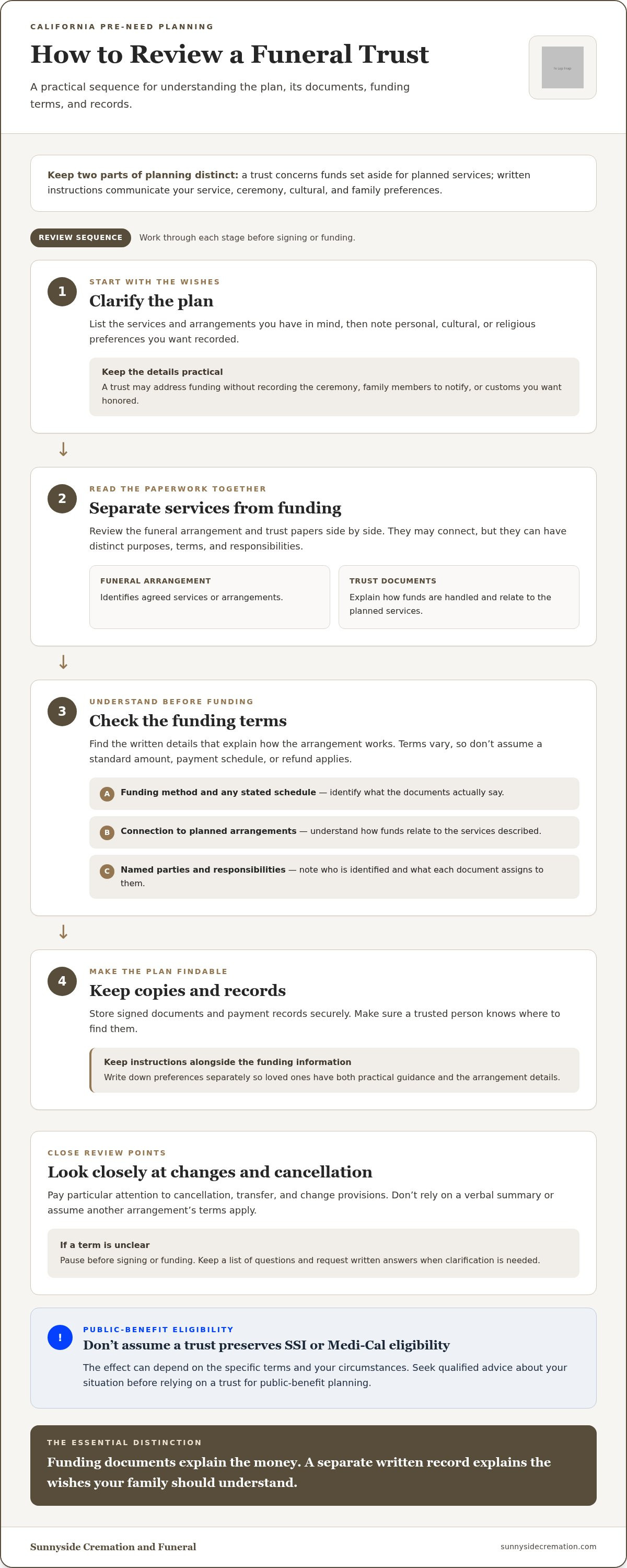
There isn’t one process that applies to every arrangement. A pre-need funeral trust in California may involve separate trust and funeral documents. Those documents determine how funds are handled and how they connect to planned services. Use the steps below as a practical review sequence, not as a statement of legal requirements or a promise that every plan works the same way.
A careful review moves from clarifying wishes to understanding the documents, funding terms, and recordkeeping. Take time at each stage. If a term is unclear, pause before signing or funding the arrangement and seek an explanation from an appropriate source.
- Clarify the plan. List the services and arrangements you have in mind, along with personal, cultural, or religious preferences you want recorded.
- Review the documents. Read the funeral arrangement and trust papers together. Identify which document describes the services and which explains the funding.
- Understand the funding terms. Look for the funding method, any stated schedule, how funds relate to the planned arrangements, and the responsibilities of the named parties. Don’t assume a standard amount, payment schedule, or refund applies.
- Keep copies. Store signed documents and payment records securely. Make sure a trusted person knows where to find them.
California rules and consumer information can change, so verify legal questions against current official sources. The California Cemetery and Funeral Bureau provides consumer information about funeral and cemetery matters. Its resources can help you identify questions to address, while the terms in your own documents remain central to understanding your arrangement.
What information should families understand before funding a trust?
Review the planned services, the parties named in the documents, how funding is made, and the written terms connecting the trust to the funeral arrangement. Pay particular attention to cancellation, transfer, and change provisions. These details can vary, so don’t rely on a verbal summary or assume another arrangement’s terms apply. Keep a list of questions and request written answers when you need clarification.
If you’re considering an arrangement in connection with SSI or Medi-Cal, don’t treat a general explanation as a decision about eligibility. The effect can depend on the specific terms and your circumstances. Get qualified advice about your situation before relying on a trust for public-benefit planning.
What records should loved ones be able to find later?
Keep signed trust and funeral documents, payment records, and a separate note of service preferences together or clearly cross-referenced. Personal instructions can describe ceremony wishes, important customs, and family contacts. Keep financial records organized and appropriately protected. Tell a trusted person where each set is stored, and update the records if your plans change.
For families organizing the service itself, Sunnyside’s pre-planning funeral contracts help bring funeral wishes and family details into the planning conversation. This work is separate from deciding how advance funds are held or receiving legal or public-benefit advice.
Pre-Need Funeral Trust vs. Other Planning Options: What Should California Families Compare?
No single funding approach fits every family. A pre-need funeral trust in California, a funeral pre-planning contract, and keeping money separately serve different purposes. Compare the documents, level of control, and responsibilities involved rather than assuming one option is always safer, less costly, or more appropriate. You can also record funeral wishes separately from any funding choice.
| Option | Purpose and documentation | Flexibility and administration | Questions to resolve |
|---|---|---|---|
| Pre-need funeral trust | Sets aside funds toward planned services; trust documents describe the funding arrangement. | Depends on the signed terms, including who administers the funds and what changes are allowed. | How are funds handled? What do the cancellation, transfer, and change provisions say? |
| Pre-planning contract | Records agreed funeral services or arrangements in a contract. | Change procedures and responsibilities depend on the contract and any linked documents. | What services are described, and how do the contract terms connect to any funding? |
| Funds kept separately | Money remains outside a funeral-specific trust or contract; records of the funds and funeral wishes may be separate. | The account holder generally manages the funds, subject to account terms and applicable rules. | Who can access the funds, and how will loved ones learn your wishes? |
Use this comparison as a starting point, then read the actual documents. Two arrangements with similar labels may have different terms. Review both the financial paperwork and the written description of services to see how well they work together.
How should families compare control, flexibility, and documentation?
Start by identifying who holds or administers the funds, who is named in the documents, and what written process applies if you want to change your plans. Read the provisions for cancellation, transfer, and amendments rather than assuming you know what refunds or access are allowed. If one document refers to another, obtain and review both. The signed arrangement and applicable rules determine what options are available.
Could a trust affect SSI or Medi-Cal eligibility?
This is a fact-specific question. The effect may depend on the trust’s terms, the person’s circumstances, and current program rules. Don’t assume that a trust or a particular label preserves eligibility. Some materials describing a California Master Trust make claims about public benefits; those claims refer to a particular arrangement, not a universal rule for every trust. Verify current SSI and Medi-Cal policies with a qualified benefits adviser before relying on an arrangement for eligibility planning.
Irrevocability also deserves careful review. A restriction on changing or accessing an arrangement may matter to your family, but the consequences depend on the actual documents and rules in effect. Ask for a clear written explanation of the terms, then consider whether the arrangement fits your priorities for funding, flexibility, and family guidance.
What Should You Review Before Choosing a Pre-Need Funeral Trust in California?
Before choosing a pre-need funeral trust in California, take time to read the paperwork and distinguish what it says from what you assume it means. A careful review helps you understand the arrangement without relying on a general description or verbal summary. The trust and related contract documents govern the specific terms. Questions about current California requirements call for up-to-date official guidance.
Use this checklist to compare written terms, not promises or assumptions:
- Services: Are the planned services and arrangements described clearly, and do they reflect your wishes?
- Named parties: Who is identified in the documents, and what role does each person or organization have?
- Funding and records: What do the documents say about funding, and what payment records will you receive or retain?
- Changes: Is there a written process for changing service preferences or other plan details?
- Cancellation and transfer: What do the actual documents say about these situations? Don’t assume a particular refund, transfer, or access outcome.
- Administration: Who administers the funds, and where do the documents explain that responsibility?
Quotable summary: “Confirm each important detail in the signed documents, and treat anything you can’t find in writing as an open question, not an established term.”
Which written terms deserve careful attention?
Read the trust documents alongside any funeral contract or service description. Check that the covered services, named parties, and payment records make sense together. Then find the written procedures for changes, cancellation, transfer, and administration. If a document uses unfamiliar language or refers to another document, mark the passage and request a plain-language explanation before proceeding. The signed documents and applicable rules determine how the arrangement works.
What California and Orange County details should families plan for?
Check California-specific oversight, disclosure, and consumer-protection requirements against current official guidance instead of relying on older explanations or another state’s rules. The California Cemetery and Funeral Bureau is an official consumer-information resource for funeral and cemetery matters. Use it to identify relevant information and verify current requirements before relying on a legal statement about a particular trust.
Orange County is a local service context, not a separate trust-law regime. Alongside financial paperwork, note the location or locations you have in mind, your preferred type of service, and the family contacts or customs you want considered. Keeping those practical details with your written wishes helps loved ones understand your plan without confusing personal instructions with financial terms.
If you’re ready to organize service preferences alongside funding questions, explore Sunnyside’s pre-planning funeral contracts as a way to begin documenting funeral wishes and family details.
How Can Sunnyside Help Families Connect Advance Funding With Funeral Wishes?
Funding and funeral wishes answer different questions. A trust or other funding arrangement concerns how money is set aside and applied. A written funeral plan helps loved ones understand the service, ceremony, and personal details that matter to you. Keeping those roles distinct makes planning clearer, especially when several relatives may help carry out your wishes.
Sunnyside’s pre-planning funeral contracts and service discussions help families organize arrangements and record preferences. As a family-owned California mortuary serving Orange County and nearby communities, Sunnyside supports Chinese, Korean, Taiwanese, Vietnamese, and Hindu families with culturally specific funeral planning. This planning conversation is separate from legal or public-benefit advice about a pre-need funeral trust in California.
How can a written plan preserve cultural and personal wishes?
Traditions are personal, even within the same family or community. Write down what you want your loved ones to know rather than assuming one set of customs applies to everyone. You might describe a preferred service type, meaningful ceremony details, language needs, important family contacts, or customs you’d like considered. Families looking for broader cultural planning context can explore this guide to funeral pre-planning for Asian families.
A practical plan can include details such as:
- The kind of service you prefer, such as a traditional gathering, cremation service, or graveside burial.
- Religious, cultural, or personal practices you want discussed with your family.
- Languages that would help relatives take part in conversations or ceremonies.
- Family members or other trusted people who should be included in planning.
- Preferences you want loved ones to know are flexible, as well as those that are especially meaningful to you.
Your notes don’t need to answer every question. They can give relatives a helpful starting point while leaving room for family discussion, changing circumstances, and the details of the time.
What is a calm next step for Orange County families?
Begin at your own pace with a conversation about the wishes you already know and the questions you’re still considering. Sunnyside helps families organize funeral preferences through pre-planning contracts and service discussions. This can connect practical arrangements with the details that make a service personal, while keeping those wishes distinct from how advance funds are held.
Before a conversation, write down the service type you have in mind, customs or language preferences, and the relatives you want involved. Bring questions about how to document your plans, then review the written arrangements in your own time. If you’re weighing funding or public-benefit questions, keep them separate and seek qualified guidance based on your circumstances.
You don’t need to settle every detail at once. Begin a funeral pre-planning conversation with Sunnyside when you’re ready to put your wishes into words and help your family understand what matters to you.
Let Your Next Step Be a Conversation
You don’t need every detail settled before beginning. Write down a preference you feel sure about, note a question you want answered, or invite someone you trust to take part in a planning conversation. Small steps make your wishes easier to discuss and give loved ones a clearer place to begin.
A pre-need funeral trust in California concerns advance funding, while a conversation about funeral preferences gives those plans personal meaning. Sunnyside’s pre-planning support helps you record the service and family details that matter, with care for individual traditions and wishes. Questions about trust terms or public-benefit eligibility deserve separate, qualified guidance.
As a family-owned California mortuary, Sunnyside offers pre-planning contracts and culturally specific funeral arrangements for families with varied traditions. If you’re ready to begin at your own pace, begin a thoughtful funeral pre-planning conversation with Sunnyside. Take the first step when it feels right and build a plan that reflects the care you want to leave with your family.
Frequently Asked Questions
Is a pre-need funeral trust required in California?
No. Families shouldn’t assume a pre-need funeral trust in California is universally required. Advance planning can simply mean writing down preferences without selecting a funding product. If you’re considering a trust, review current California consumer guidance for applicable requirements and protections. First decide whether your immediate goal is to communicate wishes, arrange services in advance, or set aside funds. Those goals don’t automatically require the same documents.
How much should a family put into a California pre-need funeral trust?
There’s no single amount that suits every family. Planned services, the written contract, trust funding terms, and applicable rules all matter. Before committing, compare the written plan with your budget and priorities. Clarify which arrangements the funds are intended to support and whether the documents explain how any difference between the funds and future costs is handled. Don’t rely on a general balance as proof that a particular plan is fully funded.
What happens to money in a pre-need funeral trust if the planned services change?
The result depends on the signed trust and funeral documents. Changing a preference, such as choosing a different type of gathering, doesn’t establish whether funds can be changed, transferred, or returned. Find the relevant written provisions and make them accessible to the person who may help carry out your plan. If the documents don’t clearly address your situation, get an explanation before making changes or assuming funds are available.
Can a pre-need funeral trust affect SSI or Medi-Cal eligibility in California?
It can be relevant to eligibility, but the answer depends on current program rules, the trust’s terms, and the individual’s circumstances. A provider’s general statement about benefits isn’t a decision about your eligibility. Before relying on a trust for SSI or Medi-Cal planning, ask a qualified benefits adviser to review the actual arrangement and your situation. Treat broad claims about benefit protection as something to verify, not as a guarantee.
What happens if a family moves away from California after setting up a pre-need funeral trust?
Moving may raise questions about where services will take place, who administers the arrangement, and whether the plan can be changed or transferred. Don’t assume the outcome is the same for every contract or trust. Review the documents for terms addressing a move, a different service location, and changes in administration. Before relocating, make sure the person who may handle arrangements knows where the documents are and can access the relevant instructions.
Can a pre-need funeral trust include cultural or religious funeral preferences?
A trust mainly addresses funding, so don’t rely on financial paperwork alone to preserve ceremony instructions. Record customs, language needs, service preferences, and family contacts in a separate plan or related service documents. Sunnyside’s pre-planning support helps families shape arrangements around their own wishes. This can be useful for families in Garden Grove, Buena Park, La Mirada, Cerritos, Anaheim, La Habra, Fullerton, Norwalk, Cypress, Artesia, Stanton, Tustin, Orange, Los Alamitos, Westminster, and Irvine.
What is the difference between a revocable and irrevocable pre-need funeral trust?
Generally, “revocable” describes an arrangement that may be changed, while “irrevocable” describes one that limits the ability to change it. Those labels alone don’t explain what you can access, how changes work, or whether benefits rules apply. Read the actual documents and verify current California-specific guidance before drawing conclusions. If you’re weighing this choice for public-benefit planning, get advice based on your circumstances rather than relying on a general description.


