

What if a conversation about final wishes could begin with what makes your parents feel most like themselves, rather than with paperwork or death? If you’re wondering how to discuss final wishes with elderly parents, it’s understandable to worry that the subject may sound like giving up, or that you’ll ask the wrong thing at the wrong time. You don’t have to settle every detail in one sitting. It’s all right to pause and return to the subject later.
A gentle conversation is an invitation to understand what matters to your parent. Their values, faith, culture, relationships, and personal preferences can guide future choices while leaving them in control of what they share and when. Families may hold different expectations, so listening with curiosity matters as much as finding the right words.
This guide will help you choose a thoughtful moment, open the discussion without pressure, and ask useful questions about care, ceremony, and practical arrangements. You’ll also learn how to record your parent’s wishes and revisit them over time, so the conversation can unfold at a respectful and reassuring pace.
Key Takeaways
- Knowing your parent’s values can reduce guesswork later, without requiring a perfect script or a single, all-at-once conversation.
- Learn how to discuss final wishes with elderly parents by preparing, asking permission, explaining your intention, and listening before suggesting a next step.
- Use open-ended prompts to explore personal values, ceremony preferences, and practical considerations while making room for individual and family differences.
- With your parent’s permission, record their own words, the date, and who took part. Keep personal notes distinct from documents that may have legal effect.
- Funeral pre-planning contracts can help preserve expressed preferences and support a thoughtful discussion about future arrangements.
Why Discuss Final Wishes with Elderly Parents Before a Crisis?
Talking about final wishes can feel tender. You may worry that raising the subject sounds like you’re predicting a death or trying to take charge. There’s no perfect script, and you don’t need to cover every detail in one conversation. The purpose of learning how to discuss final wishes with elderly parents is to understand what matters to them while making clear that their choices and comfort come first.
Knowing a parent’s values can ease guesswork during an already difficult time. If relatives understand what brings your parent comfort, which traditions they cherish, or what kind of gathering feels right, they have a clearer guide for future decisions. Preferences may be shaped by faith, culture, family history, or simply what feels meaningful to that individual. There’s no single set of wishes that fits every family.
A final-wishes conversation is an ongoing exchange about a person’s values and preferences, not a one-time checklist to complete. It can begin with listening and grow gradually as your parent decides what they’re ready to share. Your role is to make space for their perspective, not to force decisions or take control.
Choose a calm moment rather than waiting for an emergency
Look for an ordinary, private moment when neither of you is rushed or preoccupied. A quiet visit at home, a relaxed meal, or a walk together may feel more comfortable than a formal family meeting. A milestone, such as a birthday, or a conversation about family history can also provide a natural opening without making the discussion feel like an alarm.
Readiness varies. Your parent may be open to talking now or prefer to wait. Postponing one conversation isn’t failure. Leave the door open and try again when the moment feels more settled.
Separate planning from fear or pressure
Avoid framing the conversation as a prediction about death or an urgent task. Instead, explain your caring reason for asking: “I’d like to understand what matters to you, so our family can respect your preferences.” You might connect the discussion to planning generally rather than leading with a list of decisions. If you touch on medical-care preferences, an advance directive is one kind of document people use to express wishes about future healthcare.
Then give your parent room to respond. They may want to pause, decline, or choose another time. Respect that without treating it as a refusal forever. A calm “That’s okay. We can leave it here for now” protects their dignity and keeps the relationship more important than completing a plan.
Even a brief exchange can be a meaningful starting point. Listen for what your parent values, thank them for sharing, and let them decide whether to continue. The conversation can unfold at their pace, with care rather than pressure.
How to Start the Conversation About a Parent’s Final Wishes
The first words don’t have to be perfect. A simple invitation can help your parent understand that you’re asking because you care, not because you expect them to make every decision on the spot. If you’re considering how to discuss final wishes with elderly parents, keep the first conversation small. Your aim is to open a door, not finish a plan.
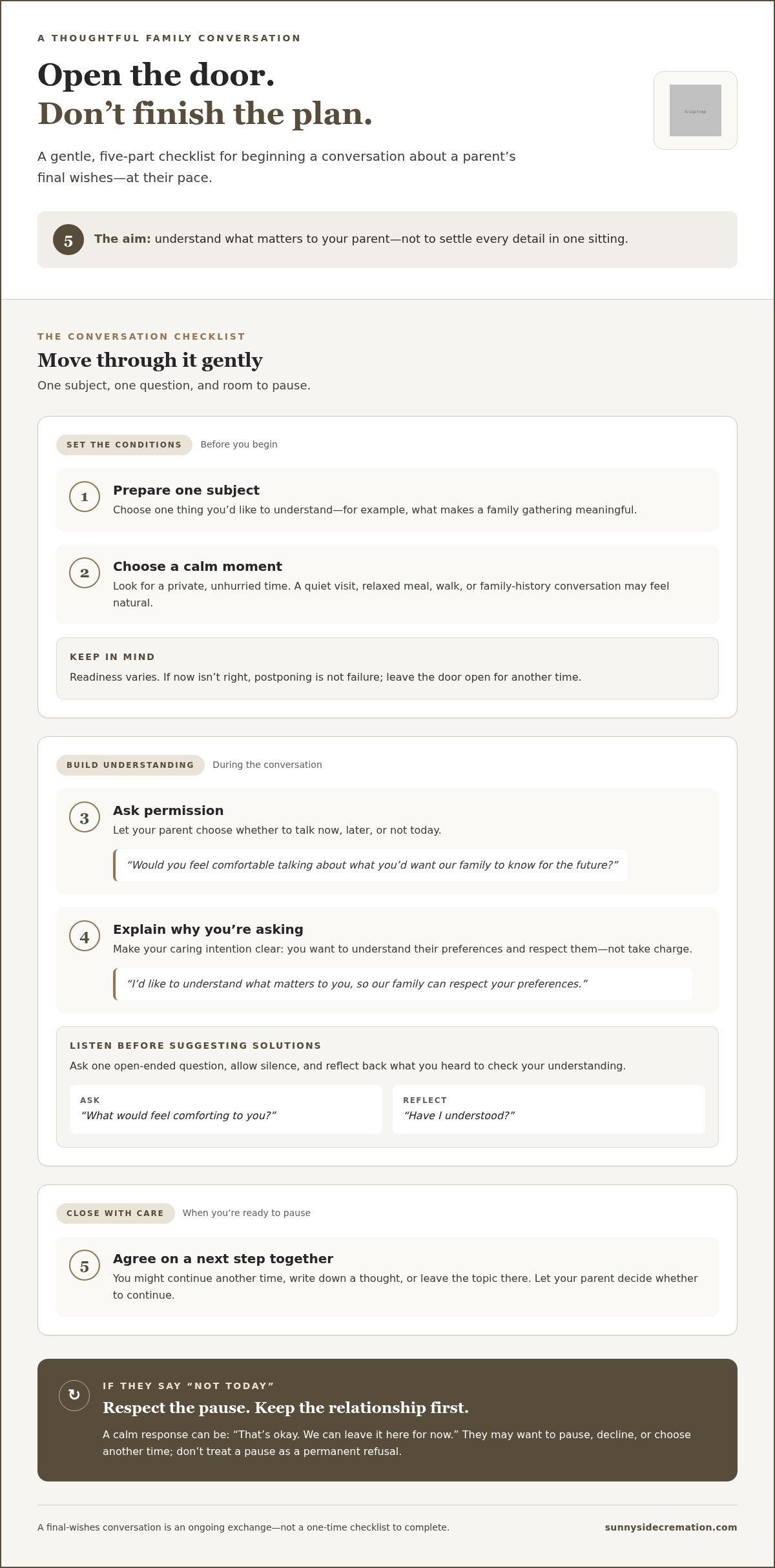
A gentle sequence can help you stay present instead of searching for the next thing to say:
- Prepare: Choose one subject you’d like to understand, such as what makes a family gathering meaningful.
- Ask permission: Give your parent the choice to talk now, later, or not today.
- Explain your intention: Share that you want to understand their preferences and respect them.
- Listen: Ask one open-ended question, then leave room for an answer.
- Agree on a next step: Decide together whether to continue another time, write down a thought, or leave the topic there.
Use an opening that invites, rather than demands, a conversation
Use words that sound like you, and make clear that your parent can set the pace. For example: “Would you feel comfortable talking about what you’d want our family to know for the future?” Or, “I’ve been thinking about how each of us has different ideas about family traditions. Could I ask what feels important to you?” Connecting the subject to personal planning or a family story can make it feel less abrupt.
Avoid guilt, ultimatums, or statements like “We have to decide everything now.” They can make a parent feel cornered. An invitation leaves room for an honest answer, including “not today.”
Listen for what matters before suggesting solutions
Once your parent responds, resist the urge to fill every pause. Silence can give them time to find the words. Ask one open-ended follow-up, such as, “What would feel comforting to you?” or “Is there a tradition you’d especially want included?” Then reflect their words back: “It sounds like having the family together matters more than a formal ceremony. Have I understood?” This checks your understanding without correcting how they feel.
Asking permission and listening patiently help your parent remain in control of what they share, how much they share, and what happens next.
If your parent declines, accept the answer without arguing. You might say, “I understand. Would another time feel better, or would you rather bring it up yourself?” If they choose another time, follow their lead rather than turning the next meeting into an appointment they didn’t ask for. If they don’t want to revisit it, let the conversation rest.
When they are ready, a next step might be as simple as talking about one preference with another family member. If discussing practical arrangements would help, funeral pre-planning conversations can offer a calm way to explore preferences together at your parent’s pace.
Which Personal, Cultural, and Spiritual Wishes Should You Explore?
Once your parent is ready to share, explore what gives their choices meaning, not just which arrangements they prefer. Personal values, family traditions, spiritual beliefs, and practical needs can all shape a farewell. Asking about each with an open mind helps you understand your parent as an individual. Heritage or faith may be important, but neither tells you what a particular person wants.
Use these prompts as a menu, not a checklist. Choose a few that feel relevant, and write down your parent’s own words only with their permission.
| Topic | Open-ended question | Note-taking prompt |
|---|---|---|
| Personal values | “What would you want people to remember or feel?” | Record qualities, memories, or priorities they mention. |
| Faith and traditions | “Are there customs or spiritual practices you’d like included, if any?” | Note the practices they name and what they mean to them. |
| People and language | “Who would you want involved, and what language would feel comfortable?” | Write down important people, community connections, and language preferences. |
| Ceremony and remembrance | “What kind of gathering or farewell would feel right to you?” | Capture preferences for the tone, participation, music, or remembrance. |
| Practical considerations | “Do you have a preference for cremation or burial, or a place that matters to you?” | Record the preference or note that they’re undecided. |
Ask about meaning, faith, and family traditions without making assumptions
Invite your parent to identify which customs, if any, they want honored. You might ask whether they’d like spiritual guidance, particular family members involved, or connections to a community included. For Asian and multicultural families, preferences differ within every community and from one relative to another. General information about traditional Chinese funeral customs can provide context, but your parent’s own wishes should lead the conversation.
Discuss ceremony and disposition preferences in the parent’s own words
Ask what kind of gathering, remembrance, or farewell feels meaningful, and whether they picture something intimate, community-centered, or another approach. Explore cremation or burial without presenting either as the expected choice. A preference may also involve a particular place, language, spiritual guide, or role for family members. If your parent isn’t sure, record that honestly rather than filling in an answer for them.
As you learn how to discuss final wishes with elderly parents, keep the focus on the meaning behind each preference. Someone may value a familiar language because it helps relatives feel connected, or want a particular person present because of a shared spiritual practice. Those details can guide later planning while leaving room for your parent to clarify or change their mind.
How to Record Final Wishes and Revisit Them Respectfully
After a conversation, a few careful notes can help preserve what your parent shared without turning personal preferences into decisions they haven’t made. Ask permission before writing anything down. Capture their words as closely as you can, along with the date and who was present. If they later change or clarify a preference, add the update and its date rather than quietly replacing the earlier note.
Written preferences should be reviewed and shared only with your parent’s consent. Their wishes may evolve, and the record should reflect what they want now, not become a fixed instruction imposed by someone else.
Keep personal notes separate from formal legal documents
Informal notes can serve as a memory aid for family conversations. They can record preferences about a gathering, traditions, or people your parent wants involved, but they aren’t a substitute for formal legal or medical documents. If your parent wants to express healthcare choices or designate decision-making authority, treat that as a separate matter. Document names, requirements, and legal effects can depend on the situation, so don’t assume a personal note carries legal force.
For questions about legal authority, document validity, or California requirements, encourage your parent to consult a qualified California attorney. This keeps family notes useful without confusing them with documents intended to have legal effect.
Agree on who should know and where information belongs
Ask your parent who they want included in future conversations. They may prefer to involve certain relatives, a trusted friend, or a spiritual adviser, or keep the discussion private for now. With their permission, note where agreed records are kept and who may access them. Don’t circulate notes more broadly just because several relatives are concerned. Sharing should follow your parent’s wishes.
If the family wants to explore practical arrangements, culturally attentive funeral pre-planning for Asian families can provide a way to discuss preferences while recognizing that customs and beliefs vary from person to person. The purpose is to preserve what your parent has expressed, not to assume a tradition based on heritage.
Revisit the record when your parent asks, after a meaningful change in their life, or when they raise the subject again. A move, a change in family relationships, or a shift in personal beliefs might prompt them to rethink what feels right. You can ask, “Would you like to review what we wrote down, or does it still feel accurate?” If they don’t want to revisit it then, respect that choice and leave the notes unchanged.
Learning how to discuss final wishes with elderly parents includes caring for what happens after the conversation: keeping their words accurate, private, and open to revision. If your parent is ready to turn preferences into a practical plan, explore funeral pre-planning contracts as one option for documenting wishes and planning ahead at a considered pace.
How Funeral Pre-Planning Can Help Honor Your Parent’s Wishes
Once your parent has shared what matters to them, the family can consider how those preferences might guide future arrangements. A planning conversation can connect a personal wish, such as including a spiritual guide or gathering in a familiar place, with practical choices about a service. It doesn’t mean every decision must be made at once. Your parent can explore options, ask questions, and decide what they’re comfortable recording.
For families who want to put preferences into a more organized plan, Sunnyside Cremation and Funeral offers funeral pre-planning contracts that provide an option for documenting wishes and planning ahead. This can help keep personal and cultural preferences in view as arrangements are considered. The conversation should remain led by your parent, with their choices and pace respected.
When a funeral home conversation may be helpful
A discussion with a funeral home may be useful if your family wants to understand arrangement options, preserve cultural preferences, or talk through what a particular ceremony could involve. You can begin with questions rather than commitments. Families in Orange County may also discuss plans involving Forest Lawn or Rose Hills, with Sunnyside Cremation and Funeral coordinating with those cemeteries when relevant to the family’s plans.
Sunnyside Cremation and Funeral serves Korean, Chinese, Taiwanese, Vietnamese, and Hindu families with culturally attentive funeral and cremation services. Traditions and preferences vary within every community, so the conversation can focus on what your parent personally wants included, whether that involves language, ceremony, spiritual guidance, or family participation.
Take one manageable next step together
After exploring the possibilities, ask your parent what would feel comfortable next. They might prefer another family conversation, a discussion about practical arrangements, or simply time to consider what they’ve heard. Understanding how to discuss final wishes with elderly parents also means allowing the planning process to move at their pace. A useful next step is one they choose, not one others impose.
As a family-owned mortuary serving Orange County and nearby communities, Sunnyside Cremation and Funeral provides funeral and cremation services shaped around families’ expressed preferences. Its culturally tailored services reflect different traditions while recognizing that no two families share exactly the same wishes. A planning discussion can help clarify which details matter most and how they might be honored.
If your parent is ready to explore this option, you can learn about funeral pre-planning contracts and consider how they may help document preferences. There’s no need to have every answer first. Listening carefully and recording even one preference, with your parent’s consent, is meaningful progress toward honoring what matters to them.
Let One Honest Conversation Lead to the Next
You don’t have to leave a conversation with every detail settled. A parent might share one preference today and want to think about the rest later. That is still meaningful progress. The heart of how to discuss final wishes with elderly parents is making room for their voice, then letting their wishes guide what happens next.
If your family is ready to explore practical arrangements, Sunnyside is a family-owned California mortuary offering culturally tailored funeral and cremation services, pre-planning contracts, and coordination with Forest Lawn and Rose Hills. These options can support families as they consider how to honor personal preferences, without assuming one tradition or plan fits everyone.
There’s no need to force the timing. You can begin with a question, listen closely, and decide together whether to continue the conversation or explore planning. Explore compassionate funeral pre-planning with Sunnyside when it feels right for your family. Each thoughtful step can help preserve what matters to your parent, and that care is worth carrying forward.
Frequently Asked Questions
What if my elderly parent refuses to discuss final wishes?
Respect their refusal and avoid turning the subject into a test of trust or affection. You might say, “I hear you. I won’t push, but I’m here if you want to talk later.” If you’re learning how to discuss final wishes with elderly parents, remember that protecting the relationship matters more than getting an answer today. Your parent can choose whether to reopen the subject, and when.
How often should families revisit a conversation about final wishes?
There’s no required schedule for revisiting personal preferences. Let your parent’s comfort guide the timing, and check in if they raise the subject or mention a change in what matters to them. A simple question such as “Would you like to talk about this again?” can help you avoid making the discussion feel like a routine obligation. If they say no, respect that response.
Can siblings be included in the conversation about a parent’s wishes?
Yes, if your parent wants them involved. Ask whom they’d like included and whether they prefer a group conversation or separate discussions. Relatives coordinating across Orange County, including Garden Grove, Buena Park, La Mirada, Cerritos, Anaheim, La Habra, Fullerton, Norwalk, Cypress, Artesia, Stanton, Tustin, Orange, Los Alamitos, Westminster, or Irvine, might use a shared call to hear the same preferences. Let your parent decide who participates.
What should I do if my parent’s wishes differ from the family’s traditions?
Make space for your parent to explain what feels meaningful to them, even if it differs from a custom relatives expected to follow. Ask which parts of a tradition they want to keep, adapt, or leave out. Families can honor heritage without assuming every practice is required. If relatives disagree, return to your parent’s expressed preferences and keep the discussion respectful rather than asking them to defend their choice.
Can a family conversation replace an advance health care directive?
No. A family conversation helps relatives understand a parent’s preferences, but it isn’t a substitute for a formal document intended to record healthcare wishes or name someone for healthcare decisions. If your parent wants to document medical preferences, discuss the appropriate California documents and requirements with a qualified California attorney or healthcare professional. Keep informal notes clearly separate so relatives don’t mistake them for formal paperwork.
How can I discuss final wishes when my parent has memory problems?
Keep the conversation calm, brief, and focused on one familiar question at a time. A parent may find it easier to discuss a specific preference, such as who they’d want nearby, than to consider many future arrangements at once. Don’t treat memory difficulties alone as proof that they can’t express a preference. If communication or understanding concerns you, seek guidance from a healthcare professional familiar with your parent.


