

What if a farewell could feel less like a formal occasion and more like the person you’re remembering? The most meaningful non-traditional funeral ideas don’t have to set family customs aside. A favorite song, a shared meal, or a familiar ritual can bring personal memories into a gathering while honoring the traditions that matter to your family.
It’s understandable to want a tribute that feels true to your loved one, yet knowing where to begin can be difficult. There’s no single right way to remember someone. Start with the people who will attend, the customs you want to preserve, and the memories you hope the gathering will bring forward.
This guide explores thoughtful ways to celebrate a life, from memory-sharing and creative displays to outdoor gatherings and meaningful rituals. You’ll find practical ways to adapt these ideas to cultural, spiritual, and family traditions, along with planning steps to help make decisions manageable. Whether you’re imagining a quiet remembrance or a more informal celebration, you can create a gathering that reflects the life, relationships, and values you want to honor.
Key Takeaways
- A non-traditional service can reflect your loved one’s life while making room for religious, cultural, and family customs.
- Explore non-traditional funeral ideas by considering the memories, relationships, and interests you want the gathering to bring forward.
- Compare gathering formats by their atmosphere, guest participation, and planning needs.
- Keep planning manageable by agreeing on priorities first, then choosing essential ceremony elements before optional details.
- In Orange County, personal touches can complement family traditions. Let your loved one’s preferences and your family’s wishes guide the choices.
What Makes a Funeral Non-Traditional, and Can It Still Feel Respectful?
A non-traditional funeral is a remembrance shaped around the person being honored and the family’s values, rather than a fixed ceremony template. It may include familiar rites alongside personal choices, such as a meaningful reading, music, or time for guests to share memories. A different format isn’t automatically less dignified. The care behind the choices, and the way people are welcomed and remembered, matter more than whether a service follows a standard pattern.
For families in Garden Grove, the choice doesn’t have to be between tradition and personalization. You can consider non-traditional funeral ideas while keeping the customs that bring comfort and meaning. A personal detail can complement an established rite, not replace it. Families may also find it helpful to explore a broad overview of funerary customs, while remembering that each family’s practices and preferences are their own.
How does a celebration of life differ from a traditional funeral?
A celebration of life often foregrounds stories, relationships, and activities that reflect the person. Guests might share memories, listen to meaningful music, or gather in a setting connected to the person’s life. A traditional funeral can also include personal tributes, and a celebration of life can include formal or spiritual elements. Neither format has one required tone or structure.
The gathering’s style is separate from the disposition choice. A family may hold a celebration of life whether their loved one is buried or cremated. Consider these as distinct decisions: first decide what kind of remembrance feels right, then consider how it fits with the family’s arrangements and wishes.
Can personal touches honor cultural or spiritual traditions?
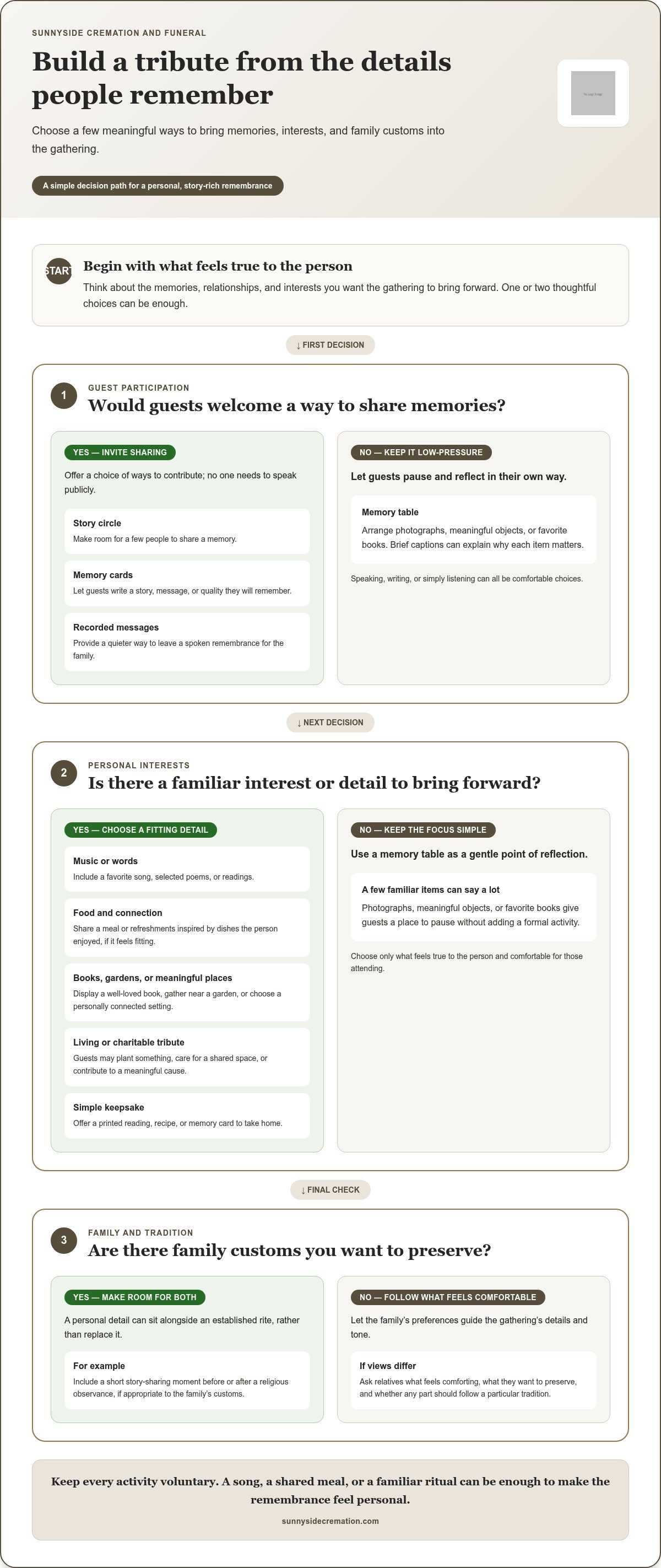
Yes. When the family wishes, music, readings, photographs, or a personal display can sit alongside established rites. For example, a family might include a short story-sharing moment before or after a religious observance, or display photographs in a way that feels appropriate to their customs. Let the people who know what holds significance guide the details, rather than relying on assumptions about a culture or faith.
Start with a gentle conversation. Ask relatives what feels comforting, what they’d like to preserve, and whether any parts of the gathering should follow a particular tradition. Family members can have different perspectives, even when they share a cultural or spiritual background. Listening helps make room for those differences and supports considered, respectful choices.
Non-Traditional Funeral Ideas for a Personal, Story-Rich Tribute
The most meaningful tributes often grow from small, recognizable details: a song someone loved, a familiar recipe, or a story that always made the family laugh. These non-traditional funeral ideas can suit a quiet gathering or a larger remembrance. Choose only what feels true to the person and comfortable for those attending.
A personal detail can turn a gathering into a reflection of the life, relationships, and memories people carry with them.
Ideas that invite guests to share memories
A memory table gives guests a simple place to pause and reflect. Arrange photographs, meaningful objects, or favorite books, and add brief captions explaining why each item matters. You might also invite guests to contribute in ways that suit them:
- Story circle: Make space for a few people to share a memory, without requiring everyone to speak.
- Memory cards: Set out cards where guests can write a story, message, or quality they’ll remember.
- Recorded messages: Offer a quiet way for guests to leave a spoken remembrance for the family.
Keep each option voluntary. Some people find comfort in speaking; others prefer to listen or write privately. The National Funeral Directors Association shares more personal memorial ideas that families can use as inspiration.
Ideas shaped by a loved one’s interests
Think about what made everyday life feel like theirs. A favorite-song gathering could include a short playlist, with music woven between moments of reflection rather than treated as a performance. Selected poems or readings can offer another way to express what’s difficult to say aloud.
- Food and connection: Share a meal or refreshments inspired by dishes the person enjoyed, if that feels fitting for your family.
- Books, gardens, or meaningful places: Display a well-loved book, gather near a garden, or choose a setting with a personal connection.
- Living or charitable tributes: Invite guests to plant something, care for a shared space, or contribute to a cause meaningful to the person. Treat these as optional gestures, not promises of a particular outcome.
- Simple keepsakes: Offer a printed reading, recipe, or memory card for guests to take home.
One or two thoughtful choices are often enough. Sunnyside Cremation and Funeral can help families plan funeral and cremation arrangements while keeping the focus on remembrance. Explore funeral planning support to learn more.
Choosing a Non-Traditional Funeral Format: Compare Settings and Participation
The right format is the one that fits your family’s preferences, practical needs, and meaningful customs. A quiet gathering may suit relatives who want time to talk, while a larger event can welcome a wider circle of friends and community. Neither is more authentic or appropriate by default. Use the comparison below to consider what each setting makes possible.
| Format | Atmosphere | Guest participation | Planning considerations |
|---|---|---|---|
| Intimate family gathering | Quiet and personal | Close relatives may share stories or take part in a simple ritual | Consider who should be invited and how to make time for conversation |
| Larger celebration of life | Open and communal, with room for varied expressions of remembrance | More guests can offer memories, readings, or other tributes | Plan a clear order of events and ways for guests to participate comfortably |
| Graveside remembrance | Focused and connected to the burial place | Guests can gather for words, reflection, or a brief tribute | Consider the site, family customs, and practical arrangements for attendees |
| Virtual participation | Connects people who can’t be together in person | Remote guests may listen or share a remembrance from afar | Think through how remote attendees will join and follow the gathering |
Which gathering style fits your family and guests?
A small gathering can leave space for close family members to speak naturally, remember privately, or share a meal. A larger celebration may help distant relatives, friends, and community members feel included. If travel or distance makes attendance difficult, virtual participation can offer another way to be present. It can complement an in-person service rather than replace it.
As you compare non-traditional funeral ideas, consider what guests will be comfortable doing. Some may welcome an invitation to speak, while others may prefer to listen. Clear, gentle guidance helps everyone take part in a way that feels right to them.
How can a meaningful place shape the remembrance?
A place connected to your loved one, such as a family gathering space or a garden, can give a remembrance a personal setting. Consider guest access and whether the location suits the gathering you have in mind. A graveside remembrance is another option, not a requirement for a personal tribute.
In Orange County, families may coordinate a gathering alongside burial arrangements at a cemetery such as Forest Lawn or Rose Hills. Sunnyside Cremation and Funeral coordinates with Forest Lawn and Rose Hills, helping bring the setting and remembrance together while keeping family preferences and customs at the center. The Federal Trade Commission’s guidance on consumer rights for funerals can also help families understand the practical side of planning as they make choices.
How to Plan a Non-Traditional Funeral Without Overwhelming Your Family
Planning can feel more manageable when you make decisions in a calm order instead of trying to settle every detail at once. Begin with what matters most to your family, then build a gathering around those priorities. Treat non-traditional funeral ideas as options, not a checklist. A few meaningful choices can be enough.
What should the family decide first?
Start by talking about the feeling you hope the gathering will hold, who you want to include, and which customs or rites are important to preserve. Then decide whether the remembrance will center on ceremony, storytelling, shared food, or quiet reflection. These answers set a helpful scope before optional activities or decorations enter the conversation.
From there, move through the essential choices:
- Format: Decide what kind of gathering best fits the people attending and the customs you want to honor.
- Personal elements: Choose a small number of readings, music selections, photographs, or memory-sharing moments.
- Practical details: Settle the location and how guests will receive the information they need.
Keep a separate list for optional touches. If time or energy is limited, simplify or leave out those details without changing the heart of the remembrance.
How can relatives take part comfortably?
Offer specific, voluntary roles rather than asking relatives to plan everything. One person might select a reading, another could choose a photograph, and someone else may be willing to share a memory. Give people room to decline or participate quietly. A family member who prefers familiar or more traditional observances can still be included with care.
Clear communication helps guests know what to expect. In an invitation or message, briefly describe the gathering’s format and note whether sharing a story, bringing a photograph, or joining remotely is optional. That guidance can ease uncertainty without putting anyone on the spot.
For families planning ahead, the funeral pre-planning guide for Asian families offers a starting point for considering wishes and family traditions. Sunnyside Cremation and Funeral provides funeral planning support. Explore funeral planning options to learn more.
Personal Memorial Ideas That Can Honor Tradition in Orange County
A personal tribute doesn’t need to replace family customs. A favorite song, a short story, or photographs displayed with care may complement meaningful rites, if the family wishes. The best non-traditional funeral ideas are guided by the people closest to the person being remembered, not by assumptions about what a whole community believes or practices.
How can a personal tribute complement cultural customs?
Begin by asking relatives which customs they want to preserve and where a personal element might fit. One family may welcome a memory-sharing moment alongside a religious observance; another may prefer the ceremony to follow familiar forms without additions. Both choices deserve respect.
Traditions vary among Chinese, Buddhist, Hindu, Korean, Taiwanese, and Vietnamese families. Even within one family, relatives may hold different preferences. Rather than treating any practice as universal, invite family members to share what is significant and seek appropriate cultural or religious guidance for ceremony details. Sunnyside’s guides to Buddhist funeral services in Orange County, Chinese funeral services in Southern California, and Hindu cremation services in Orange County offer more context for families considering tradition-specific arrangements.
What support can help families carry out their wishes?
Thoughtful coordination can bring ceremony, disposition, and personal touches together without losing sight of what matters to your family. Sunnyside Cremation and Funeral serves Orange County families with culturally specific funeral and cremation arrangements, as well as graveside options. Its services include arrangements for Chinese, Korean, Taiwanese, Vietnamese, and Hindu family traditions, along with Buddhist funeral guidance and Mandarin-speaking staff.
For families making burial arrangements, Sunnyside Cremation and Funeral coordinates with Forest Lawn and Rose Hills. These services can help families organize plans while keeping their own preferences at the center. No single approach fits every household, and a personal element can remain simple if that feels more comfortable.
If you’re considering a tribute that reflects your loved one while honoring family customs, explore Sunnyside Cremation and Funeral’s funeral and cremation services for support planning a respectful remembrance.
Shape a Remembrance That Feels True to Your Family
A meaningful farewell doesn’t need to follow a fixed template. The right non-traditional funeral ideas can reflect your loved one’s stories and interests while leaving room for customs your family holds dear. Start with what matters most, choose a gathering style that feels comfortable, and let personal touches support rather than overshadow remembrance.
Planning those details can feel tender and complicated, especially when relatives have different wishes. Sunnyside Cremation and Funeral is a family-owned mortuary serving Orange County communities, with culturally specific funeral and cremation arrangements, Mandarin-speaking staff, Buddhist funeral guidance, and coordination with Forest Lawn and Rose Hills.
Sunnyside serves families in Garden Grove, Buena Park, La Mirada, Cerritos, Anaheim, La Habra, Fullerton, Norwalk, Cypress, Artesia, Stanton, Tustin, Orange, Los Alamitos, Westminster, and Irvine. If you’re considering a personal tribute or want support planning arrangements that respect your family’s traditions, explore Sunnyside Cremation and Funeral’s culturally respectful services.
Frequently Asked Questions
What is a non-traditional funeral?
A non-traditional funeral is a gathering shaped around the person being remembered and the family’s wishes, rather than a fixed ceremony format. It might be a small family gathering, a celebration of life, or a service that includes meaningful music or shared stories. Families in Garden Grove can choose personal elements while retaining religious, cultural, or family customs that matter to them. Thoughtful choices, not a particular style, define the tribute.
Can a non-traditional funeral still be respectful?
Yes. Respect comes from honoring the person who died and the people who are grieving, not from following one specific format. A family might include a favorite song, a reading, or a moment for sharing memories while keeping familiar rites in place. Talk with close relatives about what feels meaningful, make participation optional, and consider different comfort levels. A creative element can complement tradition rather than replace it.
What are some simple alternatives to a traditional funeral service?
Simple options include a small remembrance, a celebration of life, a shared meal, or a gathering with a memory table. Guests might contribute a written message or listen to a favorite song. Choose only what suits your family. A personal service doesn’t need elaborate activities or decorations to feel meaningful. For families in Garden Grove, the format can be shaped around the people attending and the memories they wish to share.
How can we personalize a funeral without upsetting family members?
Begin by listening to close relatives and identifying the customs they want to preserve. Then suggest personal touches as additions, such as displaying photographs, including selected music, or inviting guests to share memories if they wish. Explain why an idea matters to you, and leave room for others to participate quietly or prefer familiar observances. Making choices together can help a tribute feel personal while respecting different family perspectives.
Can you have a celebration of life instead of a funeral?
A celebration of life can be the gathering family and friends choose to remember someone, with a style shaped around stories, music, or shared memories. It may feel less formal than a conventional funeral, though there’s no single required format. Families can also hold a celebration alongside other funeral or memorial arrangements. The right choice depends on the family’s wishes, practical needs, and traditions they want to honor.
How do we include relatives who cannot attend in person?
Consider a virtual connection, recorded greetings, or inviting absent relatives to send photographs and written memories. Share the format and participation options with guests ahead of time so they know what to expect. A shared collection of messages can include distant family without changing the gathering’s tone. Choose an approach that feels manageable for the family, and make remote participation optional for anyone who would rather remember privately.
How can we honor cultural traditions in a non-traditional memorial?
Ask family members which customs, spiritual practices, or ceremony elements they want to preserve. Traditions can vary between families, even within the same cultural or religious community, so avoid treating any practice as universal. Music, photographs, or storytelling may complement established rites when the family chooses. In Garden Grove, Sunnyside Cremation and Funeral provides culturally specific arrangements and Buddhist funeral guidance to help families plan with care for their wishes.


