

A meaningful farewell doesn’t need to follow every tradition, but it should reflect the practices and wishes that matter most to your family. Culturally specific funeral planning can feel uncertain when relatives have different expectations or practical arrangements seem to conflict. Starting with open conversations can help clarify what matters most.
It’s natural to want to honor your loved one while making decisions that feel right for the family. You don’t have to settle every detail at once. This guide explains how to discuss customs, share your loved one’s wishes with relatives and faith leaders, and coordinate arrangements with funeral professionals.
For families in Orange County, planning may involve choosing between cremation, a traditional service, or graveside burial. Sunnyside Cremation and Funeral supports Chinese, Korean, Taiwanese, Vietnamese, and Hindu families with culturally tailored arrangements, Mandarin-speaking staff, and guidance for Buddhist traditions. These steps can help you plan a respectful farewell with greater clarity and care.
Key Takeaways
- Culturally specific funeral planning starts with the person’s wishes and the practices that hold meaning for their family.
- Ask thoughtful questions about ceremony format, faith practices, language, and family participation rather than assuming every family follows the same customs.
- Consider each arrangement in light of family traditions, the loved one’s wishes, ceremony needs, and practical coordination.
- A simple planning sequence can help Orange County families gather wishes, identify priorities, choose a service format, and organize details.
- Culturally tailored support can help families coordinate arrangements while honoring distinct Chinese, Korean, Taiwanese, Vietnamese, and Hindu traditions.
Culturally specific funeral planning: begin with the person and family
Grief can bring relatives together while also revealing different expectations. One person may feel a familiar ritual is essential; another may focus on wishes the loved one shared during life. Culturally specific funeral planning makes room for both conversation and care. Rather than assuming one custom or family member speaks for everyone, start by listening to the people closest to the deceased.
Culturally respectful funeral planning honors the person’s wishes and the family’s own practices by listening first, not relying on assumptions or a cultural checklist. Culture and faith can shape how families approach mourning, ceremony, and remembrance, but no tradition is practiced in exactly the same way by everyone. A broad overview of global death customs can provide context, but it can’t tell you what matters most to a particular person or family. A respectful conversation with those who knew the person is a more useful starting point.
What does culturally respectful funeral planning mean?
It means considering how ceremony choices connect to the person’s identity, beliefs, and expressed wishes. Ask what would feel meaningful: a particular type of service, time for prayer or reflection, spoken tributes, or a role for relatives. These are prompts for discussion, not requirements. Even relatives who share a faith or cultural background may observe a tradition differently or value particular practices to different degrees. Listening without judgment helps the family plan a farewell that feels personal and sincere.
Whose wishes should guide the arrangements?
Begin with what the person said or recorded, if those wishes are known. Then invite close relatives to share what they understand to be important, including spiritual practices, family customs, and the kind of gathering that would feel fitting. Choosing one primary family contact can help collect questions, share updates, and keep decisions organized. That role is practical, not a measure of whose grief or viewpoint matters most.
If preferences differ, pause before framing the disagreement as a choice between honoring the person and honoring the family. Ask each relative what they hope a particular detail will preserve or express. Look for shared intentions, such as dignity, remembrance, faith, or togetherness, and consider how the arrangements might reflect those values. A family contact can help keep the conversation focused on the person as decisions take shape.
How culture, faith, and personal wishes shape funeral arrangements
A farewell can reflect a person through many details: the kind of gathering, the words or prayers shared, the language used, and how relatives take part. Personal wishes, family practices, or faith may also inform the choice of burial or cremation. These decisions are connected, but they aren’t one-size-fits-all. Culturally specific funeral planning gives families space to discuss each choice without assuming a cultural or religious identity dictates the answer.
Discussing cultural and spiritual customs with care
Begin with open questions: Which rituals, readings, prayers, or people would you like included? Is there a language that would help relatives feel present and understood? Would you like a faith leader or community elder to guide any part of the gathering? The family can decide whom to involve and what feels right. The American Psychological Association’s guidance on Culturally competent palliative care highlights the importance of communication and family context in culturally responsive care, ideas that can also support thoughtful funeral conversations.
Chinese, Korean, Taiwanese, Vietnamese, Hindu, and Buddhist families are not all alike. Practices can differ among individuals, households, and relatives. Customs should be confirmed with the family and its chosen spiritual guide, never inferred from cultural or religious identity alone. Sunnyside’s funeral team listens, helps organize the details the family identifies, and provides Buddhist funeral guidance when requested.
Choosing a service format that reflects the person
Families may consider a traditional service, a graveside gathering, or direct cremation. These are broad arrangement formats; they don’t determine which cultural or spiritual observances can be meaningful to the family. Discuss how a prayer, reading, moment of silence, or time for relatives to gather could fit the chosen format. For Buddhist funeral guidance in Orange County, Sunnyside can help families consider how their own beliefs and wishes may shape the service.
Discuss the format and observances as related but separate choices:
- Format: What kind of gathering feels fitting, and who should be able to attend?
- Practices: Which prayers, readings, or rituals are meaningful to this person and family?
- Participation: Would relatives, a faith leader, or community members like a role?
For families arranging a farewell in Orange County, a conversation with Sunnyside’s funeral team can help bring these preferences together in a clear plan.
Balancing family traditions, individual wishes, and practical choices
Families may need to consider several priorities at once: a loved one’s known wishes, customs that carry deep meaning, and the practical details involved in bringing people together. To work through a decision, consider what it means to the family, what the person wanted, what the ceremony requires, and how the arrangement can be coordinated.
When relatives have different expectations
Disagreement doesn’t mean a family cares any less. Rather than asking one relative to decide every cultural or spiritual detail, give close family members space to name one priority they most hope to preserve. Then distinguish customs the family considers essential from preferences that might be adapted. Keep the person’s known wishes central while making room for the grief and perspectives each relative brings.
A respectful plan can adapt to the family’s needs while keeping the person’s wishes and meaningful traditions at its heart. Treat this as a shared aim, not a promise that every preference can be included exactly as imagined.
Burial, cremation, and ceremony preferences
Burial or cremation can involve personal, family, or faith considerations, but no cultural or religious identity dictates one universal choice. Before settling on a format, discuss what the person expressed, which observances matter, who should participate, and what kind of gathering would feel fitting. Families exploring Chinese traditions can also refer to a Chinese funeral services guide for additional planning context.
These questions can help turn different viewpoints into practical next steps:
| Decision | Family question | Possible next step |
|---|---|---|
| Meaningful customs | Which practices feel essential, and which are preferences? | List priorities together; invite a chosen spiritual guide to offer input if the family wishes. |
| Service format | Would a traditional service, graveside gathering, or direct cremation best reflect the person’s wishes? | Discuss the format separately from the observances that may accompany it. |
| Family participation | Who wants to speak, lead a prayer, or take part in another way? | Identify roles early so relatives can prepare and feel included. |
| Practical coordination | What details affect timing, location, or who can attend? | Share the family’s priorities with the funeral team and organize the next decisions around them. |
This conversation is central to culturally specific funeral planning. It helps the family move forward without leaving one person to carry every decision, and keeps practical arrangements connected to what matters most.
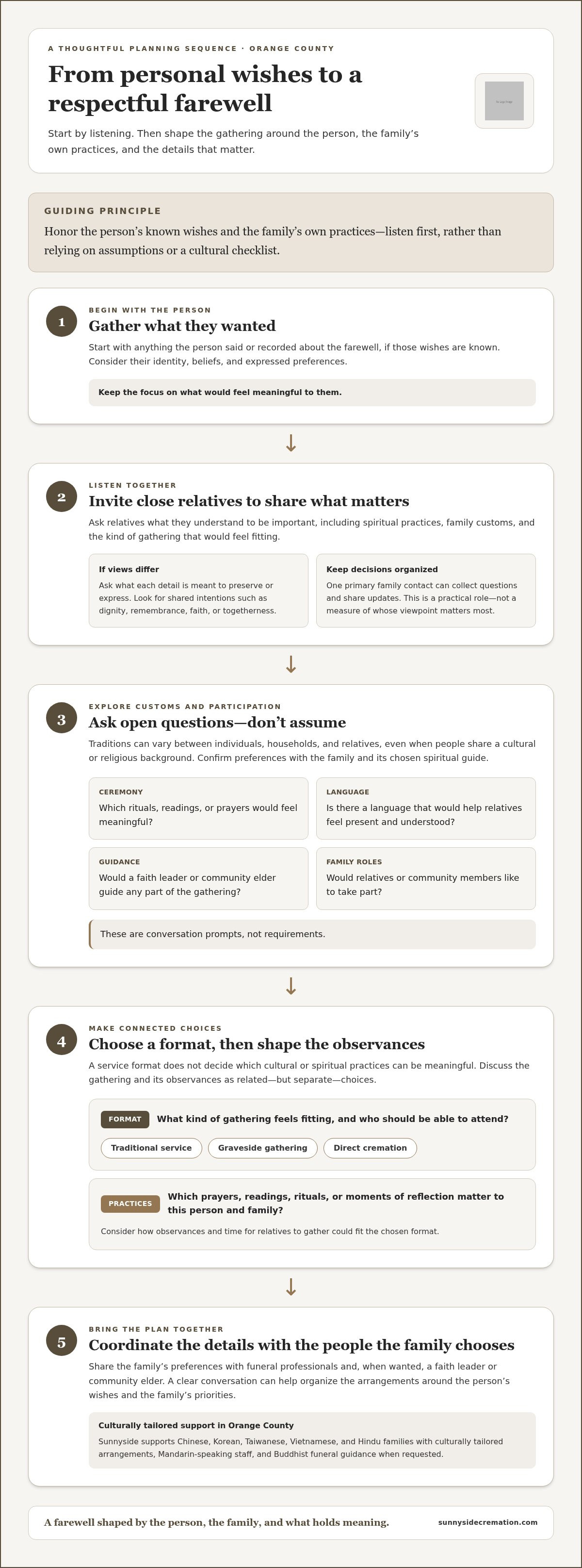
A manageable planning sequence for families in Orange County
Once the family has a clearer sense of its priorities, a steady sequence can make the next decisions feel more manageable. Culturally specific funeral planning doesn’t require every detail to be settled at once. Start with the person’s wishes, agree on family priorities, choose a service format, then coordinate ceremony and local arrangements around those decisions.
What to gather before making arrangements
Bring together information that can guide an initial conversation. It doesn’t need to be perfectly organized. A short list can help relatives and spiritual or community leaders focus on the person and the practices the family wants to honor.
- Any known instructions or expressed preferences about the farewell.
- The names and contact details of close relatives involved in planning.
- Meaningful customs, ceremonies, readings, prayers, or other observances the family wants to discuss.
- Language preferences and whether the family would like a spiritual or community leader involved.
- Questions or differing views the family wants help working through.
Timelines and documentation depend on the circumstances. Instead of relying on general assumptions, organize your questions and discuss the arrangements with your funeral professional, who can clarify the practical steps relevant to your situation.
Coordinating ceremonies and local arrangements
With the family’s priorities in view, decide how the ceremony, burial plans, and participant roles fit together. If a memorial park is part of the chosen arrangements, include its details in the planning conversation. Sunnyside coordinates with Forest Lawn and Rose Hills, helping families organize arrangements in Orange County while keeping the person’s wishes and family practices in focus.
Use this checklist when talking with relatives or a spiritual leader:
- Which wishes or practices should guide the arrangements?
- What service format and burial plans feel appropriate to the family?
- Who would like to participate, and in what way?
- What language or support would help family members take part?
- Which local details need to be coordinated next?
Families considering Chinese traditions alongside arrangements at Forest Lawn can explore a Chinese funeral planning with Forest Lawn guide as they prepare their questions. Sunnyside helps organize culturally tailored arrangements in Orange County. Speak with Sunnyside’s funeral team to discuss your family’s priorities.
Culturally tailored funeral care and a gentle next step
Thoughtful support begins with listening. A family-owned mortuary can help relatives share what matters, organize arrangements, and consider cultural and spiritual needs without treating a community’s traditions as a preset template. For Orange County families, decisions can be shaped around the individual and family, with support coordinating the chosen service details.
Support shaped around each family’s traditions
Sunnyside serves Chinese, Korean, Taiwanese, Vietnamese, and Hindu families with culturally tailored arrangements. These traditions are distinct, and each family brings its own beliefs, preferences, and ways of honoring a loved one. Planning can begin with what the family wants to preserve, whether that involves ceremony, faith practices, language, or participation by relatives and community members.
Families can consider arrangements ranging from direct cremation to traditional services and graveside burial. Mandarin-speaking staff and Buddhist funeral guidance support families for whom those forms of communication or spiritual guidance are meaningful. When a family’s chosen arrangements involve Forest Lawn or Rose Hills, Sunnyside can coordinate with those memorial parks as part of the planning process.
Planning ahead gives relatives an opportunity to share preferences and understand the choices available to them. Families considering arrangements in advance may find an Asian family funeral pre-planning guide helpful as they begin those conversations. Sunnyside also offers pre-planning funeral contracts to help families make arrangements in advance and preserve cultural customs.
Taking the next step with Sunnyside
You don’t need to arrive with every detail decided. Begin by sharing what you know about your loved one’s wishes, which customs matter to your family, and what questions feel most important. A clear conversation can turn those priorities into an organized plan, one decision at a time.
Culturally specific funeral planning is personal, and support should make room for that. If your family is facing arrangements during a time of grief, it’s all right to take the next step gently. Explore Sunnyside’s culturally tailored funeral services and share what you hope the farewell will honor.
Honor your loved one with a plan that feels true to your family
Culturally specific funeral planning begins with listening: to the wishes your loved one shared, the customs your family values, and the different perspectives relatives may bring. Identifying what matters most can help shape a farewell that feels personal, respectful, and manageable.
In Orange County, Sunnyside is a family-owned and operated mortuary serving multicultural families. Its culturally tailored arrangements support Chinese, Korean, Taiwanese, Vietnamese, and Hindu families, with Mandarin-speaking staff, Buddhist funeral guidance, and coordination with Forest Lawn and Rose Hills. Each family’s traditions are distinct, and arrangements can be organized around the wishes and practices that matter to them.
You don’t need to have every answer before beginning. Sharing a few priorities or questions can be a meaningful first step. Learn how Sunnyside can support your family’s funeral plans with thoughtful guidance. Your loved one’s farewell can reflect the life they lived and the care your family holds for them.
Frequently Asked Questions
What does culturally specific funeral planning involve?
Culturally specific funeral planning involves shaping a farewell around the person’s wishes and the practices their family finds meaningful. Families can discuss ceremony format, spiritual observances, language, relatives’ roles, and burial or cremation preferences. Rather than relying on assumptions about a cultural or religious group, begin with what the person expressed and ask family members which customs they want to honor. A spiritual leader can offer guidance if the family wishes.
How can a family honor cultural traditions while respecting the deceased’s wishes?
Start with the person’s known instructions, then invite relatives to explain which traditions feel most important to them. If a preference and a custom seem to conflict, discuss what each represents and whether the ceremony can honor the underlying meaning in another way. A chosen spiritual leader may help the family consider observances. The goal isn’t to follow every custom automatically, but to make thoughtful choices that respect the person and family.
Can funeral traditions vary within the same cultural or religious community?
Yes. People within the same cultural or religious community may practice traditions differently, and individuals may hold personal beliefs that don’t match a family’s expectations. Customs can also vary between relatives and households. That’s why it helps to ask rather than assume: “Is there a practice you’d like included?” or “What would feel meaningful to our family?” These questions make room for differences without treating any one approach as universal.
What should a family discuss with a spiritual leader when planning a funeral?
Ask which prayers, readings, rituals, or forms of participation would be meaningful to the family, and how they might fit the chosen service format. You can also discuss who should lead or take part, language preferences, and questions relatives have about observances. Share the person’s known wishes with the spiritual leader so their guidance reflects the individual, not only general customs. Involving a leader is the family’s choice.
How do families handle different opinions about funeral customs?
Give each close relative space to name one priority, then separate customs the family considers essential from preferences that may be adapted. Keep the person’s known wishes at the center of the conversation while recognizing that relatives may be grieving in different ways. Identifying shared values, such as faith, remembrance, or togetherness, can help guide decisions. A primary family contact can organize questions and updates.
Can a funeral service combine cultural traditions with cremation or burial?
Families can discuss ceremony practices alongside their preferred arrangement, whether that involves cremation or burial. These are related planning choices, but one doesn’t automatically determine the other. Talk through the person’s wishes, the observances that matter, and how relatives or a spiritual leader may participate. Sunnyside supports direct cremation, traditional funeral services, and graveside burial options, with arrangements shaped around the family’s expressed needs and preferences.
How can families arrange culturally respectful funeral services in Orange County?
Begin by gathering the person’s wishes, family priorities, language preferences, and questions for a spiritual leader. Sunnyside Cremation and Funeral is a family-owned mortuary serving multicultural families in Orange County, including Garden Grove, Buena Park, La Mirada, Cerritos, Anaheim, La Habra, Fullerton, Norwalk, Cypress, Artesia, Stanton, Tustin, Orange, Los Alamitos, Westminster, and Irvine. Its culturally tailored arrangements include Chinese, Korean, Taiwanese, Vietnamese, and Hindu services, Mandarin-speaking staff, Buddhist funeral guidance, and coordination with Forest Lawn and Rose Hills.


