

Buddhist cremation rituals can look different from one family to another. A respectful farewell is not necessarily one that follows a fixed sequence. If you’re unsure what should happen before or after cremation, start with the wishes of the person who died and the customs that matter to your family. Practices that are meaningful in one household may not be familiar or appropriate in another.
You don’t have to know every detail to begin planning. This guide describes practices some families choose and offers practical questions to help you decide what fits. Consider which prayers, ceremonies, or family customs matter most, who should help guide those choices, and how to coordinate them with the practical arrangements.
Families may honor a loved one before or after cremation, or choose a quieter form of remembrance. Sunnyside Cremation and Funeral offers Buddhist funeral guidance and culturally respectful support for families in Orange County, helping coordinate arrangements around the loved one’s tradition rather than prescribing one way to say goodbye.
Key Takeaways
- Buddhist cremation rituals can help families honor the person who died and remember them, but practices differ among traditions and households.
- Prayers, chanting, and spiritual guidance are options some families include before or during cremation, not universal requirements.
- Gathering family wishes and speaking with a spiritual advisor can clarify which customs are important and help shape the arrangements.
- In Orange County, Sunnyside’s Buddhist funeral guidance helps families coordinate practical arrangements while reflecting their loved one’s traditions and preferences.
What Are Buddhist Cremation Rituals, and What Do They Honor?
Buddhist cremation rituals are observances some families include in a farewell to honor the person who has died, express care, and give loved ones a meaningful way to remember them. Depending on the family, they may involve prayer, chanting, offerings, reflection, or guidance from a spiritual teacher. There is no single prescribed ceremony for every Buddhist family, and cremation is only one part of the farewell. Families may gather before or afterward, or choose another way to commemorate their loved one.
Across Buddhist communities, honoring the deceased is a shared intention; the customs that express it can differ from one family to another.
Buddhism encompasses many traditions shaped by culture, community, and individual belief. For a broad introduction to this diversity, see this overview of Buddhist funeral practices. It provides context, but it should not be treated as a checklist for a particular family. The wishes of the person who died and the guidance of those closest to them are better starting points for deciding which observances feel right.
What spiritual ideas may shape Buddhist funeral practices?
Ideas such as impermanence, the understanding that life changes, and compassion may inform how some Buddhists approach death and remembrance. These ideas can offer a frame for reflection, but they do not mean every family holds the same beliefs or observes the same rites. Some relatives may find comfort in quiet remembrance, while others may draw on prayers, chanting, or teachings from a spiritual guide. Family members, community elders, and spiritual teachers can help identify observances that feel familiar and respectful.
Do all Buddhist families follow the same cremation customs?
No. Customs may vary with a family’s Buddhist tradition, cultural background, history, and personal wishes. Even relatives from similar backgrounds may make different choices. One family might include a spiritual teacher or community members in a ceremony; another might prefer a private gathering or a simpler farewell. Neither choice should be assumed to represent every Buddhist family.
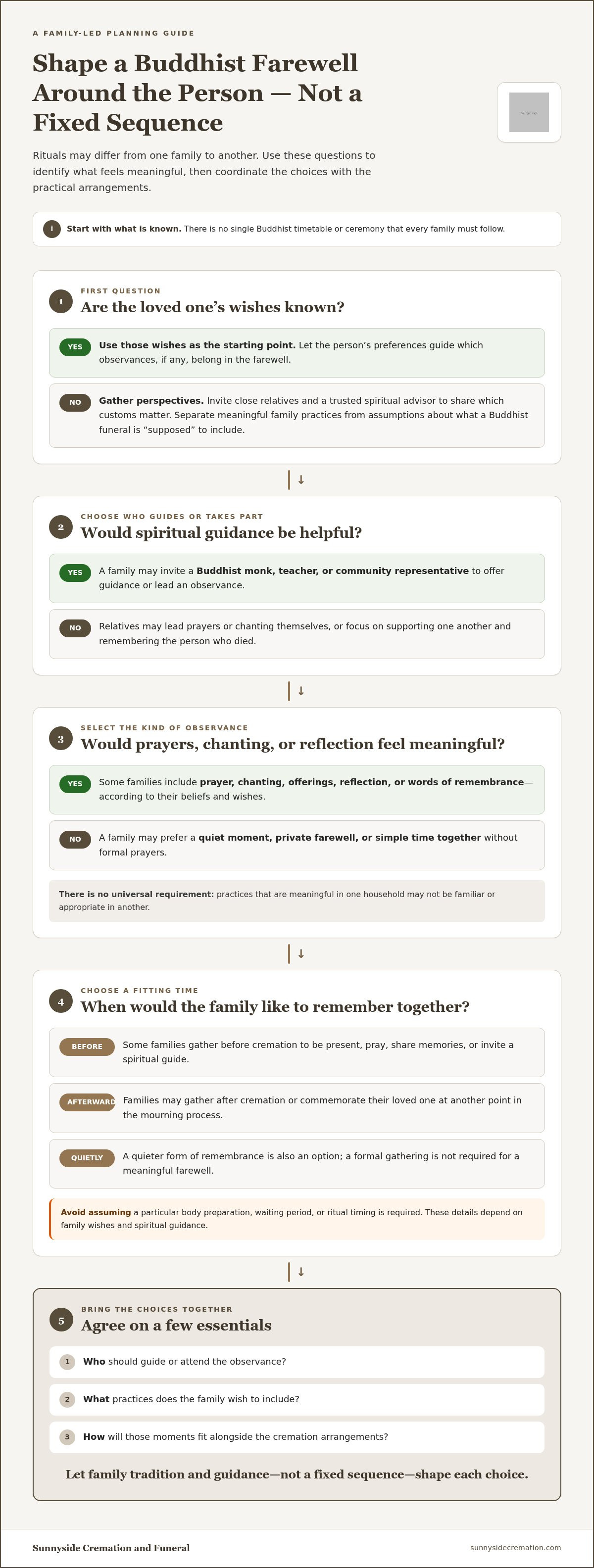
When planning, begin with what the deceased expressed, if their wishes are known. Then invite close relatives and a trusted spiritual advisor to share which observances matter to them. This can help distinguish meaningful family customs from assumptions about what a Buddhist funeral is “supposed” to include. The goal is not to reproduce a universal sequence, but to make space for a farewell that reflects the person’s life and the family’s values.
How Buddhist Rituals May Unfold Before and During Cremation
There is no required Buddhist timetable for a farewell. Depending on the family’s tradition and wishes, observances may take place before cremation, around a gathering, or at another point in the mourning process. One possible arrangement is for relatives to gather, share prayers or words of remembrance, and invite a spiritual teacher or community representative to lead an observance before proceeding with the arrangements they have chosen. This is an example, not a required sequence.
These choices can reflect deeply held beliefs, but they can also be simple and personal. Some families include chanting; others prefer time together without formal prayers. A scholarly analysis of Buddhist death practices explores how understandings and customs differ across Buddhist cultures, offering context without prescribing what any one family should do.
What may happen before the cremation?
Before cremation, some families value an opportunity to be present, pray, or share memories. Others choose a private farewell or a gathering with relatives and community members. Practices involving the body and the timing of observances depend on family wishes and spiritual guidance, so avoid assuming a particular preparation or waiting period is required. If several relatives are involved, discuss what would feel meaningful and who needs to be part of the decision.
Ritual details can also depend on what is practical for the family. Decide who should be present, whether a spiritual guide will participate, and whether you’d like prayers, a few words, or a quiet moment. Sharing those preferences while arrangements are being coordinated helps keep the farewell personal without adding customs that don’t fit your loved one.
What role can monks, teachers, or family members play?
Families may invite a Buddhist monk, teacher, or community representative to offer spiritual guidance or lead an observance. In some households, relatives lead prayers or chanting themselves; in others, family members focus on supporting one another and remembering the person who died. No single role or ceremony is universal. Keep the family’s preferences central when deciding who will participate and how the observance will fit with the arrangements.
A useful way to plan is to agree on a few essentials: who will guide or attend the observance, what practices the family wishes to include, and how those moments fit alongside cremation arrangements. The family’s tradition and guidance, not a fixed sequence, should shape each ritual choice. Sunnyside’s Buddhist funeral guidance helps families coordinate practical arrangements while honoring those preferences with care.
How Buddhist Cremation Practices Differ, and What Families Shouldn’t Assume
Families may share the wish to honor someone who has died yet express that care in different ways. Buddhist cremation rituals can vary in ceremony format, who offers spiritual guidance, whether prayers or chanting are included, and how relatives take part. One family might prefer a gathering led by a spiritual teacher; another may choose a quiet farewell shaped mainly by close relatives. These are possibilities, not customs that apply to everyone.
A person’s cultural background alone does not establish their beliefs. Even within one family or community, people may have different levels of religious practice and different hopes for a farewell. A respectful plan makes room for those differences instead of treating a familiar custom as a requirement.
Which customs may vary by family or Buddhist tradition?
Some families may want a formal ceremony with spiritual leadership, while others prefer a personal gathering with time for reflection. Prayers, chanting, and family participation can also differ. The deceased’s expressed wishes, when known, offer an important starting point. Close relatives and a trusted spiritual advisor can help clarify which practices feel appropriate for this person and family.
If relatives have different expectations, discuss the choices one at a time: who should guide the observance, which prayers or other practices matter, and how family members wish to participate. This makes it easier to distinguish a deeply meaningful custom from a detail someone assumes is necessary. It can also help the family create a farewell that feels welcoming rather than overly complicated.
Which assumptions can make planning less respectful?
Do not assume that every Buddhist family wants identical prayers, timing, or ceremony arrangements. A person’s heritage should not be treated as proof of their personal beliefs. A family may observe some customs, adapt others, or choose a simpler gathering. Presenting uncertain details as religious requirements can add pressure when loved ones are already making many decisions.
When a custom is unclear, frame it as a question for the family or their trusted spiritual guide, not as a rule. Ask what the person wanted, what relatives remember from past family farewells, and which observances would bring comfort. Sunnyside’s Buddhist funeral guidance helps families consider tradition alongside practical planning, while keeping arrangements responsive to their preferences. The aim is not to make every farewell look the same. It is to honor the person with care.
Planning Buddhist Cremation Rituals in Orange County: A Gentle Checklist
Planning can feel more manageable when the family begins with a few clear decisions. In Orange County, families bring many cultural and spiritual experiences to a farewell, so shape arrangements around the person who has died instead of assuming one local custom applies to everyone. A short conversation can help relatives identify what matters most and provide a steady starting point.
What should families decide first?
Begin with the deceased’s known wishes, then gather the family’s preferences. If it feels helpful, choose one relative to keep track of decisions and share updates. A Buddhist teacher or community representative may offer spiritual guidance if the family wishes. Consider how you’d like the ceremony, cremation, and any remembrance gathering to fit together. You don’t need to settle every detail at once; start with the choices that will guide the rest.
How can families coordinate ceremony and cremation details?
A mortuary can help coordinate practical arrangements alongside the family’s preferences. Sharing details early can make planning clearer and help relatives understand what has been decided. Consider discussing:
- Timing: Which dates or times work for the family and any spiritual guide?
- Participants: Who will lead or attend the observance, and who is the family’s main contact?
- Ceremony elements: Would the family like prayers, chanting, quiet reflection, or another form of remembrance?
- Arrangement preferences: How should the ceremony relate to the cremation and any later gathering?
In California, cremation arrangements involve required authorization and documentation. Because procedural details can depend on the circumstances, rely on the mortuary for guidance through the applicable steps rather than treating a general checklist as legal instructions. This allows relatives to focus on spiritual and personal decisions while practical arrangements are coordinated.
As you plan Buddhist cremation rituals, write down agreed choices and questions for a spiritual advisor. Sunnyside’s Buddhist funeral guidance supports families in Orange County with arrangements that reflect individual wishes, not a fixed ritual template. Explore Buddhist funeral guidance for context as you consider a respectful farewell.
Arranging a Respectful Buddhist Cremation with Sunnyside
Planning a farewell while grieving can leave families carrying emotional and practical responsibilities at once. Sunnyside Cremation and Funeral offers Buddhist funeral guidance to help families consider those details with care. As a family-owned mortuary serving Orange County, Sunnyside listens to what matters to the family and helps shape arrangements around those preferences, rather than expecting every farewell to follow one ritual template.
Buddhist cremation rituals are personal as well as spiritual. A family may have specific customs, wish to include guidance from a Buddhist teacher, or prefer a quieter gathering. Sharing those wishes early helps keep arrangements connected to the person being remembered.
How can mortuary coordination support a family’s wishes?
Coordinating practical arrangements alongside family and spiritual guidance can ease some of the planning burden. Sunnyside helps organize funeral and cremation details while taking the family’s preferences into account. That may include keeping track of planned ceremony elements, who will participate, and how the arrangements fit together. The family can focus on the decisions that feel most meaningful without having to hold every logistical detail alone.
Sunnyside also provides culturally specific funeral and cremation arrangements, with Mandarin-speaking staff. This can help families communicate preferences and discuss a farewell in a way that feels comfortable and respectful. Each family’s needs are different, so planning begins with listening rather than assuming what a Buddhist ceremony should include.
What can families expect when they begin planning?
There’s no need to arrive with every choice settled. Families can begin by sharing what they know about their loved one’s wishes, the customs they hope to honor, and the kind of farewell they envision. If a spiritual teacher or community representative is guiding the family, their input can help clarify which observances matter most.
From there, the family and mortuary can discuss practical arrangements in a calm, orderly way. Questions about ceremony details, participants, and timing can be addressed as the plan takes shape. Sunnyside supports the family’s decisions and coordinates arrangements with care, without prescribing a single set of Buddhist cremation rituals.
If you’re beginning to plan a Buddhist funeral or cremation in Orange County, Sunnyside welcomes a conversation about the traditions and preferences you’d like to honor. You can share what matters, ask questions, and take the next steps at a pace that feels manageable.
Shape a Farewell Around What Matters Most
Buddhist cremation rituals can differ from family to family, so a respectful farewell doesn’t need to follow a universal sequence. Begin with your loved one’s known wishes, then consider which customs, spiritual guidance, and moments of remembrance feel meaningful to those closest to them. Clear communication can bring those personal choices together with practical arrangements.
Sunnyside Cremation and Funeral is a family-owned and operated mortuary offering Buddhist funeral tradition guidance and culturally specific arrangements, including support from Mandarin-speaking staff. The team helps families consider their preferences and coordinate arrangements with care, without imposing a fixed ritual template.
If you’re ready to talk through a Buddhist funeral or cremation arrangement in Orange County, speak with Sunnyside about respectful Buddhist funeral and cremation arrangements. Share the wishes and questions you have today, and take each next step with care.
Frequently Asked Questions
What are Buddhist cremation rituals?
Buddhist cremation rituals are observances some families choose to honor a person who has died and support remembrance. They may include prayers, chanting, reflection, or guidance from a spiritual teacher, but none of these practices is universal. Buddhist cremation rituals vary with tradition, family history, and personal wishes. Cremation is one part of a farewell, which may also include gatherings or remembrance in a form meaningful to the family.
Do all Buddhist families choose cremation?
No. Cremation is common in some Buddhist communities, but it isn’t a requirement followed by every Buddhist family. Some choose burial or another form of farewell based on personal beliefs, cultural customs, family circumstances, or the wishes of the person who died. If those wishes are known, they’re a helpful starting point. Relatives and a trusted spiritual advisor can offer guidance without assuming one choice represents all Buddhists.
What happens before a Buddhist cremation?
There isn’t one required sequence before cremation. Some families gather for prayer, chanting, quiet reflection, or time to remember their loved one; others choose a simpler or more private farewell. Practices involving the body and the timing of observances depend on the family’s tradition and spiritual guidance. Relatives can begin by identifying which customs matter to them and sharing those preferences as arrangements are coordinated.
Can family members attend a Buddhist cremation?
Whether relatives attend depends on the family’s wishes and the arrangements being made. Some families value being present for a gathering or part of the farewell, while others prefer to hold a separate remembrance. Attendance and ceremony details can be discussed during planning, keeping the family’s comfort and spiritual guidance in view. There’s no single expectation that applies to every Buddhist family.
Are prayers or chanting required at a Buddhist cremation?
No single prayer or chanting practice is required of every Buddhist family. Some families may invite a monk, teacher, or community representative to guide prayers or chanting; others may choose quiet reflection or a different observance. The person’s expressed wishes, if known, and the family’s guidance can help shape the ceremony. If relatives aren’t sure what feels appropriate, they may seek direction from a trusted spiritual advisor.
What happens to ashes after a Buddhist cremation?
Families decide how they wish to care for cremated remains, guided by personal preferences, family customs, and any spiritual counsel they value. Some may keep the remains in an urn, while others may consider interment or scattering where permitted. These choices aren’t the same for every Buddhist tradition or household. If considering a particular option, families can discuss practical arrangements and applicable local requirements with their mortuary.
How can I arrange Buddhist cremation services in Orange County?
Start by sharing your loved one’s known wishes, the customs you hope to honor, and whether a Buddhist teacher or community representative will guide the farewell. Sunnyside Cremation and Funeral offers Buddhist funeral guidance and culturally specific arrangements, with Mandarin-speaking staff. The family-owned mortuary serves Orange County communities including Garden Grove, Buena Park, La Mirada, Cerritos, Anaheim, La Habra, Fullerton, Norwalk, Cypress, Artesia, Stanton, Tustin, Orange, Los Alamitos, Westminster, and Irvine.


