

Hindu funeral ceremony planning can feel difficult when customs vary between families and religious, cremation, venue, and timing arrangements all need attention. A respectful plan begins with your family’s beliefs, not a standard checklist.
It’s understandable to want meaningful traditions honored while making practical decisions during a painful time. You don’t have to assume one set of customs applies to everyone. Start by speaking with close family members and your priest or pandit about the rituals and preferences that matter most.
This guide covers ceremony choices, cremation coordination, timing, and what to ask a funeral provider in California. Sunnyside Cremation and Funeral is a family-owned California mortuary serving Orange County, with a Hindu cremation package and a team that can help coordinate funeral details around your family’s stated traditions and preferences.
Key Takeaways
- Begin Hindu funeral ceremony planning by identifying the traditions and preferences your family wants to prioritize.
- Ask family members and a priest or pandit which possible rites, prayers, or readings are appropriate for your family.
- Compare ceremony settings by considering religious guidance, family needs, and the arrangements each provider or facility can currently accommodate.
- Separate religious choices from practical questions about providers, venues, scheduling, and coordination so each decision is easier to discuss.
- Learn how Sunnyside’s family-owned care and Hindu cremation package may fit into funeral arrangements in Orange County.
Planning a Hindu Funeral Ceremony in California: Start With Your Family’s Wishes
There is no need to settle every detail at once. Begin with the beliefs and wishes that feel most important, then work through practical arrangements one decision at a time. Hindu practices vary across families and communities, so a respectful ceremony does not have to follow a single prescribed sequence. Listen, ask questions, and coordinate arrangements around the family’s choices.
Start by clarifying a few points: Which customs does the family consider essential? Who will provide religious guidance? What setting feels appropriate? Is the family considering cremation or burial? These answers can guide later decisions about timing, participants, and coordination. For background, the overview of Antyesti (Hindu funeral rites) describes the Hindu funeral rite and its significance. A family’s own religious guide can help interpret what is meaningful for them.
Respectful planning is family-led coordination: honor the beliefs of the person who died by asking what matters, seeking trusted guidance, and arranging practical details around those choices.
Which family and religious preferences should you clarify first?
Ask close relatives which customs they hope to include and who should guide religious decisions. Confirm preferred language, prayers, readings, and participants instead of assuming these details are the same for everyone. If a practice is unfamiliar or relatives disagree about it, note the question and bring it to a priest or another trusted religious guide. A brief written list helps keep the discussion focused and makes it easier to revisit unresolved choices.
Who should help coordinate the ceremony?
Choose one family contact to gather preferences and share updates, giving relatives a clear point of communication. Ask the religious guide about their role, preferred timing, and ceremony recommendations. Then speak with a funeral provider about its coordination role, what it can arrange, and which details must be confirmed with a venue or cremation facility. Keep religious decisions distinct from practical arrangements, while allowing each to inform the other.
Before contacting providers, write down the family’s current preferences and open questions:
- Family priorities: customs that feel essential and the people who should be included in decisions.
- Religious guidance: the priest or trusted guide to consult, plus questions that still need answers.
- Ceremony preferences: desired setting, language, prayers, readings, and participants.
- Disposition wishes: whether the family is considering cremation or burial.
These notes do not need to be final. They give the family and its chosen helpers a practical starting point for Hindu funeral ceremony planning, while leaving room to confirm details and adjust the plan as decisions unfold.
Hindu Funeral Customs and Ceremony Elements: Confirm What Fits Your Family
Hindu funeral customs are not a single checklist. Practices and preferences can differ between families and communities, and religious guidance may shape what feels appropriate. A puja, the recitation of mantras, or selected readings may be part of a ceremony, but none should be treated as a requirement for every Hindu family. For broader background, Harvard University’s Pluralism Project discusses the core beliefs of Hinduism. A family’s religious guide can help connect that background with its own observances.
Puja, mantras, readings, and particular ceremony roles are possibilities to discuss. Confirm what is appropriate or expected with the family and its religious guide. This helps prevent well-meant assumptions from turning into pressure. Invite relatives to share what feels meaningful, then raise questions with someone familiar with the family’s tradition.
How can families choose prayers, readings, and participants?
Ask whether the family would like particular prayers, devotional practices, or readings. Confirm wording and language with the religious guide, especially if relatives have different preferences or are unsure what a prayer means. Discuss potential roles with family and community members, too. Participation should be an invitation, not an obligation. Relatives may want to honor their loved one in different ways, including by attending without taking on a ceremony role.
How should cremation preferences fit into ceremony planning?
Discuss how the family wants the ceremony to relate to cremation. Some families may prefer a ceremony beforehand, others may want elements connected with cremation, and some may choose a separate gathering. These are options to explore, not a universal sequence. Ask the religious guide what order fits the family’s observances, then confirm with the provider and facility which arrangements can be accommodated.
For local information about related arrangements, see Sunnyside’s Hindu cremation services guide. When comparing options, ask providers what they can coordinate and what needs confirmation with the religious guide or facility. Sunnyside offers a Hindu cremation package. Families can learn about Hindu cremation arrangements as they consider what may fit their preferences.
Choosing Ceremony and Cremation Arrangements in Orange County
Once the family has identified its priorities, compare settings by how well they support those wishes. A funeral home, a religious or community venue, or a ceremony connected with cremation may each be worth asking about. Suitability depends on the family’s needs and the provider’s and facility’s current arrangements. The Hindu American Foundation’s overview of Hindu perspectives on death offers additional context. The family’s religious guide can advise on its specific observances.
Use the questions below as a starting point, not as an assumption that every location offers the same options. Religious choices belong to the family and its guide. A funeral provider can explain its coordination role, describe possible arrangements, and identify details that need confirmation.
| Possible arrangement | Questions to ask | Details to confirm |
|---|---|---|
| Ceremony at a funeral home | Can the preferred ceremony elements be accommodated? What guest access and timing are possible? | Permitted elements, facility procedures, scheduling, and any access considerations. |
| Ceremony at a religious or community venue | Does the family’s religious guide recommend this setting? Who will coordinate with the venue? | Venue availability, guest arrangements, timing, and any rules affecting the ceremony. |
| Ceremony connected with cremation | Which parts does the family want coordinated with cremation, and what role does the provider handle? | Facility arrangements, scheduling, documentation, and the sequence advised by the religious guide. |
| Separate ceremony and cremation arrangements | Would the family prefer a gathering apart from the cremation arrangements? | Locations, timing between arrangements, and who will communicate changes to relatives. |
What should families ask about ceremony settings?
When contacting a venue or provider, describe the ceremony elements the family hopes to include. Ask about guest access, timing, permitted practices, and facility procedures. Find out who will confirm each point, then check the answers with the people responsible for the location. Availability and procedures can vary, so confirm current details directly rather than assuming Orange County venues offer identical choices.
How can families compare cremation arrangements respectfully?
Ask the provider to explain its coordination role, possible timing, and which decisions remain with the family. Before making plans, verify documentation, facility, and scheduling details with the provider. Requirements depend on the arrangements being considered and should be confirmed directly. A family-owned Orange County mortuary such as Sunnyside may be one coordination partner to consider. Families can review its Hindu cremation arrangements and ask which details can be coordinated around their preferences.
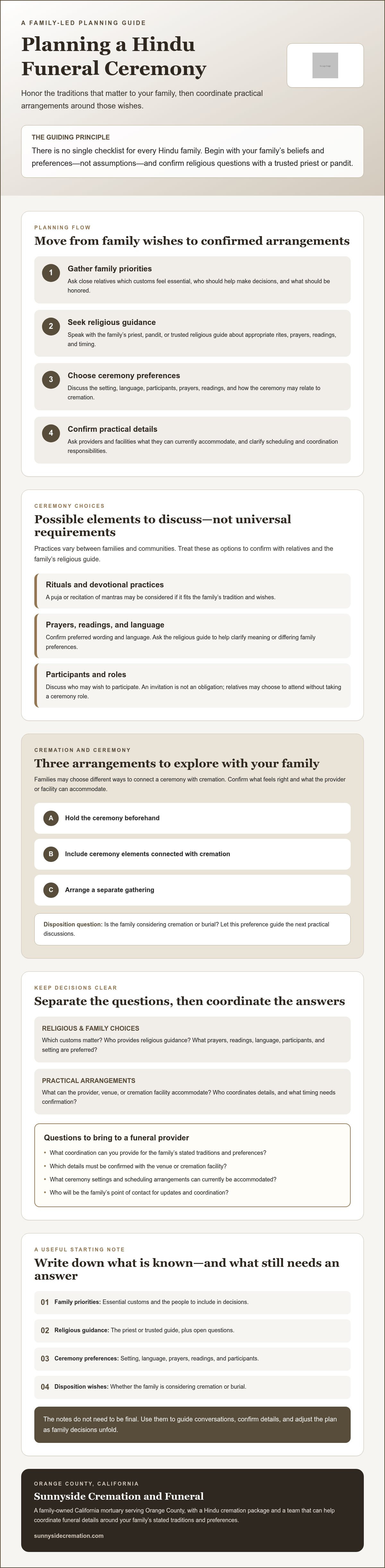
A Step-by-Step Hindu Funeral Ceremony Planning Checklist for California
A written checklist helps relatives share decisions without treating every question as urgent. Keep religious preferences in one part of the plan and provider, venue, and scheduling details in another. The family’s choices guide Hindu funeral ceremony planning, while providers and relevant authorities can help confirm practical requirements.
- Gather family preferences. Ask close relatives what they hope to honor and note where views differ. Don’t assume everyone has the same expectations or that agreement has already been reached.
- Choose a family contact. Identify one person to gather updates, communicate decisions, and keep a shared record that relatives can review.
- Consult the religious guide. Confirm preferred ceremony elements, participants, readings, and language with the priest or trusted guide. Record unresolved questions and ask for guidance before treating any practice as required.
- Settle the family’s ceremony and disposition preferences. Discuss the preferred setting and whether the family is considering cremation or burial. Ask the religious guide how the ceremony choices may relate to those wishes.
- Speak with a funeral provider. Ask which Hindu-related arrangements the provider can coordinate. Distinguish confirmed services from requests that still need approval or coordination with a venue or facility.
- Confirm practical details. Review proposed timing, venue procedures, cremation coordination, and the information the provider needs. Ask who will communicate updates and how changes will be shared with the family.
- Verify local requirements. Confirm current California and county documentation, timing, and facility procedures with the provider and the appropriate authority. Don’t rely on assumptions or information that may not reflect the arrangements being considered.
- Review the plan together. Share current decisions with the family contact, religious guide, provider, and anyone else who needs to act on them. Mark unanswered questions clearly and confirm changes as they arise.
If relatives have different expectations, distinguish firm preferences from open questions. A shared record can identify who will follow up, rather than forcing the family to settle every disagreement immediately. Keep the religious guide’s recommendations separate from provider and venue confirmations, then bring the information together when reviewing the plan.
Save or share: Start with family wishes, confirm religious choices with a trusted guide, coordinate practical details with the provider, and verify California and county procedures with the appropriate sources.
Families considering a provider for these arrangements can learn about Sunnyside’s Hindu cremation package and ask which details can be coordinated around their stated preferences.
How Sunnyside Can Help Coordinate Hindu Funeral Arrangements in Orange County
After considering religious preferences, ceremony settings, and practical questions, families may want to speak with a provider about coordination. Sunnyside Cremation and Funeral is a family-owned California mortuary serving Orange County and offers a Hindu cremation package. Its team can help coordinate funeral details with respect for the customs and preferences the family identifies.
Begin that conversation with your family’s wishes, not assumptions about what every Hindu ceremony includes. Share guidance from a priest or other religious guide, describe the ceremony elements you hope to arrange, and ask which requests the team can currently support. Confirm what is included in the package and what may need separate coordination with a venue or facility.
What can families discuss with Sunnyside?
Bring a short list of priorities and open questions. You might discuss the preferred ceremony setting, how the ceremony relates to cremation, religious guidance, and any timing or facility questions. Ask who will coordinate each detail and which arrangements need confirmation elsewhere. Clear answers help relatives understand what is settled and what remains undecided.
A provider can explain its coordination role, but the family and its religious guide determine which customs and ceremony elements are meaningful. If relatives have differing preferences, share that context and ask what options may be possible rather than expecting one standard arrangement to suit everyone.
How can families plan ahead for future arrangements?
Planning ahead can give relatives a written record of preferences to refer to during future discussions. Families may note religious guidance, desired ceremony elements, and questions to revisit with a provider. Sunnyside offers pre-planning funeral contracts; ask how current options work and which preferences can be recorded. For broader planning context, see the funeral pre-planning guide for Asian families.
Whether arrangements are needed now or considered for the future, Hindu funeral ceremony planning can begin with a conversation. Sunnyside Cremation and Funeral’s team can discuss the family’s stated traditions, its Hindu cremation offering, and current coordination details for Orange County. You can ask questions before every decision is settled.
Honor Your Loved One With a Plan That Reflects Your Family
Hindu funeral ceremony planning can feel more manageable when you begin with what matters most to your family. Customs and preferences differ, so confirm meaningful ceremony elements with relatives and a trusted religious guide rather than relying on assumptions. Then work through practical questions about the setting, cremation arrangements, timing, and current provider or facility requirements.
A clear family contact and shared record of decisions can help keep everyone informed as details take shape. Ask a funeral provider which arrangements it can currently coordinate and what needs confirmation elsewhere.
Sunnyside Cremation and Funeral is a family-owned mortuary serving Orange County communities and offers a Hindu cremation package. To discuss your family’s preferences and ask about current arrangements, contact Sunnyside about Hindu funeral arrangements. Take the next step at your own pace. Your family’s wishes can guide the way forward.
Frequently Asked Questions
How do you plan a Hindu funeral ceremony in California?
Start by asking close relatives which customs and ceremony elements feel important, then consult the family’s priest or trusted religious guide. Choose a family contact to track decisions and share updates. Discuss the preferred setting and cremation or burial wishes, then ask providers about coordination, timing, and facility arrangements. Verify current California and county procedures with the relevant provider or authority, since details should be confirmed for your situation.
What happens during a Hindu funeral ceremony?
There isn’t one sequence followed by every Hindu family. Depending on family and religious guidance, a ceremony may include prayers, mantras, readings, or participation by relatives, with cremation included in the arrangements or handled separately. Some families may observe additional rites. Ask the family’s religious guide which elements fit their observances, then confirm ceremony choices with relatives and the provider so the plan reflects the person being honored.
Do all Hindu families follow the same funeral customs?
No. Hindu funeral customs and preferences can differ across families, communities, and religious guidance. One family may consider a particular prayer or ceremony role important, while another may choose different practices. Avoid treating examples as requirements. Ask close relatives what feels meaningful, and bring uncertain questions to a priest or trusted religious guide. This helps the family make choices with care, without assuming one tradition represents every Hindu family.
Can a Hindu funeral ceremony take place before cremation?
Yes, a family may ask about holding a ceremony before cremation, but the preferred sequence depends on its religious guidance and current provider and facility arrangements. Some families may choose a ceremony connected with cremation or a separate gathering instead. Tell the provider which parts the family hopes to coordinate, then confirm timing and facility procedures directly. A priest or trusted religious guide can advise whether the proposed sequence fits the family’s observances.
How long does a Hindu funeral ceremony usually last?
There isn’t a single duration that applies to every Hindu funeral ceremony. The length can depend on the rites the family chooses, the religious guide’s recommendations, and arrangements at the selected venue or facility. Ask the priest or trusted religious guide how much time the planned observances may require, then confirm the schedule with the provider and venue. Build the timing around the family’s choices rather than relying on a general estimate.
What should I ask a funeral home when planning a Hindu cremation in Orange County?
Ask which Hindu-related arrangements the provider can currently coordinate, what details need confirmation with a venue or facility, and who will share updates if plans change. Confirm timing, procedures, and required information directly. Sunnyside Cremation and Funeral is a family-owned mortuary serving Orange County communities, including Garden Grove, Buena Park, La Mirada, Cerritos, Anaheim, La Habra, Fullerton, Norwalk, Cypress, Artesia, Stanton, Tustin, Orange, Los Alamitos, Westminster, and Irvine. Sunnyside offers a Hindu cremation package.
Can family members choose which prayers or readings are included?
Families can discuss preferred prayers, readings, language, and participants with their religious guide and provider. The guide can help confirm wording and whether a requested element is appropriate for the family’s observances. Relatives may be invited to participate without pressure to take on a role. If family members have different preferences, record the questions and talk them through together rather than assuming there is already agreement. To discuss your family’s preferences and ask about Sunnyside’s Hindu cremation package, contact Sunnyside Cremation and Funeral.


