

What if honoring Vietnamese traditions didn’t mean carrying every arrangement alone? For families in Garden Grove, Westminster, and nearby communities, choosing among Vietnamese memorial service options can raise an important concern: Will the rites that matter to our family be respected while the practical details are handled clearly?
That concern is understandable. A service may involve family customs, faith, burial or cremation preferences, and coordination with a memorial park such as Forest Lawn. When language differences add another layer, it helps to have a knowledgeable point of contact who can explain the choices and keep arrangements organized.
This guide explores how families can bring Vietnamese funeral practices together with practical planning in Southern California. You’ll find considerations for comparing burial and cremation, questions to ask about Buddhist or Catholic services, and ways to clarify ceremony details, language support, and paperwork. Whether you’re planning in Garden Grove or Westminster, a thoughtful plan can help your family honor your loved one while making the next steps more manageable.
Key Takeaways
- Learn how filial piety shapes Vietnamese memorial traditions and why honoring ancestors may continue beyond the funeral.
- Understand how preparation and coffining rituals may be incorporated, and which details to discuss with your family and funeral provider.
- Compare Vietnamese memorial service options by considering burial, cremation, faith, and the family’s wishes for participating in the farewell.
- See what to plan when arranging services near Garden Grove, Westminster, or Santa Ana, including coordination with Forest Lawn or Rose Hills.
- Explore how a specialized Vietnamese funeral package and a clear point of contact may help keep cultural and logistical details organized.
The Significance of Vietnamese Memorial Traditions in 2026
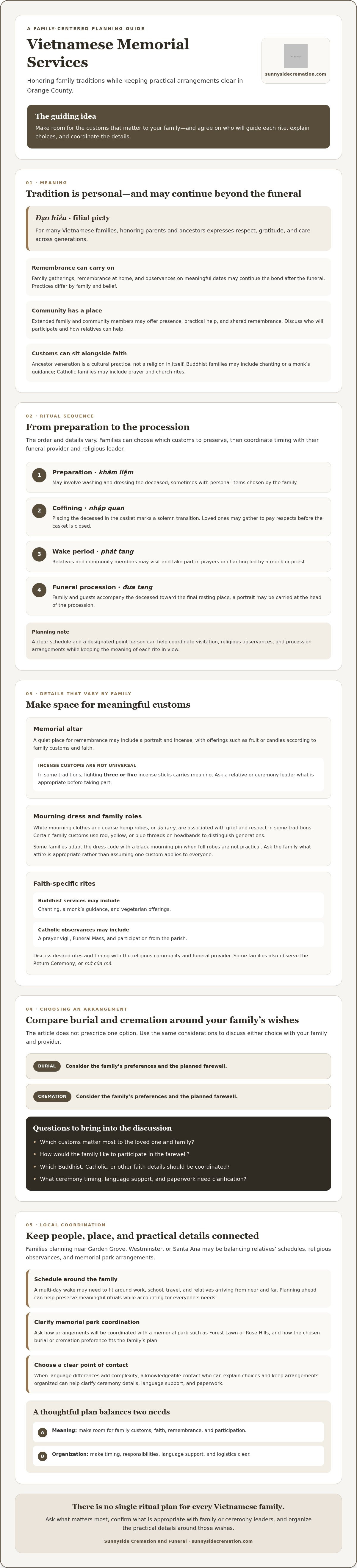
For many Vietnamese families, a funeral is not only a farewell. It is an expression of Đạo hiếu, or filial piety: the enduring responsibility to honor parents and ancestors with respect, gratitude, and care. Funeral rites give loved ones a way to grieve together while affirming the bond between generations.
That bond may continue after the funeral through remembrance at home, family gatherings, and observances on meaningful dates. Ancestor veneration is a way of life for many households, though practices differ by family and belief. In Orange County, families may be balancing a multi-day wake with work, school, travel, and relatives arriving from near and far. Planning the schedule in advance can help preserve meaningful rituals while accounting for everyone’s needs.
Extended family and community members also have an important place in mourning. Their presence, practical help, and shared remembrance can support close relatives as they honor the person who died. When considering Vietnamese memorial service options, discuss which customs matter most, who will guide each rite, and how relatives can participate.
Ancestral Veneration and Religious Rites
Ancestor veneration is a shared cultural practice, not a religion in itself. Buddhist families may include chanting or guidance from a monk, while Catholic families may incorporate prayer and church rites. These traditions can sit alongside family customs, with details shaped by the loved one’s wishes and the family’s community. Some families observe the Return Ceremony, or mở cửa mả, as a ritual bridge between the world of the living and the spirit of the deceased.
The Role of the Memorial Altar
A memorial altar can provide a quiet place for remembrance. Families may display a portrait and incense, along with offerings such as fruit or candles, according to their customs and faith. Guests should follow the family’s guidance. In some traditions, lighting three or five incense sticks carries meaning. Because practices vary, ask a relative or ceremony leader what is appropriate before taking part.
There is no single schedule or ritual plan for every Vietnamese family. A respectful service makes room for meaningful customs and communicates clearly about timing and participation. That balance can help younger relatives understand not only what is being done, but why these acts of remembrance matter.
Key Rituals: From Coffining to the Funeral Procession
Vietnamese funeral rites give family members ways to care for the deceased and accompany one another through grief. The sequence and details vary by family, faith, and practical circumstances. Relatives can decide which customs they want to preserve, then discuss timing with the funeral provider and religious leader.
Preparation, known as khâm liệm, may involve washing and dressing the body, sometimes with personal items chosen by the family. During the coffining ceremony, or nhập quan, placing the deceased in the casket marks a solemn transition. Loved ones may gather to pay their respects before the casket is closed. A wake period, often called phát tang, allows relatives and community members to visit and take part in prayers or chanting led by a monk or priest. The funeral procession, đưa tang, accompanies the deceased toward the final resting place; a portrait may be carried at its head.
These acts reflect traditions of remembrance. Pew Research Center’s report on Ancestor veneration practices offers broader context on how such customs are observed in Vietnam. For families in Orange County, a clear schedule and a designated point person can help coordinate visitation, religious observances, and procession arrangements while keeping the meaning of each rite in view.
Traditional Mourning Dress and Family Roles
White mourning clothes and coarse hemp robes, or áo tang, are associated with grief and respect in some Vietnamese traditions. Headband colors may distinguish relatives’ generations, with red, yellow, or blue threads used in certain family customs. These details aren’t universal. Some families adapt the dress code with a black mourning pin when full robes aren’t practical. Ask the family what attire is appropriate instead of assuming one custom applies to everyone.
Buddhist and Catholic Service Traditions
Buddhist services may include chanting, a monk’s guidance, and vegetarian offerings, while Catholic observances may involve a prayer vigil, Funeral Mass, and participation from the parish. Discuss the desired rites and timing with the religious community and funeral provider. In Garden Grove, a funeral home familiar with Vietnamese services can offer guidance on Buddhist ceremony arrangements. Confirm directly how coordination with a particular temple or church will be handled.
For families comparing Vietnamese memorial service options, careful coordination can make room for important rituals and the practical needs of relatives. Sunnyside offers Vietnamese funeral packages and Buddhist ceremony guidance. Families can learn more about Vietnamese funeral arrangements and ask which details can be tailored to their customs.
Comparing Vietnamese Memorial Options: Burial vs. Cremation
Choosing burial or cremation is personal, and neither choice is less respectful of Vietnamese traditions. Some families prefer burial because a gravesite offers a place to visit and care for over time. Others choose cremation to reflect their preferences and practical circumstances. Either choice can leave room for prayer, family participation, and remembrance. This overview of Vietnamese death rituals describes customs surrounding funerals and later observances.
Traditional Graveside Burial
Burial may feel meaningful to relatives who value a lasting place for Thăm mộ, or visiting the grave. Planning typically involves choosing a casket, confirming cemetery requirements such as whether a vault is needed, and coordinating the graveside service. In some families, loved ones place a handful of earth or rice into the grave as a final gesture of farewell. Customs vary, so ask relatives or a religious leader what is appropriate. Families incorporating Buddhist rites can explore Buddhist funeral services in Orange County.
Cremation and Family Participation
Cremation can be arranged with different service plans. A simpler arrangement may take place without a traditional visitation beforehand, while another plan may include a wake or ceremony before cremation. Some families ask about witnessed cremation, which allows relatives to be present for part of the process and may provide a meaningful moment of participation or closure. Availability and procedures differ, so confirm what the provider and facility can accommodate rather than assuming it is included.
After cremation, families may consider keeping ashes in an urn, placing them in a columbarium, or choosing another arrangement that reflects their beliefs and preferences. Ask whether a particular temple or memorial location accepts placements and what its requirements are. For another planning consideration, see this guide to affordable cremation in Orange County.
A Practical Way to Reach a Family Decision
Give each concern room in the conversation. Families can compare options by asking:
- Tradition: Which rites, religious observances, or forms of remembrance matter most?
- Practical needs: What can relatives attend, and which cemetery or facility arrangements need confirmation?
- Budget: What do the written package details include, and what additional charges should the family review?
- Consensus: What wishes did the deceased express, and how can close relatives reach a decision together?
Sunnyside offers Vietnamese funeral packages and coordinates with Forest Lawn and Rose Hills. Ask for clear explanations of burial and cremation arrangements, including which ceremony elements are available and how they fit the family’s wishes.
Navigating Logistics in Orange County and Little Saigon
In Orange County, the choice of mortuary and memorial location can affect how easily relatives travel between a wake, religious service, and cemetery. Families in Garden Grove, Westminster, Buena Park, and Santa Ana may want to consider where close relatives live, parking and travel needs, and whether the service location fits their plans. A local point of contact can help connect the arrangements when a ceremony involves several venues.
The Cáo Phó, or death announcement, is another practical detail. Families may share it through Vietnamese-language media, community networks, or other channels their relatives use. Confirm the wording, service details, and preferred language with the family before submitting it. Check the publication’s deadlines and requirements directly.
Coordinating with Forest Lawn and Rose Hills
Working with a large memorial park may involve confirming service arrangements, timing, and site-specific guidelines. A local mortuary can help communicate the family’s plans and clarify what the park can accommodate. For example, ask in advance whether incense or other cultural elements are permitted in the chosen space, and whether there are restrictions on setup or procession timing. For another perspective on coordinating culturally specific services at a major cemetery, see this guide to Chinese funeral planning with Forest Lawn.
Funeral processions also benefit from clear coordination. Confirm the departure point, destination, timing, and how participating vehicles should follow the route. If the procession passes through local neighborhoods, share practical instructions with attendees beforehand and check whether route or traffic arrangements need to be confirmed with the relevant parties.
Death Certificates and Family Paperwork
Death certificates may be needed for personal, financial, or family matters. A funeral provider can explain what information is needed to register the death and how certified copies may be requested through the appropriate Orange County vital-records office. Ask about the current process and expected processing time rather than relying on an estimate that may not apply to your circumstances.
If relatives expect to use records for property or inheritance matters in Vietnam, ask the relevant Vietnamese authority or legal adviser which documents, translations, or authentication steps are required. The number of copies needed depends on the family’s circumstances, so identify likely uses before placing an order.
Because Sunnyside coordinates with Forest Lawn and Rose Hills, families can ask about memorial arrangements and park coordination while discussing Vietnamese memorial service options in Orange County.
Personalized Vietnamese Funeral Packages at Sunnyside
A culturally meaningful funeral depends on more than selecting a service. Families may be weighing religious customs, language needs, burial or cremation, and arrangements with relatives across generations. Sunnyside is a family-owned Orange County mortuary offering Vietnamese funeral packages, Buddhist ceremony guidance, and coordination with Forest Lawn and Rose Hills. For families in Garden Grove, Westminster, Buena Park, and nearby communities, a point of contact can help keep the many details connected.
Language support matters, too. Sunnyside has Mandarin-speaking staff. Ask directly which language assistance is available for your specific needs, especially when elders or relatives who don’t speak English are involved. Clear explanations can help everyone understand the choices and share their wishes.
Why Families Choose Sunnyside in Garden Grove
Families can discuss the traditions they hope to include, the kind of service they want, and the practical arrangements involved. Sunnyside offers Buddhist ceremony guidance. Families planning Catholic rites can clarify their preferences and ask how coordination with their parish will work. A dedicated point of contact can help organize conversations about the mortuary, ceremony, and cemetery, including Forest Lawn or Rose Hills. Learn more about choosing a Vietnamese funeral home in Orange County.
The Peace of Mind in Pre-Planning
Pre-planning gives a person time to record preferences and talk them through with family, rather than leaving loved ones to interpret every detail during a difficult period. Sunnyside offers pre-planning funeral contracts. Contract terms vary, so review the written agreement to understand what is covered, how pricing is handled, and whether changes are possible. Don’t assume a contract locks in a particular price unless its terms clearly say so.
Consider documenting preferences such as burial or cremation, religious observances, incense, chanting, and mourning attire. These notes can guide relatives, though the family should confirm details with the chosen religious leader and provider. Planning ahead may also help relatives discuss differences early and understand the person’s wishes. For more considerations, see this guide to funeral pre-planning for Asian families.
Among the Vietnamese memorial service options available to a family, the right plan is one that reflects the loved one’s beliefs and gives relatives a clear way to participate. A calm conversation about cultural, language, and contract needs can be a meaningful first step toward preserving traditions for the next generation.
Honor Their Legacy with a Thoughtful Plan
A meaningful farewell can honor family traditions while making room for the practical needs of relatives. As you consider Vietnamese memorial service options, focus on the customs that matter most, the family’s wishes for burial or cremation, and how loved ones can take part. Clear communication about ceremony details and arrangements can help bring everyone together around a respectful plan.
Sunnyside Cremation and Funeral is family-owned and offers specialized Vietnamese funeral packages, along with Buddhist ceremony guidance. The team also coordinates with Forest Lawn and Rose Hills, helping families manage important arrangements with a personal point of contact. Each family’s beliefs and preferences are unique, and discussing them can help preserve meaningful traditions for the next generation.
If you’re ready to discuss arrangements, contact Sunnyside Cremation and Funeral to plan a respectful Vietnamese memorial. Share your family’s cultural and service preferences to start a conversation about the available options.
Frequently Asked Questions
How long does a traditional Vietnamese funeral service typically last?
A traditional Vietnamese funeral often lasts several days, though the length depends on family customs, religious observances, and practical arrangements. A wake may include visitation and prayers, followed by the funeral procession and burial or cremation. Families can discuss which rites are most important and how relatives can participate. If work or travel limits the schedule, ask the funeral provider and religious leader about adapting arrangements respectfully.
Why do mourners wear white headbands at Vietnamese funerals?
White headbands are a traditional sign of mourning and respect for the deceased. In some families, mourning attire also reflects a relative’s relationship or generation, and customs may include different colors or styles of headbands. Practices aren’t identical across all Vietnamese families. If you’re attending, follow the family’s guidance on dress. If you’re unsure, ask a relative beforehand rather than assuming one custom applies.
Can we have a traditional Buddhist ceremony if we choose cremation?
Yes. A Buddhist ceremony can be held before cremation, and families may arrange chanting or guidance from a monk as part of the service. The sequence and specific rites depend on the family’s beliefs, the monk, and what the funeral provider and cremation facility can accommodate. Sunnyside offers Buddhist ceremony guidance. Discuss your preferences early so the family can confirm available arrangements and timing.
What is the Return Ceremony or Opening the Grave (mở cửa mả)?
The Return Ceremony, also called Opening the Grave, is a ritual observed by some Vietnamese families after burial. It is associated with visiting the grave and honoring the deceased, but its timing and meaning can vary with family and religious traditions. Ask an elder or religious leader whether it is part of your family’s practice and how it should be observed. It isn’t a universal rite for every Vietnamese funeral.
Is it customary to bring money or flowers to a Vietnamese memorial service?
Guests may bring flowers or offer a condolence contribution, but expectations vary by family and community. White flowers, including chrysanthemums, are traditional choices for expressing grief and respect; the family may share preferences about arrangements or where to send them. If you’re considering a monetary gift, ask a family member how contributions are being received. A sincere expression of sympathy and respectful presence are also meaningful.
How do we coordinate a service at Sunnyside with a burial at Forest Lawn?
Tell Sunnyside that the family is considering burial at Forest Lawn and share the preferred service and cultural arrangements. Sunnyside coordinates with Forest Lawn and can help connect the mortuary and memorial park details. Confirm timing, cemetery requirements, and any cultural requests directly with the teams involved. Sunnyside serves families in Garden Grove, Buena Park, Westminster, La Mirada, Cerritos, Anaheim, La Habra, Fullerton, Norwalk, Cypress, Artesia, Stanton, Tustin, Orange, Los Alamitos, and Irvine.
What should I say to a grieving family at a Vietnamese funeral?
Speak simply and sincerely. You might say, “I’m sorry for your loss,” “Your loved one will be remembered,” or “I’m here to support your family.” A quiet bow or respectful presence may also communicate care. Follow the family’s lead around religious customs and conversation, and don’t feel you need perfect words. Offering practical help, such as bringing a meal, can be thoughtful if the family welcomes it.
Does Sunnyside provide assistance with Vietnamese language death announcements?
Sunnyside has Mandarin-speaking staff, but assistance preparing or placing Vietnamese-language death announcements is not specified. Ask the team directly whether it can help with wording, translation, or sharing an announcement, and confirm any publication’s requirements yourself. Families may also ask relatives or community contacts to review names, service details, and spelling before submitting an announcement.


