

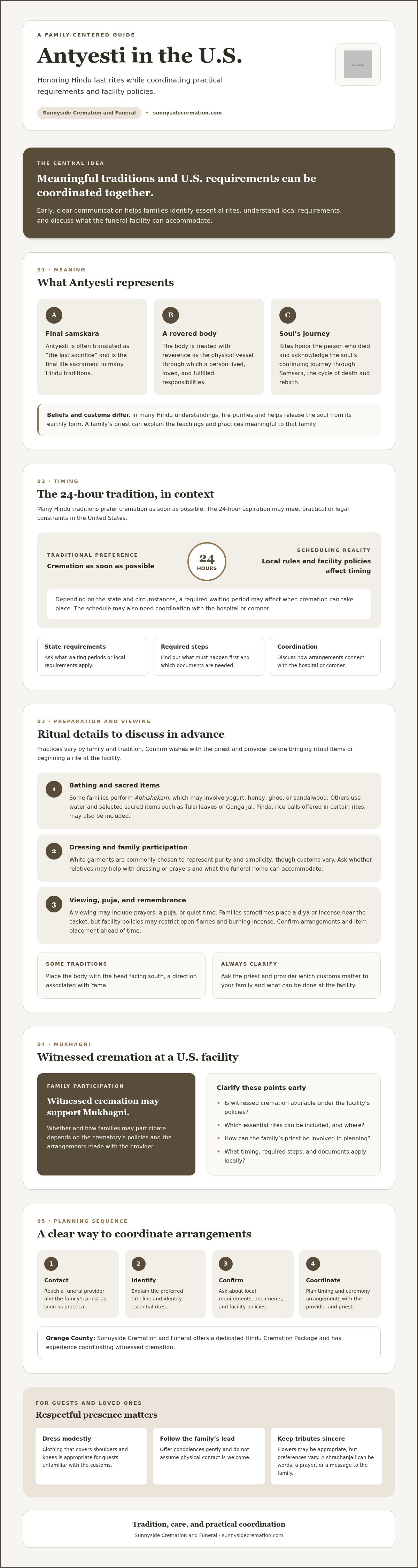
What if honoring Antyesti in the United States doesn’t mean choosing between tradition and practical requirements? Families seeking Hindu cremation rituals USA may worry that a crematorium won’t allow familiar rites, that a 24-hour timeline won’t fit local logistics, or that they won’t find a provider who understands what matters. These concerns are understandable. Many Hindu traditions call for cremation as soon as possible, ideally within 24 hours, while state requirements and crematory policies can affect timing and ceremony arrangements.
With early, clear coordination, families can preserve meaningful parts of Antyesti while working within the funeral process. This guide explains the purpose of the rites, how families may participate in Mukhagni through witnessed cremation, and what to ask when choosing a provider. It also covers timing considerations in the U.S. and how a dedicated Hindu Cremation Package in Orange County can help coordinate arrangements with cultural care. Sunnyside Cremation and Funeral has experience coordinating witnessed cremation, helping families discuss these decisions with greater clarity.
Key Takeaways
- Understand how Antyesti honors the body and reflects the soul’s journey through Samsara.
- Learn which preparation and viewing practices may be part of Hindu last rites, and what to discuss with your family’s priest.
- Explore how witnessed cremation may support Mukhagni at a U.S. facility, subject to the crematory’s policies.
- See how Hindu cremation rituals USA can be thoughtfully adapted while coordinating local requirements and family traditions.
- Learn how a dedicated Hindu Cremation Package and local experience in Orange County can help families plan with cultural understanding.
Understanding Antyesti: The Significance of Hindu Last Rites in the West
Antyesti, often translated as “the last sacrifice,” is the final samskara, or life sacrament, in many Hindu traditions. Its rites honor the person who has died while acknowledging the soul’s continuing journey through Samsara, the cycle of death and rebirth. Customs and beliefs vary across families and communities, so the family’s priest can help identify which practices are meaningful. For an overview of the tradition and its variations, see Antyesti, the Hindu funeral rites.
The body is treated with reverence as the physical vessel through which a person lived, loved, and fulfilled responsibilities. In many Hindu understandings, cremation is more than a practical choice: fire purifies and helps release the soul from its earthly form. This spiritual meaning can offer comfort, while the rituals give loved ones a purposeful way to honor the deceased.
The Soul’s Journey: Karma and Reincarnation
Hindu teachings about the soul’s passage vary. Some traditions describe the life force leaving through the Brahmarandhra, an opening at the crown of the head. Beliefs about karma and rebirth shape how families understand what follows, including the possibility of another form of life, such as human, animal, or plant. Prayer and sacred recitation can help create a peaceful, focused atmosphere at the end of life. Suffering should not be treated as a guaranteed way to cancel negative karma. Interpretations differ, and a family’s priest can explain its own teachings with care.
The 24-Hour Tradition in a Modern Context
Many Hindu traditions prefer cremation as soon as possible, as a way to begin the soul’s transition and fulfill the final rites promptly. The aspiration to act within 24 hours can, however, conflict with practical requirements in the United States. Depending on the state and circumstances, a required waiting period may affect when cremation can take place. Ask the funeral provider what applies locally and how timing may be coordinated with the hospital or coroner.
When a death occurs, contact a funeral provider and the family’s priest as soon as practical. Explain the preferred timeline and identify any essential rites. Ask the provider which steps must happen first, what documents are needed, and how the cremation schedule will be determined. Sunnyside Cremation and Funeral offers a Hindu Cremation Package in Orange County and has experience coordinating witnessed cremation. When planning Hindu cremation rituals USA, early communication can help families preserve meaningful practices while allowing time for required arrangements.
Preparation of the Body: Bathing, Dressing, and Sacred Viewing
Preparing the body is an act of care and reverence, but specific rites differ among Hindu families and traditions. Some families perform Abhishekam, a ritual bathing that may involve substances such as yogurt, honey, ghee, or sandalwood. Others use water and selected sacred items, such as Tulsi leaves or Ganga Jal. Pinda, rice balls offered as part of certain rites, may also be included. Before bringing items or beginning a ritual at a funeral home, discuss the family’s wishes with the priest and provider. Facility procedures may determine what can be done and where.
In some traditions, the body is placed with the head facing south, a direction associated with Yama, the deity connected with death. White garments are commonly chosen to represent purity and simplicity, although customs vary. Ask whether relatives may help with dressing or prayers, and what the funeral home can accommodate. Agreeing on these details in advance helps preserve a meaningful family role while treating the person’s body with dignity.
The Public Viewing and Puja
A viewing may include prayers, a puja, or quiet time for loved ones to pay their respects. Families sometimes place a diya or incense near the casket, but facility policies may restrict open flames and burning incense. Confirm arrangements in advance, including where ritual items can be placed. Research on the modern reinterpretation of Hindu death rituals can also offer context on how practices adapt across settings.
Guests unfamiliar with Hindu funeral customs can choose modest clothing that covers the shoulders and knees. Offer condolences gently, and don’t assume physical contact is welcome. Follow the family’s lead. Flowers may be appropriate, but preferences vary. A shradhanjali, or tribute expressing respect and remembrance, may take the form of a few sincere words, a prayer, or a message to the family.
Attire and Etiquette for Mourners
White is a traditional mourning color in many Hindu communities, though local and family customs may differ. Simple, modest attire is a respectful choice. If you’re unsure about flowers, colors, or how to offer a tribute, ask the family or funeral provider beforehand. These small steps help guests show care without imposing on the family’s practices.
For families planning Hindu cremation rituals USA, a conversation with the provider can clarify which preparations relatives may perform, what supplies are welcome, and how viewing customs fit facility procedures. Families in Orange County can discuss Hindu cremation arrangements with Sunnyside Cremation and Funeral as they decide which rites matter most to them.
The Mukhagni: Navigating Witnessed Cremation in American Facilities
Mukhagni refers to the ritual act of lighting the funeral pyre, traditionally performed by the eldest son or another close relative. In the United States, families may be able to participate through witnessed cremation, a modern adaptation that allows the chief mourner to take part in initiating cremation at a facility. It is not an open-air pyre or a legal equivalent. State requirements and crematory policies determine what participation is permitted.
In many Hindu traditions, fire, or Agni, is understood as a purifier and a messenger between the human and divine. The cremation rite can symbolize the body’s return to the elements and the soul’s release from its physical form. For a scholarly perspective on Hindu last rites and their spiritual meaning, see this resource on the Hindu rite of entry into heaven.
The Fire Ritual in a Controlled Environment
The Karta, or lead mourner, may offer prayers and perform a symbolic act to initiate the cremation. Depending on family custom, this may include circling the casket or breaking a clay pot, often associated with the final separation from the body. The sequence varies. Ask the priest and crematory in advance which actions can be accommodated and where they may take place.
At a modern crematorium, the family’s role is coordinated with staff and facility procedures. The Karta may be invited to press a control or otherwise signal the start of the process, but this must be confirmed with the provider. The facility’s equipment and safety rules shape how the rite is carried out. They do not diminish its spiritual importance to the family.
Family Participation at the Crematorium
Before the ceremony, ask who may enter the cremation area, how many people can attend, and whether prayers or ritual items are permitted. Staff can explain where the family will stand and when the initiation will occur. Knowing the sequence and facility rules ahead of time gives the Karta and relatives space to focus and helps everyone understand what to expect.
Sunnyside Cremation and Funeral has experience coordinating witnessed cremation for Hindu families. Ask what the crematory can accommodate, including whether family participation is possible, rather than assuming a private area or a particular ritual is available. For more information about local arrangements, read Hindu Cremation Services in Orange County. Early planning can help families preserve meaningful parts of Mukhagni while honoring facility requirements, an important consideration for Hindu cremation rituals USA.
Post-Cremation Rituals: Mourning Periods and Ash Scattering
After cremation, families may observe a mourning period known as Sutak. In many traditions, it lasts 13 days and may include limits on social activities, household routines, or religious observances. Practices differ, so the family’s priest can explain what applies to their tradition. Ritual bathing and cleaning the home after the funeral may also mark a transition from the rites of death toward daily life.
The cremated remains, often called Asthi, are collected according to the crematory’s release process. Ask the provider when the remains are expected to be available and how they will be returned to the family. A priest can guide the next rites, including Asthi Visarjan, the immersion or scattering of ashes in water.
Ash Scattering (Asthi Visarjan) in California
For scattering ashes at sea, follow both state and federal requirements. California requires a Disposition Permit for scattering. The EPA’s Clean Water Act rules require scattering at least 3 nautical miles from shore. If an urn is used, it must be biodegradable, and the EPA must be notified within 30 days. Scattering from a beach, pier, or directly from shore is not permitted. Confirm current requirements with the responsible agency before making arrangements.
Because ocean scattering must take place offshore, families may need to arrange a boat through a provider that offers this service. Sunnyside’s offerings do not include a boat service, so ask funeral providers or vessel operators directly about availability, permissions, and how family members may participate. If the family plans to take ashes to India for immersion in the Ganges, check current airline, Indian government, and consular requirements before travel. Documentation rules can depend on the circumstances.
The 13th Day Ceremony (Preta Karma)
In some traditions, the 13th-day rites include prayers, a meal, and donations. These acts may be understood as helping the departed move from the Preta state toward becoming an ancestor, or Pitri. The details are not universal. A priest can help the family plan a ceremony that reflects its beliefs and circumstances. Some families also observe Shraadh, an annual remembrance honoring ancestors.
Several practical steps may need coordination, from receiving the remains to confirming a permitted scattering location. Families planning Hindu cremation rituals USA can ask Sunnyside Cremation & Funeral about its Hindu Cremation Package and local arrangements in Orange County. Discuss Hindu cremation arrangements as you consider the family’s wishes.
Planning a Culturally Respectful Hindu Funeral in Orange County
Planning ahead gives families time to record preferences before grief makes decisions harder. Hindu customs can vary by family, region, and lineage. A priest may guide the rites, while a funeral provider can clarify practical arrangements. Sunnyside Cremation & Funeral offers a dedicated Hindu Cremation Package for families in Orange County, providing a starting point for discussing cultural and logistical needs.
A package can help bring funeral arrangements together, but confirm which specific rites and services are included. Ask whether witnessed cremation can be coordinated, what participation the crematory permits, and how the provider can work with the family’s priest. Sunnyside has experience with witnessed cremation and coordinates with major memorial parks, including Forest Lawn and Rose Hills. Ask which location and arrangements fit your family’s plans.
The Sunnyside Difference: Empathy and Stewardship
Clear explanations and a calm point of contact can make complex decisions feel more manageable. Share the customs you hope to preserve, from the Karta’s role to the timing of prayers, and ask how those wishes may be accommodated. For ideas on recording preferences ahead of time, read The Comprehensive Guide to Funeral Pre-Planning for Asian Families.
Starting the Conversation: Pre-Arrangement
A written plan can help relatives understand your preferences and know what to ask when arrangements begin. Consider documenting:
- Which family member or loved one you would like to serve as Karta, and whether you wish to request witnessed cremation.
- Rituals, prayers, or priest involvement that are important to your family or lineage.
- Your preferences for the handling of ashes, noting that scattering plans must follow applicable rules and be confirmed separately.
- Any memorial park preferences, such as Forest Lawn or Rose Hills, for the family to discuss with the provider.
Sunnyside offers Pre-Planning Funeral Contracts. Ask for the contract terms, what arrangements they cover, and how payment and future costs are handled. A written plan can support clarity, but review the specific terms rather than assuming a particular financial outcome. Thoughtful preparation can help ensure that Hindu cremation rituals USA reflect your family’s beliefs while giving loved ones a clearer path forward.
To discuss your family’s wishes and local arrangements, contact Sunnyside Cremation & Funeral.
Carry Your Family’s Traditions Forward with Care
Antyesti brings together rituals that honor the body and the soul’s continuing journey. Details vary by family and lineage, so speaking with a priest and funeral provider can help clarify which practices matter most. In the United States, timing, facility policies, and crematory procedures may shape how rites such as Mukhagni are carried out. Asking about witnessed cremation early can help families understand their options and plan with greater confidence.
Thoughtful preparation can also help preserve preferences for prayers, family participation, and the handling of ashes. Sunnyside Cremation & Funeral is a family-owned and operated California mortuary with specialized Hindu funeral coordination and experience with witnessed cremation. Families in Garden Grove, Buena Park, La Mirada, Cerritos, Anaheim, La Habra, Fullerton, Norwalk, Cypress, Artesia, Stanton, Tustin, Orange, Los Alamitos, Westminster, and Irvine can contact Sunnyside to discuss local arrangements. The Hindu cremation rituals USA families choose deserve respectful handling and clear communication.
If you’re considering arrangements in Orange County, explore our dedicated Hindu Cremation Packages in Orange County. A conversation can help you understand the next steps and honor your loved one’s traditions with dignity.
Frequently Asked Questions
Is it possible to have a traditional Hindu funeral in a US funeral home?
Yes. Families can often observe meaningful parts of Antyesti in a US funeral home, with arrangements adapted to facility procedures and local requirements. Ask in advance about prayers, sacred items, family participation, and witnessed cremation. In Garden Grove, Buena Park, and nearby Orange County communities, Sunnyside offers a Hindu Cremation Package and has experience coordinating Hindu funeral arrangements, helping families discuss customs and practical needs with a provider.
Can the family witness the cremation process in California?
It may be possible, but permission depends on applicable state requirements and the individual crematory’s policies. Witnessed cremation is not automatically available at every facility. Ask whether family members may attend, how many can be present, what part of the process they may witness, and whether the chief mourner can initiate the cremation. Confirm these details before finalizing arrangements so expectations are clear.
What is the traditional color to wear to a Hindu funeral?
White is a traditional mourning color in many Hindu communities and is generally a respectful choice for funeral guests. Customs differ, so follow the family’s guidance if they share a preference. Choose simple, modest clothing that covers the shoulders and knees. If you’re unsure about attire, flowers, or offering physical condolences, ask someone close to the family or the funeral provider before the service.
How soon after death must a Hindu cremation take place in the US?
Many Hindu traditions prefer cremation as soon as possible, ideally within 24 hours. In the US, required waiting periods, paperwork, and other circumstances can affect the schedule; some states require a 24- to 48-hour wait. Exact timing depends on local rules and the case. Contact a funeral provider promptly, explain the family’s wishes, and ask what steps and timing apply in your area.
Can we bring Ganges water and sacred items for the ritual?
Families may be able to use Ganga Jal, Tulsi leaves, or other sacred items, but each funeral home or crematory sets its own policies. Call ahead and describe the items, how they’ll be used, and when the family hopes to bring them. Ask about restrictions on liquids, placing objects with the deceased, open flames, or incense. This helps the family and provider plan respectfully.
What are the legal rules for scattering ashes in the ocean in California?
California requires a Disposition Permit for scattering ashes. For ocean scattering, the EPA’s Clean Water Act rules require scattering at least 3 nautical miles from shore. If using an urn, it must be biodegradable, and the EPA must be notified within 30 days. Scattering from a beach, pier, or directly from shore isn’t permitted. Confirm current requirements with the responsible agency before arranging a scattering.
Who typically performs the last rites at a Hindu funeral in the USA?
A family member known as the Karta typically leads key rites. In many traditions, this role is performed by the eldest son or another close male relative, but customs and family preferences vary. A priest may guide prayers and explain the sequence of ceremonies. Discuss roles with your family and priest ahead of time, including who will lead Mukhagni if the crematory permits witnessed participation.
How does Sunnyside help with the 13-day mourning period logistics?
Sunnyside’s services focus on funeral arrangements, including a Hindu Cremation Package and coordination for witnessed cremation. The family’s priest can guide specific Sutak observances, household customs, prayers, and the 13th-day ceremony. Ask Sunnyside which funeral-related arrangements it can coordinate and what falls outside the package, so you can plan separately with relatives and your priest. Clear conversations can help families in Garden Grove, Buena Park, and nearby Orange County communities organize the next steps.


