
Honoring a lifetime of Korean tradition shouldn't feel like a compromise against California's modern regulations. When a family loses a loved one, the weight of grief is often compounded by the pressure of maintaining sacred customs in a setting that doesn't always understand them. You may be wondering how to plan a Korean funeral in California while respecting your elders' wishes, especially when finding a venue that allows traditional food offerings feels like a heavy burden. It's natural to feel overwhelmed by these logistics during such a vulnerable time.
This guide will help you manage that journey with grace, ensuring your family feels supported and heard throughout the process. We'll walk through the essential steps of the traditional three-day timeline and explain California's specific rules, such as the eight-day death registration window. You'll gain a clear path toward a service that honors your ancestral heritage while providing the language-appropriate support and logistical clarity your family needs to find peace.
Key Takeaways
- Learn how to plan a Korean funeral in California by balancing traditional filial piety with local legal requirements like death certificate registration.
- Discover how to adapt the traditional three-day timeline, including the Yeom preparation and Jesa rites, to a Southern California setting.
- Understand why choosing a provider in Orange County with Korean-speaking staff is vital for supporting your elders and ensuring clear communication.
- Gain confidence in navigating funeral etiquette, from selecting appropriate mourning attire to performing the correct number of bows during the service.
- Simplify the final steps of coordinating burial or cremation at respected local memorial parks like Forest Lawn or Rose Hills.
Initial Decisions: Balancing Korean Tradition with California Regulations
The moment a loved one passes, the weight of responsibility often falls upon the Sang-ju, or chief mourner. Traditionally the eldest son or a close male relative, the Sang-ju acts as the steady hand for the family. In these early hours, the focus is on filial piety and ensuring a peaceful transition for the deceased. Understanding how to plan a Korean funeral in California means respecting these ancient duties while moving through the specific legal requirements of the state. It's a delicate balance of heart and law.
Understanding the Cultural Significance
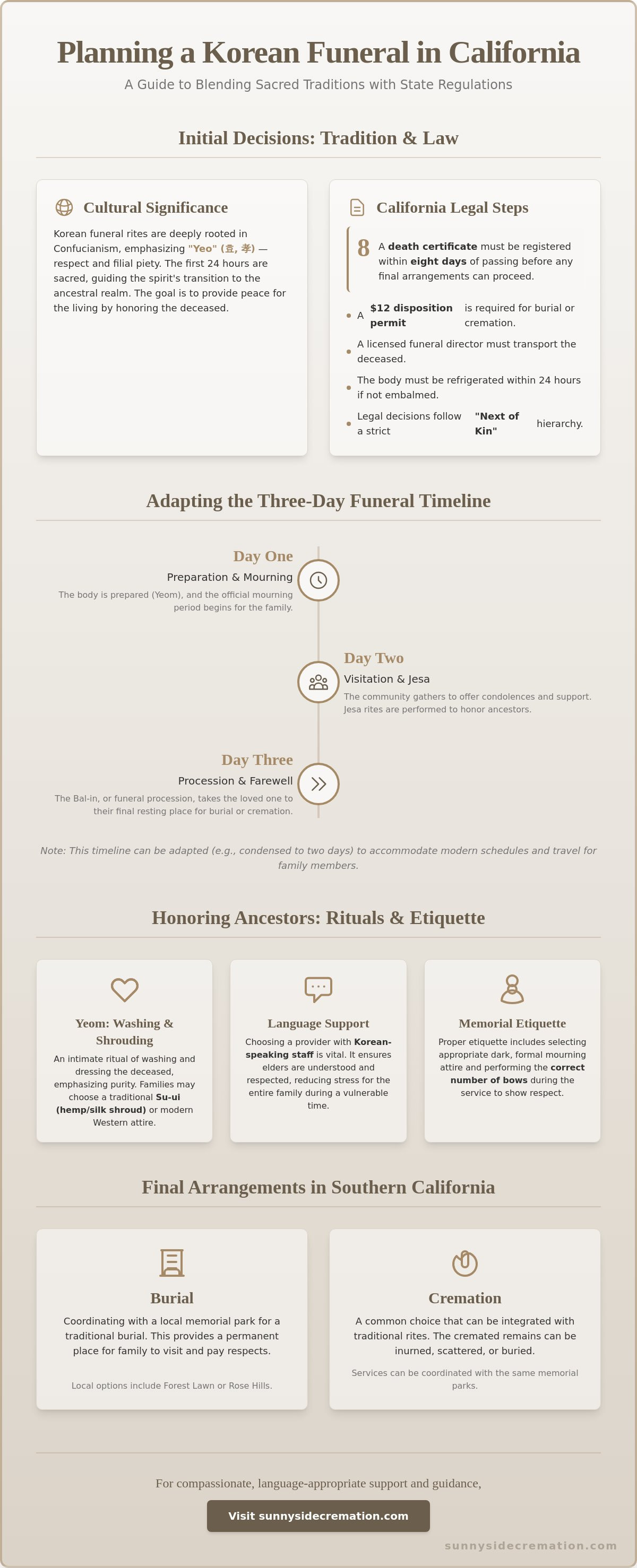
Korean funeral rites are deeply rooted in Confucianism, centered on the concept of "Yeo," or respect and filial piety. This isn't just a ceremony; it's a vital transition from life to the ancestral realm. The first 24 hours are considered sacred, as the family begins the process of guiding the spirit. While many families in Southern California now blend Korean funeral traditions with Western practices, the core values remain unchanged. Honoring the deceased through specific rituals provides a sense of continuity and peace for the living. This cultural bridge helps younger generations stay connected to their heritage while navigating a modern American setting.
First Legal Steps in Southern California
While the heart focuses on tradition, the mind must address California's legal framework. The process begins with the legal notification of death. An attending physician or the county coroner must certify the cause of death before any further steps can be taken. In California, a death certificate must be registered within eight days of the passing. This registration must happen before a permit for disposition is issued. This permit is required for any burial or cremation to proceed, and the state charges a standard fee of $12 for it.
California law also dictates how a body is handled and transported. You should know that:
- A licensed funeral director is typically required to transport the deceased from the place of death to the mortuary.
- While California law doesn't mandate embalming, a body must be refrigerated within 24 hours if the final disposition isn't happening immediately.
- The "Next of Kin" hierarchy is strictly followed for legal decision-making; this usually starts with a surviving spouse, followed by adult children.
During the initial consultation, having language-appropriate support is more than a convenience; it's a necessity. Elder family members often carry the deepest knowledge of family-specific customs. They need to understand every detail of the logistics in their native tongue to feel that their loved one is being treated with the proper dignity. This clear communication reduces the cognitive load on a grieving family, allowing you to focus on the emotional journey ahead rather than just the paperwork.
Structuring the Service: Adapting the Three-Day Funeral Timeline
Planning the sequence of events is a vital step in honoring your loved one's legacy. Traditionally, a Korean funeral spans three days, each with its own purpose and rhythm. In Korea, this timeline is strictly observed, but in Southern California, families often need a more flexible approach. Learning how to plan a Korean funeral in California involves understanding which elements are non-negotiable and which can be adapted to accommodate modern schedules and travel needs.
Day one typically focuses on the preparation of the body and the official start of the mourning period. Day two is dedicated to visitation and Jesa, where the community gathers to offer support. The final day concludes with the Bal-in, the funeral procession to the final resting place. While some families in 2026 choose to condense these rites into a two-day service to accommodate relatives flying in from overseas, the focus remains on providing a dignified farewell that follows California funeral regulations for safety and hygiene.
The Ritual of Yeom (Washing and Shrouding)
The Yeom is perhaps the most intimate part of the three-day journey. It involves the ritual washing and shrouding of the deceased, a practice that emphasizes purity and respect. Traditionally, the family chooses a Su-ui, a special funeral shroud made of hemp or silk. However, it's becoming more common for families to choose Western attire that the loved one felt comfortable in during their life. Most modern mortuaries in California are equipped to facilitate this process, allowing family members to participate in or observe the shrouding in a private, serene environment. This ritual provides a final moment of physical connection, offering a sense of closure before the public visitation begins.
Managing the Visitation and Food Offerings
The second day transforms the funeral space into a place of community and remembrance. A central memorial altar is established, featuring a large portrait of the deceased surrounded by incense and specific fruit arrangements. In Korean tradition, food isn't just for the living; it's a symbolic offering to the ancestors. Finding a facility that permits traditional catering is essential, as sharing a meal is a core part of Korean mourning etiquette. Guests often bring "Kye-po," or monetary donations, which are traditionally collected in white envelopes at the entrance. These gifts help the family manage the costs of the service and represent the community's shared responsibility. Understanding these details is key when you are learning how to plan a Korean funeral in California that truly honors your heritage. Choosing a provider that offers a Korean Funeral Package ensures that these cultural nuances, from the altar setup to the catering logistics, are handled with the reverence they deserve.
Choosing the Right Korean Funeral Home in Orange County
Selecting a partner for this journey is one of the most consequential decisions a family will make. In Orange County, the proximity to cultural hubs like Buena Park, Garden Grove, and Fullerton is often a primary consideration. When you are determining how to plan a Korean funeral in California, choosing a location near these communities makes it easier for elderly relatives and church members to attend without the stress of long commutes. A central location serves as a familiar gathering point for the community to offer their "Jo-mun" (condolences) and support the grieving family.
Language goes beyond simple translation; it's about the subtle nuances of respect that elder family members expect. A staff that speaks Korean fluently can explain the technicalities of the service to grandparents, ensuring they feel respected and included in every decision. Facilities also need to be physically prepared for traditional rites. This includes spacious chapels that accommodate the deep bowing performed during the service and ventilation systems that allow for the burning of incense without restriction. This combination of logistical readiness and cultural sensitivity provides a sense of security during an emotionally vulnerable time.
Evaluating Cultural Competency
True cultural competency involves an intuitive understanding of traditional mourning symbols. Does the mortuary staff know why the Sang-ju wears a white hemp hat or specific armbands? Can they coordinate the procurement of traditional mourning attire for the entire family? Choosing a family owned funeral home Orange County often provides a more personalized level of stewardship. These providers tend to have a deeper connection to the local community and a thorough grasp of California funeral regulations, ensuring that every cultural detail is handled within the state's legal framework.
Package Comparison and Value
When reviewing options, look for a dedicated Korean Funeral Package that clearly outlines what is included. Some families prefer an all-inclusive approach that covers everything from the altar flowers to the catering logistics. Others may seek more streamlined tributes. If the family's wishes lean toward a simpler service, exploring affordable cremation Orange County can provide a dignified and respectful alternative that still allows for traditional memorial rites. Comparing these options with a steady, reliable guide helps ensure that the final arrangements align with both your cultural values and your financial considerations.
Honoring Ancestors: Rituals, Attire, and Memorial Etiquette
The atmosphere of a Korean memorial service is defined by a quiet, rhythmic reverence. Every element, from the way a guest enters the room to the specific placement of items on the altar, serves to bridge the gap between the living and the departed. When you are learning how to plan a Korean funeral in California, understanding these cultural expectations ensures that the service remains a sanctuary of respect for your family and the community.
Attire serves as the first visible sign of mourning. While white was historically the color of grief in Korea, modern services in Southern California typically see family and guests in black. Men usually wear dark suits with a black tie, while women often opt for black dresses or a traditional black hanbok. The Sang-ju and immediate family may still incorporate traditional hemp armbands or ribbons to signify their role in the mourning process. This visual uniformity creates a sense of shared purpose and solemnity.
The focal point of the room is the Sang-dan, or memorial altar. This space is prepared with deep intentionality, featuring a large, framed photograph of the deceased. Essential items include incense (hyang), candles, and specific food offerings. Fruit arrangements, typically featuring pears, apples, and dried persimmons, are placed in odd numbers according to tradition. These offerings are more than just symbols; they're an expression of "Yeo," ensuring the loved one is provided for as they transition to the ancestral realm.
The Art of the Korean Bow (Jeol)
The most distinctive ritual for guests is the Jeol, or traditional bow. This can feel intimidating for those unfamiliar with the custom, but its meaning is simple: it's a profound gesture of humility. When approaching the altar, guests typically perform two and a half bows to the deceased. This involves two full bows where the knees and forehead touch the floor, followed by one deep standing bow. After honoring the deceased, guests turn to the family and perform one single full bow. A common mistake for non-Korean guests is to bow twice to the living family members; remember that the double bow is reserved strictly for the deceased to show the highest level of filial piety.
Religious Integration in Korean Services
Korean identity is often beautifully intertwined with faith, and services in California reflect this diversity. Korean Christian services frequently replace some Confucian rituals with scripture readings and hymns, though they almost always maintain the portrait altar and the collection of funeral donations. For families seeking Buddhist funeral services Orange County, the focus shifts toward the peaceful transition of the soul and the cycle of rebirth, often involving chanting and specific incense rituals. Balancing these religious requirements with secular Korean traditions requires a partner who understands the weight of both. If you need assistance coordinating these delicate cultural and religious details, we invite you to learn more about our Korean Funeral Package and how we can support your family's unique needs.
Final Arrangements: Coordinating Burial or Cremation in Southern California
The journey of honoring a loved one reaches its physical conclusion at the final resting place. This step requires a steady hand and a clear understanding of the logistics involved in Southern California's premier memorial sites. When deciding how to plan a Korean funeral in California, many families find themselves choosing between the traditional dignity of a burial and the modern flexibility of cremation. Each path offers a unique way to establish a lasting legacy for future generations to visit and honor.
Coordination with major sites like Rose Hills or Forest Lawn is a specialized process. These memorial parks are the primary destinations for the Korean community in the region, and they understand the specific needs of traditional services. The Ha-gwan, or graveside service, is the final ritual before the burial is complete. It's a moment of deep solemnity where the family often takes turns placing a handful of earth onto the casket, signifying the finality of the physical connection and the return to the earth.
Navigating Memorial Parks
Selecting the right location involves more than just aesthetics; it often includes "Pung-su" (the Korean equivalent of Feng Shui) considerations. Families may look for plots that face a specific direction or sit on an incline to ensure positive energy for the ancestral spirit. The logistics involved are similar to Chinese funeral planning with Forest Lawn, where coordination between the mortuary and the cemetery staff is vital for a seamless procession. Your funeral director acts as the primary liaison, managing the transport and timing to ensure the family can focus on the ritual without administrative distractions.
Cremation and Ash Placement
Cremation is increasingly common, reflecting a broader trend where 66% of Californians choose this option according to state data. Within the Korean-American community, this has led to the rise of "Jandizang" (natural burial) and the use of elegant columbariums. California law requires a permit for disposition, which carries a $12 fee, and there's a mandatory waiting period of at least 24 to 48 hours after death before cremation can occur. Whether you choose to scatter ashes in a designated area or place them in a permanent niche, planning for long-term care is essential. This ensures that traditional Jesa rites can be performed at the site during anniversaries and holidays.
The mourning process doesn't end when the service concludes. Many families observe the 49-day memorial period, a tradition that provides a structured path for grief and reflection. This time allows the spirit to transition fully while the family finds a new sense of peace. By understanding how to plan a Korean funeral in California from the first notification to these final post-funeral rituals, you provide your loved one with a farewell that is both culturally profound and legally secure. This methodical approach ensures that every detail, no matter how small, is handled with the reverence your family deserves.
Honoring a Legacy of Love and Tradition
Planning a tribute that spans generations requires both logistical precision and a heart for tradition. You've explored the importance of the three-day timeline, the sanctity of the Yeom ritual, and the delicate balance of state regulations with ancestral rites. These steps aren't just a checklist; they're a final act of filial piety that brings lasting comfort to your family. By understanding how to plan a Korean funeral in California, you've equipped yourself to lead your loved ones through this transition with confidence and grace.
As you move forward, you don't have to carry this responsibility alone. Our family-owned and operated firm in Orange County provides a steady hand and specialized staff fluent in Korean, Chinese, and Vietnamese traditions. We offer expert coordination with respected memorial parks like Forest Lawn and Rose Hills, ensuring every cultural detail aligns with your family's values. View our specialized Korean Funeral Packages or contact our Korean-speaking staff today. We're here to provide a calm presence and a clear path toward a service that truly honors your loved one's legacy. You're making a beautiful choice for your family's history and future.
Frequently Asked Questions
How long does a traditional Korean funeral last in California?
A traditional service typically lasts three days. This timeline includes the ritual washing on the first day, visitation on the second, and the final procession on the third. When you're learning how to plan a Korean funeral in California, you'll find that some families condense these rites to two days to accommodate modern schedules, though the three-day structure remains the cultural standard.
What is the proper attire for a Korean funeral in the United States?
Black is the standard choice for mourning attire in the United States. While white was historically the color of grief in Korea, modern services typically see men in dark suits and women in black dresses or black hanbok. This uniform appearance reflects the solemnity of the occasion and shows a shared sense of respect for the loved one's legacy.
Do I need to provide food for guests at a Korean funeral service?
Providing food is a central part of Korean mourning etiquette. You'll need to prepare traditional fruit and food offerings for the memorial altar and arrange a meal for guests who visit to offer their condolences. Sharing a meal is an essential way for the community to support the grieving family and honor the deceased's transition during this difficult time.
How much does a Korean funeral package typically cost in Orange County?
The cost of a service varies based on your choice of burial or cremation and the specific requirements of the memorial park. When you're researching how to plan a Korean funeral in California, it's helpful to discuss your family's needs with a provider who offers transparent package options. This ensures you receive a clear understanding of the logistics and professional fees involved.
Can I include both Christian and traditional Korean rites in the same service?
You can certainly include both Christian and traditional rites in the same service. Many families in Southern California blend scripture and hymns with traditional elements like the memorial portrait altar. This combination allows you to honor your loved one's faith while maintaining the cultural rituals that are so important to elder family members and the community.
What is the significance of the mourning armbands worn by the family?
Mourning armbands identify the immediate family and the chief mourner, or Sang-ju. Usually made of hemp or featuring a white ribbon, these symbols signify the family's official role in the mourning period. They help guests know whom to approach for formal bows and condolences, ensuring that the hierarchy of respect is maintained throughout the visitation and service.
How do we coordinate with Rose Hills or Forest Lawn for a Korean burial?
Your funeral director manages the technical coordination with cemeteries like Rose Hills or Forest Lawn. We handle the scheduling, transport, and communication with cemetery staff to ensure the graveside rites proceed without interruption. This professional oversight allows your family to focus on the spiritual and emotional aspects of the burial while we manage the logistical details with the park.
Is cremation acceptable in traditional Korean culture?
Cremation is a respectful and widely accepted choice in modern Korean culture. In California, where 66% of residents choose cremation, many Korean families opt for this path followed by placement in a columbarium or natural burial site. This choice respects ancestral traditions while offering a practical and dignified solution for final arrangements in a modern Southern California setting.


