

Last Friday, Sarah discovered that even a simple gesture like choosing a floral arrangement requires a deep understanding of tradition when she realized red flowers are strictly avoided at most services. This quiet moment of uncertainty is something many feel when preparing to honor a loved one. Mastering Chinese funeral viewing etiquette allows you to move past the fear of making a mistake and focus on what truly matters: offering comfort and reverence. Whether you're unsure about the "white envelope" tradition or worried about how to bow at the casket, these customs are meaningful threads in a tapestry of ancestral respect.
It's natural to feel concerned about accidentally causing offense during such a sensitive time. This guide will help you navigate every detail of the ceremony with confidence, from the proper way to present condolence gifts to the specific rituals performed at the casket. We'll explore the gestures of filial piety, the importance of "chromatic silence" in your clothing, and the practical steps that ensure you provide the right type of support for the grieving family.
Key Takeaways
- Understand the spiritual significance of the viewing and how the concept of "Yin" energy creates a peaceful, reverent space for final farewells.
- Learn how to observe "Chromatic Silence" through proper attire, ensuring you avoid specific colors that might inadvertently signify celebration rather than mourning.
- Master the specific rituals of Chinese funeral viewing etiquette, including the proper depth and timing of the "Three Bows" when approaching the casket.
- Ensure your condolence gift is respectful by following the "Odd Number" rule for "Bai Jin" (white envelopes) and choosing appropriate floral tributes.
- Discover how specialized local guidance helps multicultural families coordinate traditional services at Southern California memorial parks like Rose Hills and Forest Lawn.
Understanding the Significance of the Chinese Funeral Viewing
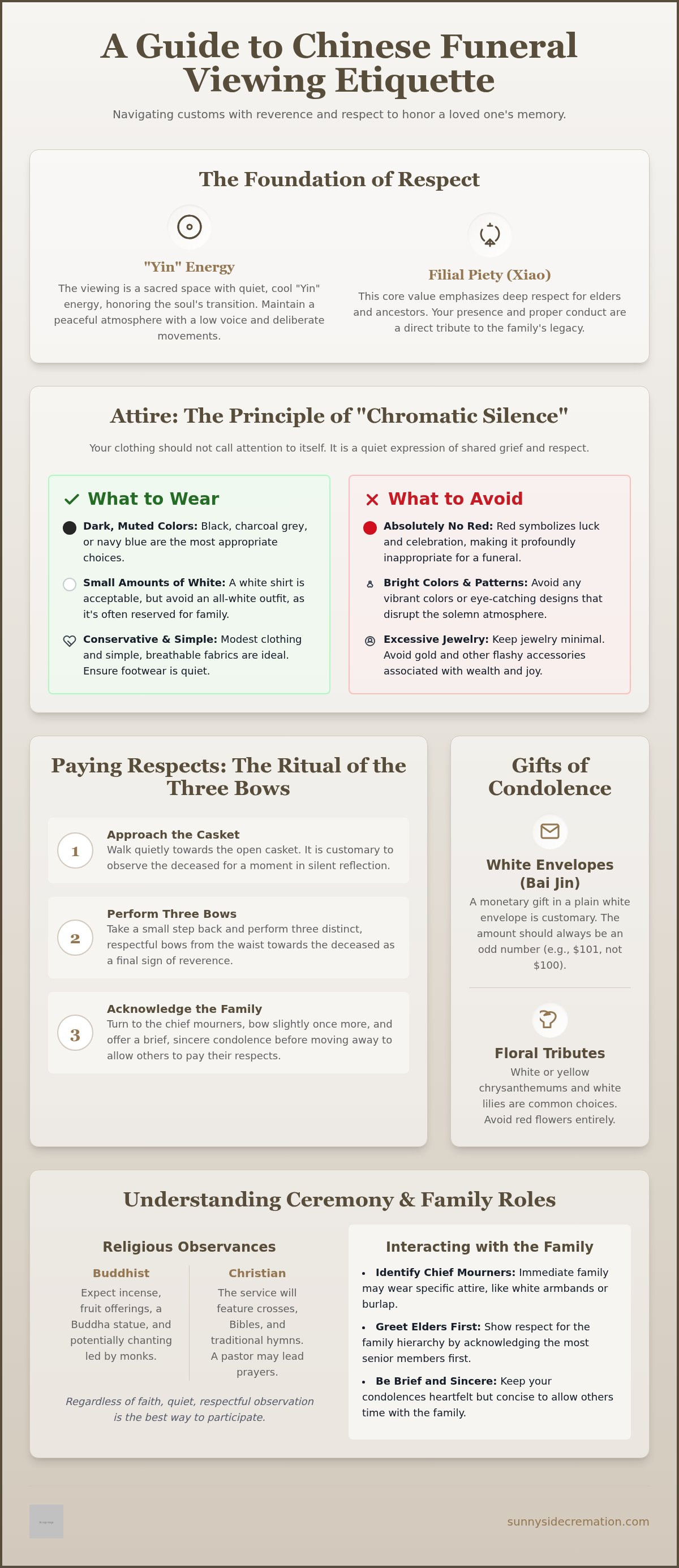
In traditional culture, the viewing isn't just a chance to say goodbye; it's a vital bridge between the physical world and the spiritual realm. This transition period is treated with immense care, as it's believed the soul is preparing for its journey. Guests who practice proper Chinese funeral viewing etiquette help maintain the "Yin" energy of the space. Yin represents the quiet, cool, and receptive nature of the afterlife. By keeping your voice low and your movements deliberate, you contribute to a peaceful atmosphere that honors the soul's transition and provides a sanctuary for the grieving.
The complexity of the viewing often reflects the age and social standing of the person who passed. If a person lived a long, full life, perhaps reaching over 80 years, the atmosphere might feel slightly more celebratory of their longevity. For younger individuals, the solemnity is often much deeper and more quiet. Regardless of the person's age, the core value of Xiao, or filial piety, guides every interaction. This concept emphasizes deep respect for elders and ancestors. Your presence and correct behavior are seen as a direct tribute to the family's legacy. You can explore the historical roots of these Chinese funeral rituals to better understand the profound weight of these gestures.
Buddhist vs. Christian Chinese Viewings
While the cultural foundation remains consistent, religious preferences change the room's landscape. A Buddhist altar often features a statue of the Buddha, incense, and offerings of fresh fruit or tea. You might hear rhythmic chanting or see monks leading prayers. In contrast, a Christian service will center on crosses, Bibles, and traditional hymns. Choosing a Mandarin funeral home that understands these distinctions ensures the setting feels authentic to the family's faith. Guests are generally encouraged to stand or sit quietly during prayers or chanting, even if they don't share the same religious beliefs. This silent participation is a powerful sign of respect.
The Role of the Family Hierarchy
Understanding the family structure helps you navigate the room with grace. Chief mourners, typically the children and spouse, are often identifiable by their attire. In very traditional settings, they may wear burlap or specific white armbands. These symbols of mourning help guests identify the immediate family members who deserve the first expressions of sympathy. It's customary for the family to stand to one side of the casket to acknowledge your arrival.
- Greet the most senior family members first upon entering the mortuary room.
- Wait for a natural pause if the family is engaged in a ritual before approaching.
- Keep your interactions brief but sincere to allow other guests time to pay their respects.
By recognizing these roles, you show that you value the family's structure and their path toward healing.
Proper Attire: Mastering Color Symbolism and Etiquette
Choosing your attire is one of the most tangible ways to express respect before you even say a word. In this space, we follow a principle often called "Chromatic Silence." This means your clothing shouldn't call attention to itself; it should instead serve as a quiet background to the solemnity of the occasion. When considering Chinese funeral viewing etiquette, the goal is to blend into the collective mourning through muted, dark tones that reflect a heavy heart and a focused mind. For those looking to incorporate high-quality, understated pieces into their formal wardrobe, the craftsmanship of Busto & Sun serves as a reminder of how dedication to tradition can create a look of timeless respect.
The most important rule is the absolute avoidance of red. In Chinese culture, red is the vibrant symbol of life, luck, and celebration, making it a profound clash with the "Yin" energy of a mortuary. Wearing red, or even bright patterns that include red, can be interpreted as a lack of empathy for the family's loss. Similarly, jewelry should be kept to a minimum. Gold is often associated with wealth and joy, so it's best to leave statement pieces at home. Even your footwear matters. Conservative, quiet shoes are essential. The sharp click of high heels or the squeak of casual sneakers can disrupt the peaceful atmosphere the family has worked so hard to create.
For guests, the safest and most respectful choices are black, navy blue, or charcoal grey. These colors signal that you're there to share in the family's burden. While white is a traditional color of mourning in China, it's often reserved for the immediate family members. As a guest, wearing a small amount of white is acceptable, but an all-white outfit might be seen as overstepping your role in the family hierarchy. Stick to simple, breathable fabrics that allow you to stand or sit comfortably during longer rituals without becoming a distraction.
- Choose dark, solid colors like navy or black.
- Avoid bright patterns, neon accents, and flashy jewelry.
- Ensure your clothing is modest and covers the shoulders and knees.
- Select shoes that are dark and produce minimal noise when walking.
The 'Old Age' Exception
There's a beautiful exception to the dark-color rule known as a "Happy Funeral." This occurs when the deceased has lived a exceptionally long and prosperous life, usually past the age of 80 or 90. In these instances, the family may view the passing as a completion of a full circle rather than a tragic loss. You might see hints of pink or even red in the floral arrangements and decor to celebrate this longevity. However, as a guest, it's still best to wear muted colors unless specifically told otherwise. If you're unsure about the family's specific traditions, consulting with our Chinese funeral services Southern California team can provide clarity. We're here to help you navigate these nuances with grace, and speaking with our compassionate staff can ensure you feel prepared for the unique needs of the family.
Casket Etiquette: The Ritual of Paying Final Respects
Approaching the casket is perhaps the most significant moment of the visitation. While Western customs often allow for a casual approach, Chinese funeral viewing etiquette requires a more structured, intentional movement. As you walk toward the casket, keep your pace slow and your head tilted slightly downward. This posture of humility signals your respect for both the deceased and the family's lineage. It's a physical manifestation of your willingness to share in the weight of the moment.
The "Three Bows" ritual, known as San Ju Gong, is the cornerstone of paying respects at the casket. This isn't a rushed movement; it's a rhythmic, three-part farewell. The first bow acknowledges the person's life and spirit. The second bow offers comfort to their soul, and the third serves as a final, formal goodbye. Bend modestly from the waist, holding the position for a brief second before straightening. This steady pace helps maintain the solemn atmosphere and shows that you aren't rushing through your duty.
Maintaining physical boundaries is equally important. While you might feel a natural urge to touch the casket or the hand of the deceased, it's generally discouraged. Keeping a small physical distance preserves the quiet "Yin" energy of the space. When you've finished your bows, don't turn your back on the casket immediately. Take one small step backward first. This subtle gesture demonstrates a reluctance to leave and honors the person one last time before you turn to rejoin the other guests.
The Incense and Joss Paper Ritual
In many traditional services, a family member may offer you three incense sticks, or Joss sticks. Hold them with both hands, typically with the left hand over the right. If they're lit, place them carefully into the urn filled with sand or ash. The rising smoke is symbolically seen as a way to "feed" the spirit or carry prayers to the heavens. If your own religious beliefs prevent you from participating, don't feel pressured. It's perfectly acceptable to decline with a soft "No, thank you" and a respectful nod. The family values your presence and your heart more than the ritual itself.
Words of Condolence
Choosing the right words can feel daunting, but simplicity is often best. Traditional phrases focus on the health and resilience of the living. In Mandarin, you might say "Jie ai shun bian," or in Cantonese, "Chit oi sun bin," which gently encourages the family to take care of themselves during their grief. Never use words like "Happy" or "Good," even when departing. Phrases like "Good night" or "See you later" are avoided because they can imply a return to this place of sorrow. A silent, deep nod to the family members as you exit often communicates more than a thousand words could.
Condolence Gifts: White Envelopes (Bai Jin) and Floral Tributes
Offering a gift at a viewing is a deeply personal way to show the family they aren't alone in their journey. In the context of Chinese funeral viewing etiquette, these gifts serve a practical purpose while honoring the memory of the deceased. The most traditional gesture is the presentation of "Bai Jin," or white gold. This contribution helps the family manage the costs associated with the service, acting as a collective safety net for the grieving household. It's a humble way to provide stewardship over the family's needs during a period of emotional vulnerability.
The amount you choose to give is at your discretion, but there's a critical mathematical rule to follow: the total must be an odd number. In Chinese culture, even numbers are reserved for joyous milestones like weddings because they symbolize things coming in pairs. For a funeral, an even number can be seen as a wish for the sorrow to be repeated. By giving an odd amount, such as $51 or $101, you're acknowledging the singular, final nature of this farewell. When you present the envelope, always use both hands. This simple physical action conveys a high level of respect and shows that the gift is coming from your heart.
Preparing the White Envelope
Finding the right envelope is your first step. It's vital to avoid the red or gold envelopes used during the Lunar New Year, as those signify celebration. A plain white envelope is the standard choice. On the back, write your name and a brief, supportive message. This helps the family keep track of those who offered support during the visitation. In many services, the family will offer you a small "return gift" after you present your envelope. This is often a single piece of candy or a small coin wrapped in tissue. Eat the candy immediately to "sweeten" the bitterness of the day, and use the coin for your journey home.
Flower Arrangements and Symbolism
Flowers bring a sense of life and peace to the mortuary room, but their colors must be chosen with care. White lilies and yellow or white chrysanthemums are the most appropriate choices. Chrysanthemums, in particular, are powerful symbols of grief and lamentation. Roses are generally avoided because their thorns can be seen as "sharp" or aggressive in a space meant for quiet reflection. If you're arranging for delivery, coordinating with a Mandarin funeral home Orange County ensures your tribute arrives at the correct time and adheres to the family's regional customs. If you need assistance selecting the right arrangement or want to ensure your gift aligns with the family's specific traditions, please reach out to our supportive team today.
Arranging Multicultural Services in Southern California
Southern California's vibrant communities in Garden Grove, Buena Park, and Cerritos require a localized approach to honoring heritage. When a family faces a loss, the weight of logistics shouldn't overshadow the need for reflection. Having a guide who understands the specific cultural landscape of Orange County is essential. This local expertise ensures that every detail of Chinese funeral viewing etiquette is preserved within the context of our modern environment. It's about more than just a ceremony; it's about providing a steady hand through a landscape of uncertainty.
Expert Coordination with Local Memorial Parks
Managing the intricate details of a service often involves coordinating with large, sprawling memorial parks. We specialize in Chinese funeral planning with Forest Lawn and Rose Hills Memorial Parks, ensuring a seamless transition from the mortuary to the gravesite. Our team understands the specific layout and viewing room availability in Buena Park and Fullerton, allowing us to find the right space for your family's unique needs. We also pay close attention to Feng Shui requirements. Whether it involves the specific orientation of the site or the timing of the burial, we work with local masters to ensure the final resting place is auspicious and peaceful for your loved one.
The Sunnyside Difference: Language and Empathy
One of the greatest challenges for multicultural families is the communication gap that can occur during times of stress. English-speaking youth and Mandarin or Taiwanese-speaking elders often have different ways of expressing grief and tradition. Our staff serves as a compassionate bridge, providing language-first care that respects the wisdom of the elders while supporting the younger generation. As a family-owned and operated business, we don't just follow a checklist. We understand the deep spiritual "why" behind every bow and every incense stick. This deep-rooted empathy allows us to guide you through the process with a calm presence. If you're looking for a culturally respectful consultation, we're here to listen and provide the gentle professionalism your family deserves.
Thinking about the future can be difficult, but pre-planning is a profound act of stewardship. It ensures that complex traditions are preserved for future generations without placing a sudden, overwhelming burden on your children. By documenting your wishes now, you ensure that the nuances of your legacy are honored exactly as you envision them. It's a way to provide security and peace for your family long before they need it, creating a clear path forward through a difficult time.
Honoring a Legacy with Confidence and Peace
Understanding these traditions turns a moment of uncertainty into a meaningful tribute. You now recognize how "chromatic silence" in your attire and the rhythmic "three bows" at the casket demonstrate profound respect. By following the "odd number" rule for your white envelope gift, you provide practical support while honoring ancient symbolism. Mastering these nuances of Chinese funeral viewing etiquette ensures you can focus on the connection and shared memory of your loved one.
Our team is here to act as your steady guide through every step of this journey. With Mandarin-speaking staff and specialized Buddhist or Taiwanese funeral packages, we bridge the gap between tradition and modern logistics. We coordinate directly with local memorial parks like Forest Lawn and Rose Hills to ensure your family's needs are met with reverence. You don't have to navigate these details alone. Plan a culturally respectful service with Sunnyside Cremation and Funeral and find the peace of mind that comes from being in capable, compassionate hands.
Frequently Asked Questions
Can I wear a very dark red or burgundy to a Chinese funeral viewing?
You should avoid wearing any shade of red, including burgundy or deep maroon, as these colors are traditionally reserved for celebrations. In the context of Chinese funeral viewing etiquette, red represents life and joy, which clashes with the solemn "Yin" energy of the mortuary. It's best to stick to muted, dark tones like black, charcoal, or navy blue to ensure your presence offers quiet support rather than an accidental distraction.
How much money should I put in the white envelope (Bai Jin)?
The amount you contribute is a personal decision based on your relationship with the family, but the total must always be an odd number. Common gifts range from $51 to $101 or more for closer relatives. Even numbers are strictly avoided because they symbolize pairs and the potential for a recurring loss. This tradition, known as "Bai Jin," is a gesture of stewardship that helps the family manage the practical costs of the service.
Is it offensive if I don't bow at the casket because of my own religion?
It's not offensive to decline bowing if it conflicts with your personal religious beliefs. The family understands that guests come from diverse backgrounds and values your presence above all else. Instead of the "Three Bows" ritual, you can simply approach the casket and offer a deep, respectful nod of the head. This gesture communicates your sympathy and respect for the deceased while allowing you to remain true to your own faith and convictions.
What happens if I accidentally wear something bright or inappropriate?
Don't let the fear of a wardrobe mistake prevent you from attending. If you realize your attire is too bright or includes red, the most respectful path is to offer a quiet, sincere apology to the family if the opportunity arises. Most families are focused on their loss and will appreciate your presence more than your clothing. If you're very concerned, you can often find a dark scarf or jacket to layer over your outfit.
Why are guests given a piece of candy or a red string after the viewing?
These small tokens are "return gifts" meant to protect guests and offer a sense of comfort. The piece of candy should be eaten immediately to help "sweeten" the bitterness of the mourning experience. The red string, often given at more traditional services, is meant to be tied around a finger or kept in a pocket to ward off any lingering "Yin" energy as you return to your daily life. These gestures show the family's care for you.
Should I bring my children to a traditional Chinese funeral viewing?
Children are generally welcome at a traditional viewing as their presence symbolizes the continuation of the family legacy. It's helpful to explain the importance of quiet behavior and the meaning of the rituals before you enter the mortuary. If a child is very young or prone to restlessness, you might consider a shorter visit. Their participation is a way to teach them about filial piety and the importance of honoring ancestors from a young age.
What are the most appropriate flowers to send to a Chinese mortuary in Orange County?
White lilies and white or yellow chrysanthemums are the most appropriate choices for a service in Southern California. These blooms symbolize lamentation and the purity of the soul's journey. You should avoid roses or any flowers with thorns, as they can be seen as too "sharp" for a peaceful space. Coordinating with a provider who understands local traditions ensures your tribute is delivered at the right time and matches the family's specific regional customs.
How long does a typical Chinese viewing last for guests?
A typical viewing is a "drop-in" event where guests stay for approximately 30 to 60 minutes. You aren't expected to stay for the entire duration of the visitation unless you're a member of the immediate family. This timeframe is standard for Chinese funeral viewing etiquette, allowing you enough time to sign the registry, present your envelope, and perform the casket rituals before quietly exiting the room to return to your daily journey.


