

Imagine standing in the stationery aisle, your hand hovering between a vibrant red envelope and a simple white one. You want to offer support to a grieving friend, but the fear of accidentally causing bad luck or offense feels heavy. In Southern California's vibrant Chinese communities, these small choices carry deep cultural significance. Mastering Chinese funeral money etiquette is about more than just currency; it's about offering a White Gold (Bai Jin) gift that speaks of respect and communal care.
It's completely natural to feel uncertain when trying to honor a tradition that feels unfamiliar. You want your gesture to reflect your genuine sympathy without the distraction of a cultural misstep. This guide will help you confidently prepare your condolence gift. We'll explain the essential odd number rule, why red is strictly avoided, and how to attend services at local landmarks like Rose Hills or Forest Lawn with quiet grace. You'll learn how to honor the family's legacy while providing the steady, supportive presence they need during this delicate time.
Key Takeaways
- Understand the heart of "White Gold" as a gesture of communal support meant to lighten the burden of funeral costs for the bereaved.
- Learn the essential odd number rule in Chinese funeral money etiquette to ensure your gift represents a singular moment of grief rather than a "doubled" or joyful event.
- Discover the quiet protocol of presenting your envelope at the reception desk and why a family scribe records each contribution for future remembrance.
- Compare the traditional impact of Bai Jin with floral arrangements and sacrificial items like joss paper to choose the most meaningful tribute.
- Find peace of mind knowing that professional guidance is available for coordinating these delicate rituals at local memorial parks like Rose Hills and Forest Lawn.
Understanding "Bai Jin": The Significance of White Gold in Chinese Culture
In the quiet moments following a loss, families in the Chinese community lean on a centuries-old tradition to provide tangible support and comfort. This practice is known as bai jin (白金), which literally translates to "white gold." It represents a communal effort to share the weight of grief and the financial responsibilities that accompany a final farewell. By contributing, you aren't just giving a gift; you're participating in a ritual of shared stewardship that has sustained families for generations.
Giving this gift is a cornerstone of Chinese funeral money etiquette. It serves as a practical way to help the bereaved cover the costs of a dignified service. In many Southern California neighborhoods, from Garden Grove to Buena Park, this tradition of "mutual aid" ensures that no family has to face the weight of a memorial alone. It's a gesture that maintains community bonds and protects the "face" or dignity of the grieving family during their most vulnerable time.
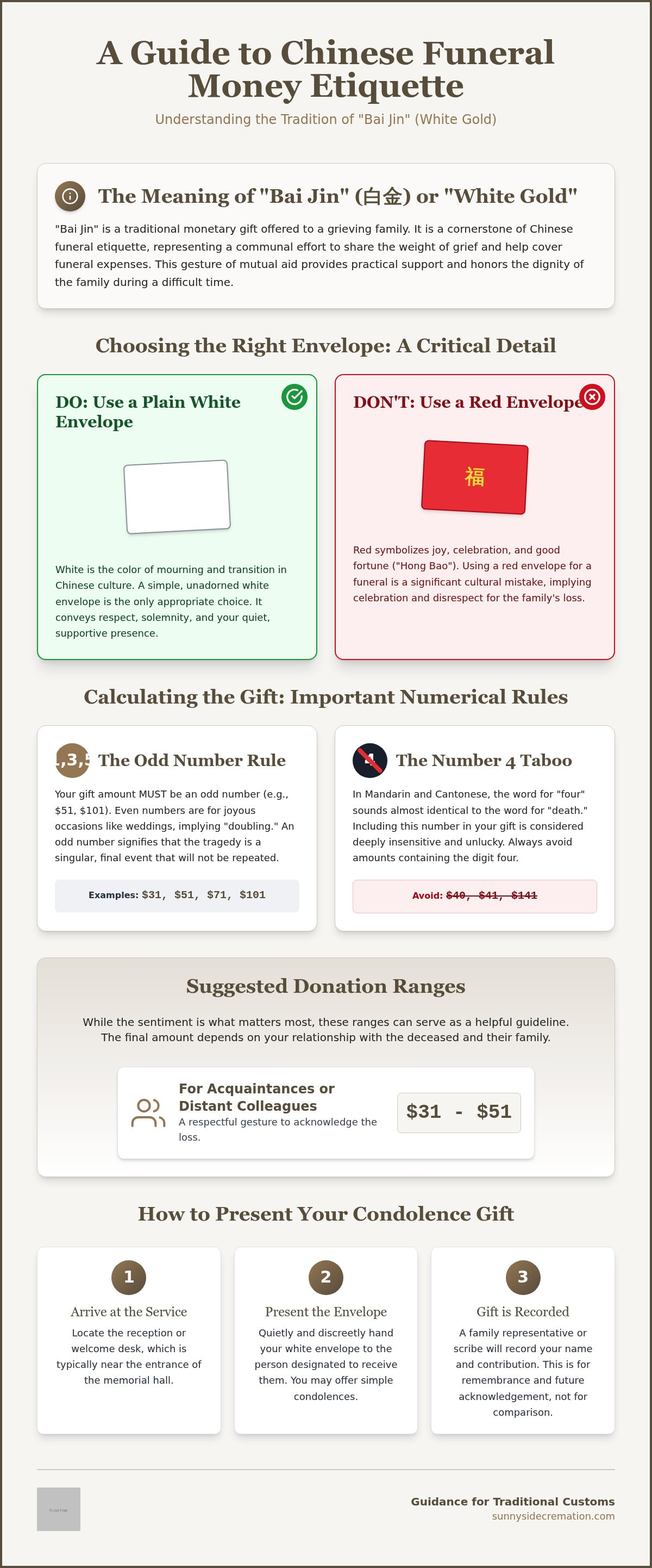
You might be familiar with "Hong Bao," the bright red envelopes filled with cash for lunar new year or weddings. Bai Jin is the solemn counterpart. While red symbolizes joy, vitality, and celebration, white represents the transition of life and the somber reality of mourning. Mixing the two is a significant cultural mistake. Understanding this distinction is the first step in honoring the deceased with the reverence they deserve.
The Symbolism of the White Envelope
In Chinese tradition, white is the primary color associated with death and the journey to the afterlife. Historically, mourners would wrap coins in simple white paper to offer their support. Today, guests typically use plain white envelopes. It's essential to choose an envelope that's entirely plain, without any decorative patterns, red borders, or "good luck" symbols. Using a decorated envelope can be seen as disrespectful, as it implies a sense of celebration that's inappropriate for the occasion. A simple, clean white envelope conveys the steady, quiet presence your friend needs right now.
Why Money is Preferred Over Other Gifts
While floral arrangements are a beautiful tribute, they are temporary. In contrast, monetary gifts provide immediate and flexible relief. Funerals at local memorial parks like Rose Hills or Forest Lawn involve many moving parts and significant expenses. Cash allows the family to manage these costs directly or choose specific items, such as incense or joss paper, that align with their specific Buddhist or Taoist traditions. This preference for money is rooted in the history of community societies where neighbors pooled resources to ensure every member of the community received a respectful burial. Following proper Chinese funeral money etiquette ensures your contribution is received as the heartfelt gesture of kindness and community support it's intended to be.
Calculating the Amount: Numerical Taboos and 2026 Standards
Deciding on the right amount to give can feel like a delicate balancing act. You want to show generosity without inadvertently breaking long-standing traditions. In 2026, the nuances of Chinese funeral money etiquette remain centered on the spiritual meaning behind specific digits. While Western traditions often favor round, even numbers for gifts, Chinese mourning rituals strictly require the opposite. This practice ensures your gift is a source of comfort rather than a cause for concern.
Even numbers are reserved for celebrations like weddings or birthdays. They represent "completeness." They carry the hope that good fortune will return. In the context of a funeral, an even amount carries a heavy, unintended meaning. It suggests that the family might experience a "double" sorrow or that another death could soon follow. To avoid this, always ensure your total is an odd number. This signifies that the loss is a singular, final event that should never be repeated.
The number four is another critical taboo. In both Mandarin and Cantonese, the word for "four" sounds nearly identical to the word for "death." Including a four in your gift is considered deeply insensitive. Avoid amounts like $40 or $44. It's a small detail that carries immense weight for a family seeking peace during their time of vulnerability.
Suggested Donation Ranges for 2026
While the heart behind the gift matters most, having a baseline can reduce the cognitive load during a stressful time. For acquaintances or distant colleagues, a range of $31 to $51 is common in Southern California. Close friends and extended family members often contribute between $101 and $201. For immediate family or those with very close bonds, gifts frequently start at $301. These amounts reflect current economic standards while maintaining the essential odd-number requirement of Chinese funeral money etiquette.
The "One Dollar" Trick
The most reliable way to navigate these rules is through a simple cultural safeguard. Giving Condolence Money: Bai Jin or Pek Kim often involves adding a single dollar to a round amount to transform its meaning. The "One Dollar" rule is the primary safeguard against numerical bad luck, where a $100 gift becomes $101 to ensure it remains an odd, singular tribute. By adding that extra dollar, you transform a standard gift into a culturally precise gesture of respect. This standard ensures your contribution is received with the same kindness and reverence you intended to provide.
If you're feeling overwhelmed by these details while planning a service at a local park, our compassionate team at Sunnyside Cremation & Funeral is here to guide you through every step with gentle professionalism.
The Ritual of Giving: When and How to Present Your Condolence Gift
Entering a memorial service can feel overwhelming, especially when you're trying to honor specific traditions. In many Southern California services, the process begins at a reception or registration desk near the entrance. This desk serves as the primary point for collecting Bai Jin. You'll often find a family member or a designated scribe sitting there with a ledger. Their role is to record the names of guests and the amounts given, ensuring the family can acknowledge your kindness and uphold the tradition of communal reciprocity later on.
The physical act of giving is as important as the gift itself. When you approach the desk, present your envelope using both hands. This small, deliberate gesture is a hallmark of Chinese funeral money etiquette. It communicates a deep sense of humility and reverence. By using both hands, you're showing the family that your support is given with your full heart and undivided attention. It's best to present your gift during the visitation period or shortly before the formal service begins, allowing the family to focus on the ceremony once it starts.
Writing on the White Envelope
Clarity is a gift to the family scribe. Use a black pen to write your name clearly on the front of the white envelope or on the small insert card if one is provided. You don't need to write a long letter; simple, traditional phrases are most appropriate. Phrases like "Deepest Condolences" or "Rest in Peace" convey your sympathy with dignity. Legible handwriting ensures your contribution is recorded accurately, helping the family manage their records without added stress during their time of grief.
Mailing Bai Jin and "Missing" the Funeral
Life sometimes prevents us from attending a service in person. If you can't be there, mailing your white envelope is a perfectly acceptable way to show your support. It's best to send it as soon as you hear the news. In 2026, some younger families may accept digital contributions via Zelle or Venmo, but this is usually reserved for very close friends. If you're unsure, a physical envelope remains the most respectful choice. The primary mourning period often lasts 49 days. Sending your gift within this window ensures your gesture of "white gold" still reaches the family while they are navigating the initial stages of their loss.
Beyond the Envelope: Complementary Gifts and Taboos
While "white gold" is the central pillar of support, it's often accompanied by other thoughtful gestures. Understanding how traditional Chinese funeral customs influence these choices helps you navigate the service with confidence. Beyond the monetary gift, you might see families using sacrificial items like incense and joss paper. These items are deeply symbolic. They are intended to ensure the deceased has resources and comfort in the afterlife. While guests aren't usually expected to bring these items, acknowledging their presence shows a deep respect for the family's spiritual path.
Color choice is perhaps the most critical taboo to remember. In Chinese funeral money etiquette, the colors you wear and bring are just as important as the amount you give. You must strictly avoid red, pink, or bright yellow. These colors represent happiness, vitality, and celebration. In a space of mourning, they can feel jarring or even disrespectful. Stick to muted tones like black, navy, or dark gray. This maintains the supportive and calm atmosphere the family needs during their time of emotional vulnerability.
Condolence Flowers vs. Bai Jin
Choosing between flowers and money often depends on your relationship with the deceased. Traditional floral choices include white lilies, chrysanthemums, and irises. These flowers carry a sense of purity and peace. However, many families in Garden Grove or Buena Park prefer Bai Jin because it's more practical. Large floral displays can be difficult to transport or place in smaller memorial chapels. If the family requests "flower money" instead, they are asking for a donation to a charity in the deceased's name. This is a beautiful way to honor a legacy while respecting the family's desire for a simple, focused service.
The "Candy and Coin" Return Gift
As you leave the service, the family will likely offer you a small token of appreciation. This is often a small red packet containing a single piece of candy and a coin. It may seem surprising to receive a red envelope at a funeral, but this is a specific ritual to protect guests. You should eat the candy immediately. This act is meant to "remove the bitterness" of the day from your mouth. The coin should be spent on your way home, perhaps on a small snack or drink. The goal is to leave the mourning behind and ensure you don't bring any lingering sorrow into your own home.
If you're looking for a partner to help you honor these traditions, we invite you to learn more about our specialized Chinese funeral and cremation services.
Honoring Heritage: How Sunnyside Cremation Facilitates Traditional Customs
Planning a farewell that honors centuries of tradition requires a steady hand and a deep understanding of cultural nuances. At Sunnyside Cremation and Funeral, we recognize that these rituals are more than just procedures; they are a profound expression of love and communal respect. Our team specializes in Chinese funeral services in Southern California, providing a bridge between the deep-rooted expectations of elders and the needs of younger, English-speaking generations. We serve as a compassionate advocate, ensuring every detail of the service reflects the dignity of your family's heritage.
Communication is the foundation of peace during a time of loss. Our Mandarin-speaking staff in Garden Grove and Buena Park are here to listen and guide you with gentle professionalism. We understand the weight of getting every detail right, from the color of the envelopes to the specific phrasing used in the registry. By providing clear, methodical support, we reduce the cognitive load on grieving families, allowing you to focus on reflection and legacy rather than logistics.
Mandarin and Buddhist Ceremony Guidance
Setting up a traditional service involves many moving parts that require cultural precision. We assist families in organizing the essential Bai Jin registration desk, providing the ledgers and guidance needed to uphold Chinese funeral money etiquette with ease. Our expertise in Buddhist funeral services in Orange County ensures that every ritual element is handled with reverence. Whether it's the careful placement of incense or the proper timing for burning joss paper, we ensure these sacred traditions are performed correctly to honor the spiritual journey of your loved one.
Coordinating with Forest Lawn and Rose Hills
Our role as a steady guide extends to the beautiful memorial parks that define our local landscape. We have deep experience with Chinese funeral planning with Forest Lawn and Rose Hills, managing the intricate transition from our mortuary to the final graveside burial. Navigating local regulations and park-specific requirements can be overwhelming for a family in mourning. We handle these details with quiet efficiency, providing a seamless experience that respects both the traditions of the past and the practicalities of the present. You don't have to walk this path alone; we're here to provide the security and support your family deserves.
Moving Forward with Cultural Grace
Honoring a loved one through traditional rituals is a profound act of stewardship. By understanding the nuances of Chinese funeral money etiquette, you ensure your gesture of "White Gold" provides both practical relief and spiritual comfort. Remember that the odd-number rule and the simple act of presenting your envelope with both hands are powerful symbols of your respect. These traditions maintain the community bonds that sustain families during their most vulnerable moments, ensuring that legacy and dignity remain at the heart of the service.
As a family-owned and operated mortuary in Orange County, Sunnyside Cremation & Funeral is dedicated to being your steady guide. We offer specialized cultural packages for Chinese and Taiwanese families, including expert coordination with Rose Hills and Forest Lawn. Our team is here to manage the intricate details so you can focus on the journey of reflection and healing. Please contact our Mandarin-speaking staff for guidance on traditional Chinese funeral planning. You don't have to navigate these delicate traditions alone; we're here to offer the security and reverence your family deserves.
Frequently Asked Questions
Is it ever okay to give an even amount of money at a Chinese funeral?
No, you should always provide an odd-numbered amount. Even numbers are associated with joyful celebrations and the hope for a repeat of the event, which is inappropriate for a time of loss. In 2026, this tradition remains a vital part of Chinese funeral money etiquette to ensure the family doesn't feel that sorrow is being doubled. Adding a single dollar to a round amount is the most common way to achieve this.
What should I do if I accidentally used a red envelope for my gift?
You should discreetly replace the red envelope with a plain white one as soon as you realize the mistake. Red symbolizes happiness and luck, which contradicts the somber nature of a funeral service. If the service has already begun, it's better to wait for a quiet moment or ask a staff member for assistance. Most funeral homes in Orange County provide plain envelopes to help guests avoid this cultural misstep.
How much Bai Jin should I give if I am attending as a representative of a company?
Corporate gifts typically range between $101 and $301 depending on the professional relationship with the deceased or the family. It is essential to ensure the total is an odd number, even when the funds are coming from a business account. If multiple colleagues are contributing, you can pool the money into a single white envelope. Clearly list the company name and the names of the individuals involved for the family's records.
Can I give a check instead of cash in the white envelope?
Yes, checks are a practical and common alternative to cash in 2026. A check allows for safer handling and easier record-keeping for the family's scribe at the registration desk. Ensure the check is made out to the primary next of kin or the person handling the arrangements. Even when using a check, the amount must still follow the odd-number rule to honor traditional Chinese funeral money etiquette with cultural precision.
What happens if I forget to bring a white envelope to the service?
You can usually obtain a plain white envelope from the reception desk at the mortuary or chapel. Most specialized funeral homes in Garden Grove or Buena Park keep a supply on hand specifically for guests. If one isn't available, a simple piece of white paper folded around the currency is a respectful temporary solution. The priority is the heart behind your gesture of support rather than the perfection of the stationery.
Why do I receive a piece of candy and a coin after giving funeral money?
This return gift is a ritual meant to protect you from bringing home the bitterness of the funeral. The candy should be eaten immediately to sweeten your palate and spirit after the somber event. The coin is intended to be spent on your way home, perhaps on a snack or small item, to symbolize leaving the mourning behind. This custom ensures that guests return to their lives with a sense of peace.
Is there a specific time during the service I should hand over the money?
The most appropriate time to present your gift is upon arrival, before the formal ceremony begins. You should look for the registration or reception desk where a family representative will be seated with a ledger. Presenting the envelope at this time allows the family to focus on the service without interruptions. If you arrive late, it's best to wait until the reception following the service to hand over your contribution.
What is the appropriate dress code when presenting a white envelope?
You should wear dark, muted colors such as black, navy blue, or charcoal gray. It's vital to avoid bright colors, especially red, pink, or purple, as these are reserved for celebrations. Your attire should reflect the same reverence as your gift. Wearing somber tones shows the family that you understand the weight of their loss and are there to provide a steady, quiet presence of support during the service.


