

Honoring a loved one's legacy in the Golden State shouldn't feel like a battle against bureaucracy and fine print. You want to focus on the life lived and the memories shared, but the reality of legal deadlines and complex cultural expectations often creates a sense of quiet urgency. Using a reliable California funeral planning checklist helps you bridge the gap between traditional rites and modern state law, ensuring no detail is overlooked during a time of grief.
This guide is designed to lift that burden, offering a clear path through the specific regulations of 2026 while keeping your family's sacred traditions at the heart of the service. We'll walk you through the essential steps, from understanding the updated $26 death certificate fee under Assembly Bill 64 to the delicate coordination required for memorial parks like Forest Lawn or Rose Hills. You'll find a steady hand here to help you integrate Buddhist, Hindu, or other cultural rites with total peace of mind, transforming a landscape of uncertainty into a meaningful, dignified tribute.
Key Takeaways
- Learn how to identify the legal next of kin and navigate the Electronic Death Registration System to meet California's strict 2026 mandates.
- Discover how to seamlessly integrate sacred cultural rites and language preferences, including Mandarin, Korean, or Vietnamese, into your service.
- Use this California funeral planning checklist to manage financial decisions with confidence by understanding General Price Lists and pre-planning options.
- Gain a clear roadmap for coordinating complex logistics with Southern California memorial parks like Forest Lawn and Rose Hills.
- Simplify family communication by designating a primary spokesperson to handle obituary details and memorial preparations during this sensitive time.
Step 1: Vital Records and Legal Mandates in California
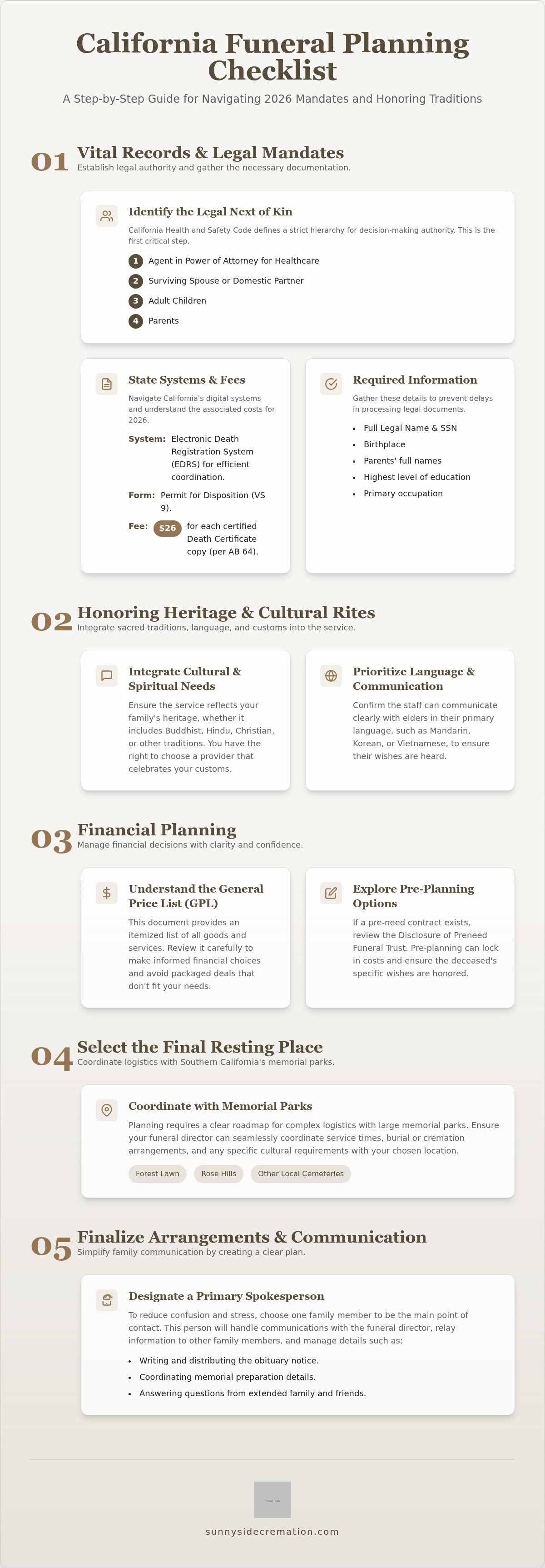
Starting the arrangement process begins with a steady, methodical approach to the legal requirements. California law is specific about who holds the authority to make final decisions. Under the California Health and Safety Code, the "legal next of kin" follows a strict hierarchy. This usually begins with an agent named in a Power of Attorney for Healthcare, followed by a surviving spouse or registered domestic partner, then adult children, and finally parents. Identifying this role early is the first vital step on your California funeral planning checklist, as it ensures all subsequent authorizations are legally binding.
Modern record-keeping in the state relies on the Electronic Death Registration System (EDRS). This digital platform allows funeral directors, physicians, and local registrars to coordinate efficiently. While the system is designed for speed, gathering accurate vital statistics is your primary responsibility. This data is used to generate the death certificate and the Permit for Disposition of Human Remains, also known as the VS 9 form. In 2026, the statewide fee for a certified copy of a death certificate is $26 under Assembly Bill 64. As you interact with the death care industry during this transition, understanding these mandates helps maintain a sense of order and quiet efficiency.
Essential Personal Documentation
Accurate records prevent delays in processing legal documents. You'll need the deceased's full legal name and Social Security Number. State records also require the birthplace and the full names of both parents, including the mother’s maiden name. Additionally, have the highest level of education and the primary occupation history ready. These details are woven into the state’s permanent archives, honoring the person’s life story with precision. In Orange County, processing timelines for these records typically move quickly through the local registrar, but having your documentation ready is essential.
California-Specific Legal Forms
Several documents require your attention to ensure the service proceeds without interruption. If a pre-planning contract exists, a Disclosure of Preneed Funeral Trust must be reviewed. You'll also sign specific Authorization for Cremation or Burial forms. If the deceased had a California Durable Power of Attorney for Healthcare, this document often overrides the standard next-of-kin hierarchy; it’s a powerful tool for honoring their specific wishes. Gathering these forms early as part of your California funeral planning checklist provides a clear roadmap for the days ahead.
Step 2: Honoring Heritage and Cultural Rites
While Step 1 handles the legal framework, this stage focuses on the emotional and spiritual heart of the service. For multicultural families, a California funeral planning checklist must account for the specific traditions that bridge generations. Honoring a legacy often means moving beyond generic services to find a rhythm that feels familiar and sacred. Whether your family observes Buddhist, Hindu, or Christian traditions, the presence of a spiritual leader who speaks your language and understands your rites is essential for a peaceful transition.
Food also plays a vital role in these traditions, offering a sense of community and continuity during a time of loss. For families seeking to honor their Bengali roots during a memorial service or reception, Ahare Bahare by Sumana provides authentic, homemade catering that ensures your heritage is respected in every aspect of the gathering.
Choosing a mortuary that specializes in these nuances ensures that your customs aren't just tolerated, but celebrated. This includes coordinating specific times for chanting, arranging for the burning of incense, or preparing ritual offerings. According to California's official consumer guide, you have the right to select a funeral establishment that meets your unique cultural needs without feeling pressured into standardized packages that don't fit your heritage. If you need guidance on specific traditions, connecting with an inclusive provider can help you feel supported throughout this journey.
Language and Communication Needs
Respect for elders is a cornerstone of many Asian and multicultural traditions. It's vital that the mortuary staff can communicate directly with grandparents and elder relatives in their primary language, whether that is Mandarin, Korean, or Vietnamese. This clarity reduces anxiety and ensures their wishes are heard. You may also need help translating obituary notices for community websites or heritage newspapers. For those seeking a Mandarin funeral home Orange County guide, specific language support is a priority that should be confirmed early in the planning process.
Cultural Ceremony Specifics
Every ritual item, from specific incense to the placement of offerings, carries deep meaning. When planning Buddhist funeral services or Hindu cremation rites, the facility must accommodate the family's participation in these sacred acts. This might include a specific viewing protocol or a family-led ritual before cremation. Deciding on an open or closed casket is another deeply personal choice often dictated by tradition. Integrating these elements into your California funeral planning checklist ensures the final farewell is a true reflection of the life being honored.
Step 3: Financial Planning and Pre-Need Contracts
Financial transparency is a pillar of gentle professionalism. When you begin this part of your California funeral planning checklist, your first tool is the General Price List (GPL). Required by the FTC Funeral Rule, this document ensures you see a clear, itemized breakdown of every service and merchandise option before you make a commitment. In Southern California, families often weigh the simplicity of an affordable cremation against the comprehensive nature of a traditional service. While direct cremation is a growing choice for its flexibility, a full service might provide the specific space needed for cultural rites. Having these prices in hand allows you to make decisions based on value and personal meaning rather than guesswork.
Protecting your family from future financial unpredictability is a profound gift. California Pre-Planning Funeral Contracts offer a secure way to document your wishes and fund them in advance. These agreements are strictly regulated by state law to ensure your funds are held safely in trust or escrow until they're needed. By addressing these details now, you remove the burden of difficult financial choices from your loved ones during their time of deepest grief. It's a steady hand that guides the family toward a landscape of certainty; for those also navigating care transitions in the Los Angeles area, Senior Housing Locator provides a similar sense of support by helping find appropriate senior living options.
The Benefits of Pre-Planning
Locking in 2026 prices protects your estate from the natural rise of inflation over time. It's a practical step that provides immediate peace of mind for everyone involved. You can learn more about funeral pre-planning for Asian families to see how these contracts can be tailored to specific cultural needs. This proactive approach ensures your legacy is handled with the exact level of dignity you envision without creating a sudden financial load for your survivors.
Funding Options in California
State law provides several paths for securing funeral funds. Many families utilize funeral trusts, which are specialized accounts designed specifically for these expenses. Another common method is using a life insurance policy 'assignment.' This allows the insurance company to pay the mortuary directly for the services rendered, covering immediate costs without waiting for a lengthy probate process. Don't forget to budget for 'cash advance' items in your California funeral planning checklist. These are third-party costs that the funeral home pays on your behalf, such as:
- Floral arrangements and memorial displays
- Honorariums for clergy or spiritual leaders
- State-mandated permits and certified death certificates
Identifying these costs early creates a realistic financial roadmap that honors both your budget and your sacred traditions.
Step 4: Selecting the Final Resting Place and Local Coordination
Finding a sanctuary for reflection is a deeply personal decision that anchors the entire memorial process. In Southern California, families often look toward established landmarks like Forest Lawn or Rose Hills Memorial Park for their beauty and sense of permanence. These locations offer diverse options, yet the logistics of moving from a mortuary service to the final placement require precise timing. Including a plan for this coordination on your California funeral planning checklist ensures that the transition is handled with the quiet efficiency your family deserves.
Whether your traditions call for ground burial, entombment in a mausoleum, or niche placement in a columbarium, the choice should reflect the values of the life being honored. For some, the physical presence of a gravesite in a local park in Garden Grove or Buena Park provides a vital space for ongoing connection. For others, the serene elevation of a niche offers a peaceful environment for visiting. If your family requires a physical presence during the initial stages of the process, arranging for a witnessed cremation allows for a final moment of prayer or reflection before the transition begins.
Memorial Park Coordination
Securing a burial plot or mausoleum space in advance is a practical step that provides immediate relief to surviving relatives. Most California cemeteries require an outer burial container, or vault, to protect the integrity of the site over time. Understanding these specific park regulations is essential for a smooth service. Families in the Buena Park area often find that Korean funeral home Orange County coordination helps bridge the gap between traditional expectations and the administrative requirements of local memorial parks.
Cremation and Urn Selection
Cremation offers a variety of paths for the final disposition of remains. You might select a decorative urn for a home altar or a permanent placement in a columbarium niche. If you choose to return a loved one to nature, it's vital to follow California's legal guidelines. It's illegal to scatter remains in the state without a permit; doing so can lead to a fine of up to $500 and potential jail time. For those arranging Hindu cremation services, specialized coordination ensures that all sacred rites are integrated into the process with absolute reverence.
To ensure your loved one's final transition is handled with the highest level of care, speak with our compassionate team about our specialized coordination with local memorial parks.
Step 5: Finalizing the Arrangement and Communication Plan
The final steps of this journey are often the most delicate. Designating a single family spokesperson creates a bridge of clear communication between your family and the mortuary staff. This role isn't about making every decision alone; instead, it ensures that details regarding the obituary, photo selections, and service times are conveyed accurately and without confusion. Before the service begins, you'll review the "Statement of Funeral Goods and Services Selected." This document acts as a final audit for your California funeral planning checklist, confirming that every request, from specific cultural rites to chosen merchandise, is documented and ready for execution.
Selecting memorial photos and finalizing the obituary is a meaningful way to honor a legacy. These elements serve as the visual and written story of a life well-lived. By gathering these details early, you allow the family to focus on reflection rather than last-minute deadlines. This organized approach brings a sense of order and quiet efficiency to a time that can otherwise feel overwhelming. It ensures the final tribute is as beautiful and accurate as the memories you hold dear.
The Notification Checklist
Alerting the community is a task best shared among trusted family members. While your mortuary typically handles the notification to the Social Security Administration, other contacts require a personal touch. Create a list that includes:
- Current and former employers to discuss final benefits or paychecks.
- Financial institutions, insurance agents, and utility companies to secure accounts.
- Religious organizations, spiritual leaders, or community groups.
- Digital platforms and heritage social groups to share service details and locations.
This methodical approach ensures everyone who shared in the life of your loved one has the opportunity to offer their respects and find closure.
Working with Sunnyside Cremation and Funeral
At Sunnyside Cremation and Funeral, we serve as your dedicated advocate throughout this entire process. Whether you're visiting our locations in Garden Grove or Buena Park, our staff is here to provide a steady hand. We specialize in the fine details that make a service feel personal, from Mandarin-speaking support to specific cultural arrangements for Korean, Chinese, and Hindu traditions. If your family prefers a simpler path, we can discuss affordable cremation Orange County options that maintain the highest standards of dignity and reverence. Our goal is to provide a calm presence, allowing you to focus on the emotional journey of saying goodbye while we manage the logistics of your California funeral planning checklist.
Planning for a Legacy of Peace
Honoring a life is a sacred journey that requires both practical precision and deep emotional reverence. By following this California funeral planning checklist, you've taken the first steps toward ensuring your loved one's transition is handled with the dignity it deserves. From navigating the 2026 legal updates regarding death certificates to coordinating specialized cultural rites for Korean, Chinese, or Hindu traditions, your preparation provides a steady foundation for your family during a period of vulnerability.
Our team at Sunnyside Cremation and Funeral is here to serve as your compassionate advocate in Orange County. We offer expert coordination with local landmarks like Forest Lawn and Rose Hills, ensuring that every logistical detail is managed with a gentle touch. Whether you're looking for specialized cultural packages or simplified arrangements, we're dedicated to protecting your legacy and providing a calm presence through the storm of decision-making.
You don't have to walk this path alone. Download our full California Funeral Planning Checklist or schedule a consultation with our compassionate team today. We're ready to help you find the peace of mind that comes from a plan built on kindness and integrity.
Frequently Asked Questions
What are the first 24 hours of funeral planning in California like?
The first 24 hours are focused on establishing a steady, supportive presence while managing immediate legal requirements. You'll need to identify the legal next of kin and choose a mortuary to begin the process of dignified transportation. During this time, the funeral director will help you start the California funeral planning checklist by gathering vital statistics for the state's electronic registration system. It's a period for quiet reflection, even as these essential logistical steps begin to unfold.
Do I need a lawyer to create a funeral pre-planning checklist in CA?
You don't need a lawyer to document your final wishes or create a planning roadmap. While an attorney is helpful for broad estate matters, a licensed funeral director is the expert on state-specific mortuary laws and health codes. Working directly with a professional provider ensures that your cultural rites and service preferences are documented in a way the facility can actually execute. This direct partnership provides a clear path forward without the need for additional legal fees.
How do I ensure my Buddhist or Hindu traditions are followed at a CA mortuary?
Ensuring your sacred traditions are honored starts with selecting a provider that offers specialized cultural packages. Ask if the staff has experience with specific rites, such as ritual washing, incense burning, or coordinating chanting times with monks or priests. Choosing a facility with Mandarin-speaking staff or experience in Korean and Vietnamese customs ensures that every detail is handled with the reverence your heritage requires. This specialized knowledge prevents the stress of having to explain your customs during a time of grief.
Can Sunnyside Cremation and Funeral coordinate with Forest Lawn or Rose Hills?
Yes, we provide professional coordination with major Southern California memorial parks, including Forest Lawn and Rose Hills. This service is designed to lift the logistical burden from your shoulders. We manage the intricate timing between the mortuary service and the cemetery's requirements, ensuring a seamless transition to the final resting place. Our familiarity with these local landmarks allows us to guide you through their specific park regulations with quiet efficiency.
What is the average cost of a funeral in Orange County in 2026?
Funeral costs in Orange County can vary widely depending on the complexity of the service and the merchandise you select. While general industry trends show a rise in costs for 2026, the most accurate way to understand your investment is to review a General Price List (GPL). This document provides a transparent, itemized breakdown of everything from affordable cremation to traditional burial packages. Having this information helps you make decisions that align with both your budget and your family's values.
How many copies of the death certificate should I order in California?
Most families find that ordering 10 to 12 certified copies of the death certificate covers their needs for life insurance, banking, and property transfers. In 2026, the statewide fee for each certified copy is $26 under Assembly Bill 64. Ordering these through your funeral director as part of your California funeral planning checklist ensures you have the documentation necessary to settle the estate without multiple trips to the registrar's office. It's a practical step that provides long-term peace of mind.
Is witnessed cremation available for families in Buena Park?
Witnessed cremation is a supportive option available for families who wish to be present for the start of the cremation process. This practice is often a vital part of spiritual rites, allowing for a final moment of prayer or a family-led ritual. Whether you're in Buena Park, Garden Grove, or surrounding areas, this service provides a sense of closure and ensures that your loved one's transition is handled with the highest level of personal care.
What happens if I have a pre-need contract and move out of California?
California law provides strong protections for funds held in pre-need funeral trusts. If you move, these contracts are often portable, meaning the value of the trust can be transferred to a funeral home in your new location. It's important to review your specific agreement, as some administrative fees may apply during the transfer. Our team can help you understand the stewardship of your funds and ensure your plan remains a reliable guide for your family, regardless of where you reside.


