

A final farewell is more than a series of appointments; it's a sacred bridge between lifetimes where every chant and offering helps guide a soul toward peace. When you're grieving, the weight of organizing authentic Buddhist funeral services Orange County can feel heavy, especially when you're balancing the needs of the temple with the strict legal requirements of California. You likely feel a deep responsibility to ensure every ritual is performed correctly, yet the pressure of logistics often clouds the path to spiritual closure.
We recognize that you want a transition that honors your heritage without the stress of language barriers or missed steps. This guide will help you navigate the delicate balance of sacred rituals and local logistics with a steady, compassionate hand. You'll learn how to coordinate with local monks, manage the mandatory 48-hour cremation waiting period, and work seamlessly with memorial parks like Forest Lawn or Rose Hills. We've gathered this information to give you a clear roadmap for a dignified farewell that provides both spiritual peace and practical confidence.
Key Takeaways
- Understand the spiritual significance of the "last thought" and how creating a tranquil environment supports a peaceful transition through Samsara.
- Identify the core elements of a traditional funeral altar and the vital role Monks play in leading sutras and spiritual guidance during Buddhist funeral services Orange County.
- Distinguish between Mahayana and Theravada practices to ensure the rituals performed align perfectly with your family's specific cultural and regional heritage.
- Follow a clear, step-by-step planning guide to bridge the gap between temple coordination and local memorial park logistics with confidence.
- Learn how specialized language support can alleviate the burden of communication, ensuring your family's wishes are respected by all parties involved.
The Spiritual Significance of Buddhist Funeral Rites
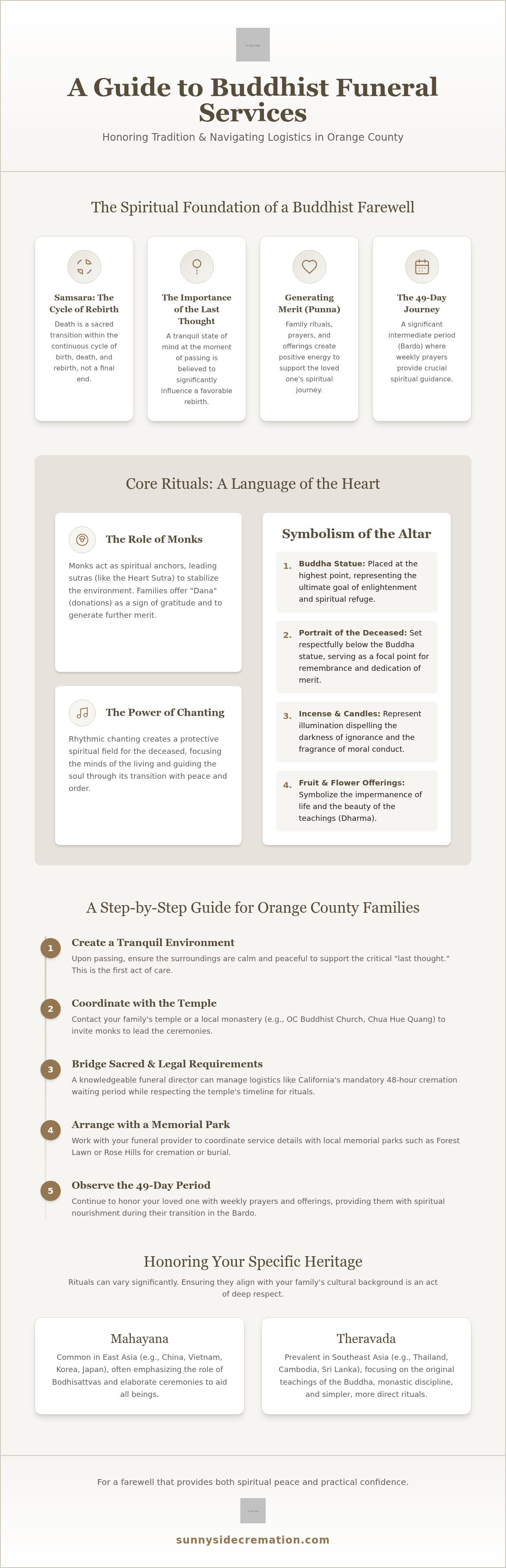
In Buddhist tradition, death is not a final curtain but a transformative threshold. It marks the conclusion of one chapter and the quiet beginning of another. When families seek Buddhist funeral services Orange County, they are often looking for more than just a ceremony; they are seeking a way to honor this profound transition with the dignity it deserves. This period is viewed through the lens of Samsara, the continuous cycle of birth, death, and rebirth. It's a journey that requires a steady hand and a heart full of reverence.
One of the most critical elements during this time is the "last thought." It's believed that the state of mind at the moment of passing significantly influences the next life. Because of this, creating a tranquil, peaceful environment is paramount. Family members act as gentle guardians, ensuring the surroundings remain calm and filled with spiritual reminders. By performing traditional rites, the family generates "Punna," or merit. This merit is then dedicated to the loved one to support their journey toward a favorable rebirth. It is a final, beautiful gift from the living to the dead.
This spirit of compassion and the desire for a peaceful transition often extends to our animal companions; for families seeking a serene end-of-life experience for their pets, Pet Requiem provides specialized support that honors this sacred connection and the Buddhist principle of reverence for all life.
The first 49 days after a passing are especially significant in many traditions. During this intermediate period, the family serves as spiritual stewards. Through weekly prayers and offerings, you provide the spiritual nourishment your loved one needs as they move through the stages of transition. It's a time of active love and dedication. We understand that this responsibility can feel overwhelming, but these rituals are designed to bring order to the chaos of grief.
Understanding Samsara and the Cycle of Rebirth
Every action and intention throughout life creates karma, a spiritual imprint that follows the soul. This intermediate state, sometimes referred to as the Bardo, is a time of great sensitivity where the soul is between lives. In the context of Orange County Buddhist traditions, Samsara represents the rhythmic, interconnected journey of existence where death is merely a pause before the soul finds its next physical home. Precise timing for rituals matters during this phase. The sooner the community and monks can begin chanting, the more stability is provided for the soul in flux.
The Goal of Spiritual Peace and Enlightenment
While the rituals are designed to aid the deceased, they also provide a vital structure for those left behind. They offer a way to channel heavy emotions into meaningful action. For many in our local community, providing a "good death" for a parent or elder is a profound act of filial piety. It ensures their legacy is honored and their suffering is minimized. The ultimate aspiration is Nirvana, the cessation of all suffering and the end of the cycle of rebirth. By coordinating with a mortuary that understands these nuances, you ensure that the spiritual peace of your loved one is the primary focus of every step.
Core Rituals: Monks, Altars, and the Power of Chanting
Rituals serve as a gentle language of the heart during times of loss. In the context of Buddhist funeral services Orange County, these ceremonies provide a structured way to express devotion and respect. Every element, from the rhythmic sound of chanting to the fragrant scent of incense, creates a protective spiritual field for the deceased. These traditions offer a profound sense of order and peace when you need it most. From the specific color of mourning attire to the precise placement of items on an altar, every detail helps guide the soul through its transition.
The Role of the Monk in the Ceremony
Monks are the spiritual anchors of the funeral ceremony. Inviting a monk from a local temple, such as the Orange County Buddhist Church or Chua Hue Quang, ensures the rituals are performed with authentic lineage and care. They lead the assembly in sutras, often including the Heart Sutra, which helps stabilize the environment and focus the minds of the living. It's customary for the family to provide "Dana," which are voluntary offerings, as a gesture of gratitude and to help generate further merit. This practice of generosity is a cornerstone of the faith, ensuring the spiritual leaders are supported as they guide your loved one.
Symbolism of the Altar and Offerings
The funeral altar serves as the focal point for both the living and the spirit of the departed. It should be arranged with intention and simplicity to reflect the quiet dignity of the occasion. A traditional setup for Buddhist funeral services Orange County typically includes several key elements:
- Buddha Statue: Placed at the highest point to represent the ultimate goal of enlightenment.
- Portrait of the Deceased: Set respectfully below the Buddha to honor their unique life.
- Incense: Representing the purification of the mind and the spreading of the Dharma.
- Candles: Symbolizing the light of wisdom that dispels the darkness of ignorance.
- Fruit and Flowers: Fresh offerings that serve as reminders of the impermanence of all things.
Mourners often wear white clothing or simple white headbands. This tradition signifies purity and a release from vanity during a time of deep reflection. Food offerings are also common, representing the family's desire to provide for their loved one one last time. While these traditions are ancient, you can still include personal memorial items that reflect the unique life of your loved one. If you're feeling overwhelmed by these details, our multicultural funeral packages are designed to help you organize these sacred elements with ease and professional guidance.
Buddhist Traditions in OC: Mahayana vs. Theravada
Orange County is home to a vibrant and diverse Buddhist community. While the heart of the teachings remains consistent, the specific rituals for Buddhist funeral services Orange County often depend on whether your family follows Mahayana or Theravada traditions. Recognizing these differences is a vital part of honoring your loved one’s unique spiritual journey. It allows you to plan with a sense of clarity and respect for the specific customs that have shaped your family’s history. Whether you are coordinating a service in Westminster or Garden Grove, understanding these nuances provides a steady hand during a difficult time.
Mahayana Customs (Chinese, Vietnamese, Korean)
The Mahayana tradition is deeply rooted in the Chinese, Vietnamese, and Korean communities of Westminster, Garden Grove, and Irvine. These practices often emphasize the Pure Land tradition and the grace of Amitabha Buddha. A defining characteristic is the 49-day mourning period, which serves as a structured time of prayer and remembrance. Families typically hold ceremonies every seven days, with the 49th day marking a final, significant farewell. This tradition often involves the following elements:
- Amitabha Chanting: Focused on helping the soul reach the Western Pure Land.
- Paper Offerings: The symbolic burning of paper items to provide for the deceased in the transition.
- Vegetarian Meals: Many families choose to eat vegetarian during the 49 days to generate additional merit.
Coordination with local temples in Little Saigon or the Korean districts of Buena Park is essential for ensuring these weekly rites are performed with precision. While cremation is increasingly popular, traditional burial remains a common choice for many Mahayana families, often involving specific feng shui considerations at local memorial parks.
Theravada Customs (Thai, Sri Lankan, Southeast Asian)
Theravada traditions, common among Thai, Cambodian, and Sri Lankan families in Orange County, lean toward a more meditative and simplified approach. The focus remains on the "Three Jewels" and the transfer of merit through quiet acts of devotion. Finding the right support for Buddhist funeral services Orange County within the Theravada tradition involves connecting with monks who understand the specific needs of Southeast Asian families. One of the most touching rituals is the pouring of water. A family member slowly pours water from a small vessel into an overflowing cup while monks chant, symbolizing the merit flowing from the living to the deceased.
These services are often shorter than Mahayana rites, frequently lasting three to seven days. Families can find Theravada monks for home or mortuary visits through the local temples found in Anaheim and surrounding areas. This sect typically shows a strong preference for cremation, viewing it as a final act of detachment from the physical form. By focusing on the essentials of the faith, Theravada funerals provide a calm and reflective environment for both the grieving and the departing soul.
A Step-by-Step Planning Guide for Orange County Families
Organizing Buddhist funeral services Orange County requires a delicate balance of spiritual timing and local regulations. The process begins with immediate care. Your first step should be contacting a mortuary that understands the specific needs of Asian families. This ensures your loved one is treated with the reverence required from the very first moment. Once the mortuary is involved, you can coordinate with your local temple to select a monk and schedule the initial chanting sessions. This early coordination is vital, as the monk's guidance will shape the rhythm of the days to come.
The next steps involve managing the physical logistics alongside the spiritual ones. You'll need to decide between a traditional burial or cremation, keeping in mind that each path has its own set of requirements. During this time, the mortuary acts as a steady hand, handling the transportation and preparation of your loved one while you focus on the altar and temple preparations. This partnership allows you to be the spiritual steward your family needs without being overwhelmed by administrative burdens.
Coordinating with Forest Lawn and Rose Hills
Many families choose major memorial parks for their final rest due to their beautiful grounds and experience with diverse traditions. We provide specialized support for Chinese funeral planning with Forest Lawn and similar coordination at Rose Hills. These parks have specific logistics for hosting monks and setting up traditional altars in their chapels. A highly valued part of Buddhist funeral services Orange County is the "Witnessed Cremation." This process allows family members to be present at the start of the cremation, offering a final moment of prayer and a symbolic release of the physical form. We help manage these intricate arrangements so you can focus on your spiritual duties rather than the venue's paperwork.
California Legal and Administrative Requirements
Practical steps must be followed to satisfy state laws. California law requires a mandatory waiting period of at least 24 to 48 hours before a cremation can take place. This rule can sometimes conflict with traditional desires for a swift transition, so planning the ritual schedule with this window in mind is essential. You'll also need to obtain a death certificate and a disposition permit. In California, a burial permit is a legal necessity that must be secured before any final disposition occurs. The current fee for this permit in Orange County is $12. Our team manages these filings on your behalf, ensuring every document is accurate and filed promptly. If you want to ensure these steps are handled with cultural expertise, you can explore our Vietnamese funeral package options to see how we bridge the gap between tradition and law.
Why Families Trust Sunnyside for Buddhist Care
Choosing a partner to guide your family through a final farewell is a decision rooted in deep trust. At Sunnyside, we don't view our work through the lens of corporate checklists or cold, clinical procedures. We're a family-owned and operated presence in Orange County, and we understand that every chant and every offering carries the weight of generations. Our commitment is to be a steady, reliable guide during a time of profound emotional vulnerability. We prioritize kindness and clarity, ensuring you never feel rushed or overwhelmed by the decisions ahead. This personal touch is what defines our role as community servants.
Our approach is built on a foundation of deep community roots and a respect for the diverse traditions that make our region unique. We've served over 3,000 families in the last decade, providing culturally specific care that respects the sanctity of the transition from this life to the next. Whether you require a specialized Chinese Funeral Package or a Vietnamese funeral package, our services are designed to honor your specific heritage while remaining accessible. We believe that spiritual peace shouldn't be a luxury; it should be a dignified standard for every member of our community.
Cultural Expertise in Garden Grove and Beyond
The geography of Orange County is rich with diverse Buddhist traditions that require specific local knowledge. From the temples in Garden Grove and Buena Park to the quiet memorial spaces in Irvine and Anaheim, we understand the local landscape and the expectations of different congregations. We specialize in providing Buddhist funeral services Orange County that bridge the gap between ancient ritual and modern logistics. Our staff includes fluent Mandarin and Vietnamese speakers who act as compassionate advocates for your family. This ensures that language barriers never stand in the way of your spiritual needs or the correct execution of sacred rites.
Pre-Planning for Peace of Mind
Securing your family's traditions in advance is one of the most thoughtful gifts you can provide for your loved ones. It allows you to document your preferences for specific monks, altar arrangements, and the 49-day rituals without the pressure of an immediate crisis. Our funeral pre-planning for Asian families offers a clear path forward through a landscape of uncertainty. By making these choices now, you ensure that your legacy is honored exactly as you envision it. It brings a sense of order and quiet efficiency to a time that would otherwise be filled with stress. Contact us today to discuss your family's needs and discover how a partner who understands your culture can provide true spiritual peace.
Honoring a Sacred Journey with Confidence
Planning a final farewell is a profound act of love that requires both spiritual precision and logistical expertise. By understanding the nuances of Mahayana and Theravada traditions, you ensure that every chant and offering serves its sacred purpose. We've explored how a steady hand can manage the delicate coordination between local temples and memorial parks while respecting California's legal requirements. This balance allows you to focus on your role as a spiritual steward during the critical 49-day transition. Our specialized Buddhist funeral services Orange County are designed to provide this peace of mind, bridging the gap between ancient customs and modern reality.
You don't have to navigate these complex steps alone. Our Mandarin and Vietnamese speaking staff is here to ensure your wishes are heard and respected without any language barriers. With our expert coordination at Forest Lawn and Rose Hills, we handle the intricate details so you can remain present for your family. We invite you to Request a Compassionate Consultation for Buddhist Services today. Let us help you create a dignified farewell that honors your loved one's legacy with the reverence it deserves. Your family's peace is our highest priority.
Frequently Asked Questions
What is the typical length of a Buddhist funeral ceremony?
A standard Buddhist funeral service usually lasts between 60 and 90 minutes. This timeframe includes the arrival of the monks, traditional chanting, and a period for family members to offer incense or flowers. While the main ceremony is relatively brief, some families choose to hold multiple days of chanting or viewings leading up to the final farewell to ensure every spiritual requirement is met.
Can we have a Buddhist ceremony if we choose cremation?
Cremation is highly respected in the Buddhist faith and is often the preferred choice for many families. It serves as a powerful reminder of the impermanence of the physical form and the release of the soul. We offer specialized Buddhist funeral services Orange County that integrate traditional monk-led chanting directly into the cremation process, ensuring a peaceful and dignified transition.
Is it appropriate to send flowers to a Buddhist funeral in Orange County?
White or yellow flowers are traditional and deeply respectful choices for a Buddhist service. These colors symbolize mourning and purity across many different Asian cultures. You should avoid sending red flowers or any brightly colored arrangements, as red is historically associated with celebration and joy, which doesn't align with the solemnity of a funeral ritual.
What should I wear to a Buddhist funeral service?
Guests should wear modest, dark-colored clothing such as black, charcoal, or dark blue to show respect. Immediate family members often wear white or traditional white headbands, which are specific symbols of mourning in many Buddhist traditions. It's always best to choose conservative attire that covers the shoulders and knees, especially when monks are present to lead the service.
How do we find a monk to lead the service in Anaheim or Garden Grove?
You can find a monk by contacting local temples in Anaheim or Garden Grove, such as Chua Hue Quang or the Orange County Buddhist Church. Many families find the process easier when they work with a mortuary that acts as a bridge. We can help you navigate these invitations and ensure the temple’s specific requirements for "Dana" or offerings are handled correctly.
What is a witnessed cremation, and is it allowed in California?
A witnessed cremation is a service where the family is present in a designated viewing room as the cremation process begins. This is fully legal in California and is a common request for families who want to offer a final prayer or chant at the moment of release. It requires careful scheduling with the crematory, which we handle to ensure the environment remains calm and sacred.
How long is the traditional mourning period in Buddhism?
The mourning period depends on your family's specific branch of Buddhism, but it's often 49 days in Mahayana traditions. During this time, special ceremonies are frequently held every seven days to assist the soul's journey. Theravada traditions may observe a shorter period, such as three or seven days, focusing on immediate merit-making acts to support the loved one’s transition.
Can Sunnyside help coordinate with Forest Lawn Cypress for a Buddhist service?
We have deep experience coordinating with Forest Lawn Cypress and other major memorial parks like Rose Hills. We understand their specific rules for monk invitations, incense use, and altar setups in their chapels. This local expertise allows us to provide a seamless experience for Buddhist funeral services Orange County families who choose these well-known memorial locations for their final rest.


